
Original photo by zmeel/ iStock

On October 15, 2002, Buffy the Vampire Slayer did something no U.S. TV show had ever done before: use the word “Google” as a verb. The moment came in “Help,” the fourth episode of the show’s seventh and final season, when Willow (Alyson Hannigan) and Buffy (Sarah Michelle Gellar) discussed a student with psychic powers and Willow asked, “Have you Googled her yet?” In typical Buffy fashion, that query was met with humorous misunderstanding from Xander (Nicholas Brendon): “Willow, she’s 17.” Willow then informed him that Google was a search engine — a clarification that isn’t exactly necessary anymore.

Google’s former motto was “don’t be evil.”

Ready to reveal?

Oops, incorrect!

It's a fact

The directive was found in the introduction to the company's corporate code of conduct for nearly 20 years, and even served as the Wi-Fi password on the shuttles that ferried employees to company headquarters. It was quietly removed from the code of conduct in 2018.

Though it may sound counterintuitive, companies tend to be unhappy when their names are used this way. A brand name becoming so ubiquitous that it turns into a generic word for a product — think Kleenex, Band-Aid, and even Velcro — is called genericization, which in extreme cases can lead to the company losing its trademark. In legal terms, this is known as genericide. Google was well aware of this risk, and even went so far as to write a blog post about it in 2006: “We’d like to make clear that you should please only use ‘Google’ when you’re actually referring to Google Inc. and our services.” Their efforts have thus far been successful, with Google remaining a protected trademark.

Numbers Don't Lie

Numbers Don't Lie

Episodes of “Buffy the Vampire Slayer” (aired 1997–2003)
144
Emmy nominations received by the show
14
Box-office gross of 1992’s “Buffy the Vampire Slayer” movie
$16.6 million
Vampires slain by Buffy throughout the series
132

The role of Buffy on “Buffy the Vampire Slayer” was originally offered to ______.

Ready to reveal?

Confirm your email to play the next question?

The role of Buffy on “Buffy the Vampire Slayer” was originally offered to Katie Holmes.

Placeholder Image

Buffy inspired a field of academic study.

It’s called Buffy studies, and it’s exactly what it sounds like: a scholarly examination of the beloved TV series, whose influence and legacy have only grown since it went off the air in 2003. Few shows were taken seriously as works of art when Buffy the Vampire Slayer premiered in 1997, two years before The Sopranos ushered in what’s often called the Golden Age of Television — making the hundreds of academic papers devoted to the cult classic all the more remarkable. In addition to library guides and books, the show has even been the subject of college courses.

Michael Nordine
Staff Writer

Michael Nordine is a writer and editor living in Denver. A native Angeleno, he has two cats and wishes he had more.

Original photo by Sipa USA/ Alamy Stock Photo

You'd think that a wildly imaginative children's author and illustrator famed for the use of nonsensical words like "Zizzer-Zazzer-Zuzz" would have trouble fitting a story into the strict confines of a pre-approved vocabulary list. Yet it was precisely that limitation that inspired Theodor Geisel, aka Dr. Seuss, to deliver two of his best-known works.

Some chickens lay green eggs.

Ready to reveal?

Oops, incorrect!

It's a fact

All eggs start out white, but some get coated in other pigments as the egg travels through the hen’s oviduct. Green eggs are the result of both brown and blue pigments being deposited. Several breeds of chickens can produce green eggs, including the aptly named Olive Eggers.

In the mid-1950s, a publishing executive named William Spaulding, dismayed by the uninspiring material being foisted on young readers, challenged Seuss to write "a story that first graders can't put down," using a list of around 300 words (meant to help children learn how to read). The assignment flummoxed Seuss for a spell, until he zeroed in on two words that rhymed. Nine months later, he finished the groundbreaking The Cat in the Hat (1957), his tale of a havoc-wreaking feline — composed of only 236 distinct words.

Another publisher, named Bennett Cerf, then upped the ante by asking Seuss to write a book using only 50 different words, and bet the author $50 that it couldn't be done. Seuss again wrung his hands over the project, plastering his wall with flowchart maps to work his way through the narrative. But once again he pulled it off, leaving Cerf shaking his head in amazement upon hearing the story of the persistent Sam-I-Am and the many ways to eat a particular dish. And while the publisher allegedly never paid up, things worked out just fine from a monetary standpoint for Seuss, as Green Eggs and Ham (1960) became the top-selling title of his long, distinguished career.

Numbers Don't Lie

Numbers Don't Lie

Dollars paid to Dr. Seuss for his first professional cartoon sale
25
Rejections received by Dr. Seuss before his first book was published
27
Total words used in “The Cat in the Hat”
1,626
Approximate number of Dr. Seuss books sold as of 2021
700 million

Ready to reveal?

Confirm your email to play the next question?

Placeholder Image

Dr. Seuss' famous pen name grew out of a college punishment.

In the spring of 1925, Dr. Seuss was still known as Ted Geisel and enjoying the final weeks of his senior year at Dartmouth College. Of course, there were strict rules governing certain types of enjoyment during Prohibition, and after he was caught drinking in his room with his buddies, Geisel was stripped of his role as editor of the college humor magazine, The Jack-o-Lantern. Undeterred, Geisel continued submitting his distinct cartoons under a series of pseudonyms, including “L. Burbank” and “D.G. Rossetti.” He eventually stuck with “Seuss,” his mother’s maiden name and his own middle name (albeit one that was originally pronounced something closer to “zoice”). The “Dr.” part came after graduation, reportedly while writing a “mock-zoological” humor feature, in a bid to make himself sound more scholarly.

Tim Ott
Writer

Tim Ott has written for sites including Biography.com, History.com, and MLB.com, and is known to delude himself into thinking he can craft a marketable screenplay.

Original photo by Ian Parker/ Unsplash

Before he was a knight, Sir Nils Olav was a king — king penguin, that is. The flightless seabird was made both mascot and an honorary member of the Norwegian King’s Guard after the battalion visited the Edinburgh Zoo in 1972 and Major Nils Egelien had the idea to adopt a penguin. Sir Nils (he’s named for both Egelien and former King of Norway Olav V) quickly ascended through his country’s military ranks, receiving a promotion each time the King’s Guard returned to the zoo around performances for the Edinburgh Military Tattoo. The 2008 knighthood took place before 130 guardsmen and a crowd of several hundred people, during which King Harald V of Norway read out a citation describing Sir Nils as a penguin "in every way qualified to receive the honor and dignity of knighthood.” The penguin knighted in 2008 wasn’t the original Nils Olav, however. He was preceded by two others, inheriting their name and title when they went to the great penguin colony in the sky. (Penguins often live about 15–20 years, though some king penguins can live over 40 years in captivity.)

Penguins can drink salt water.

Ready to reveal?

Oops, incorrect!

It's a fact

Thanks to a gland above their eyes that connects to their bills, several species of marine birds can drink salt water — penguins among them. The gland prevents dehydration by removing excess sodium from their bloodstream.

Of course, Sir Nils isn’t the first animal with a more impressive resume than most humans. 10 Downing Street in London is home not just to the British prime minister but to Larry, the Chief Mouser. Back in World War I, a terrier named Sergeant Stubby participated in 17 battles as part of the U.S. 102nd Infantry’s 26th Yankee Division. And a number of cats, dogs, and goats have served as small-town mayors. Not bad considering none of them have thumbs.

Numbers Don't Lie

Numbers Don't Lie

Norway’s ranking on the 2020 World Happiness Report
5
All-time medals won by Norway at the Winter Olympics (the most of any country)
368
Minutes an emperor penguin can spend underwater at a time
27
Recipients of the Order of the Norwegian Lion, a knighthood established in 1904
11

Penguins were referred to as ______ when Europeans first saw them in 1520.

Ready to reveal?

Confirm your email to play the next question?

Penguins were referred to as “strange geese” when Europeans first saw them in 1520.

Placeholder Image

Frozen pizza is a way of life in Norway.

With a population around 5.4 million, Norway eats more than 47 million frozen pizzas every year — nearly half of which are made by Grandiosa. The brand is so popular among Norwegians that 20% of respondents to a 2004 survey said they considered it an unofficial national dish. The 2006 single “Respekt for Grandiosa,” made by the company, was the country’s No. 1 single for eight consecutive weeks, and the company’s 2007 song “Full Pakke” even spawned its own dance a year later. Your move, DiGiorno.

Michael Nordine
Staff Writer

Michael Nordine is a writer and editor living in Denver. A native Angeleno, he has two cats and wishes he had more.

Interesting Facts

Want to try being in four places at once? Then get thee to the aptly named Four Corners Monument, which marks the intersection of Utah, Colorado, Arizona, and New Mexico. It’s the only place in America where so many states converge, which is especially impressive given that there are at least 60 spots where three states meet. The exact location of the quadripoint (the technical term for a place where four territories touch) was a matter of more debate than you might expect, with some surveyors arguing that it should have been about 2,000 feet to the west, thanks to changes in the technical reference systems used for various surveys. It wasn’t until a 1925 Supreme Court case that the matter was officially settled. 

Kentucky borders the most other U.S. states.

Ready to reveal?

Oops, incorrect!

It's a fib

Kentucky borders seven states, but Missouri and Colorado take the cake with eight states each.

Ending the dispute was an especially lengthy process when you consider that the borders were first surveyed in the aftermath of the Civil War. What’s more, it isn’t just state boundaries that are marked by the Four Corners Monument: The lands of the Navajo Nation, which maintains the site, meet those of the Ute Mountain Ute Tribe there. The monument itself is fairly modest, with each state’s seal embedded in a cement pad around a circular granite disk that reads, “Here meet in freedom under God four states.” Sprawl just so on that disk, and you can have a different limb in Arizona, Colorado, Utah, and New Mexico each. 

Numbers Don't Lie

Numbers Don't Lie

Elevation (in feet) of the Four Corners
4,870
Federally recognized Native American tribes
574
Annual visitors to the Four Corners Monument
250,000
Members of the Augustine Band of Cahuilla Indians (one of the smallest federally recognized tribal nations)
12

The most populous Four Corners state is ______.

Ready to reveal?

Confirm your email to play the next question?

The most populous Four Corners state is Arizona.

Placeholder Image

There’s only one four-nation quadripoint in the world.

Situated in southern Africa, it marks the intersection of Zambia, Zimbabwe, Botswana, and Namibia. As with the Four Corners in the U.S., there have been disagreements over the precise boundaries and whether they constitute a true quadripoint; because the intersection involves sovereign nations rather than neighboring states, the stakes of those debates have occasionally led to diplomatic spats. Unlike its American counterpart, however, there’s no monument to mark this quadripoint — mainly because it’s in the middle of a river — but it’s a gorgeous sight nevertheless.

Michael Nordine
Staff Writer

Michael Nordine is a writer and editor living in Denver. A native Angeleno, he has two cats and wishes he had more.

Original photo by Dimensions/ iStock

When it comes to the American flag, it’s not just about 13 stripes and 50 stars — the number 27 also has an important meaning. That’s how many different versions of Old Glory have been officially recognized since the nation began. The inaugural 13-star, 13-stripe flag was approved by the Continental Congress on June 14, 1777, and later underwent an update in May 1795. That redesign — due to Vermont and Kentucky joining the Union — featured 15 stars and 15 stripes. While the number of stripes initially continued to increase as more states were admitted, the government reverted back to 13 stripes in 1818, representing the original 13 colonies, and let the stars represent the number of states instead. The current and 27th official design was adopted on July 4, 1960, after Hawaii’s admission into the United States. It is the only version in U.S. history to remain unchanged for over 50 years.

Most historians think Betsy Ross designed the American flag.

Ready to reveal?

Oops, incorrect!

It's a fib

Though many schoolchildren learn about Betsy Ross sewing the first American flag — and making some key design changes — the story only surfaced years after her death. Many historians credit Philadelphia-born judge, satirist, and artist Francis Hopkinson with designing the first flag.

Though there have been 27 official versions of the flag, there have also been some well-known yet unofficial variations. These include the Grand Union, the flag of the Revolutionary-era Continental Army, first raised in 1776 at the command of George Washington and featuring a 13-stripe design coupled with the Union Jack in place of where the stars now sit. Just a few years later, in 1789, a 13-stripe, 12-star layout that predated Rhode Island ratifying the Constitution was flown; it’s now considered one of the rarest unofficial flags ever, and only one example is thought to still exist. A 39-star flag was mass-produced around 1875 in anticipation of the Dakotas being admitted as one joint state, but in 1889 — after 14 years of unsanctioned use — the flag became obsolete when Congress decided to split the Dakotas in two.

Numbers Don't Lie

Numbers Don't Lie

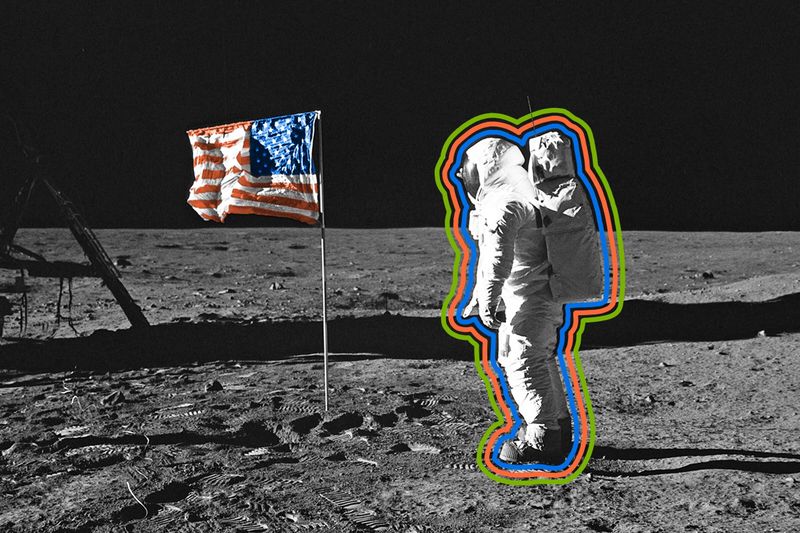
American flags planted on the moon
6
Symbolic folds on an official military flag
13
Percentage of American flags made in the USA
95%
Year the flag’s star pattern was standardized into six rows
1912

The only state that observes Flag Day as an official holiday is ______.

Ready to reveal?

Confirm your email to play the next question?

The only state that observes Flag Day as an official holiday is Pennsylvania.

Placeholder Image

The current American flag was designed by a high school student.

In 1958, at a time when Alaska and Hawaii seemed likely to join the United States, a class at Lancaster High School in Ohio was tasked with creating a show-and-tell project related to American history. One student, Robert G. Heft, decided to make a new 50-star flag, spending 12 hours cutting out and sewing on stars in a pattern that included five rows of six stars and four rows of five stars. Alas, he received a lowly B-. Despite the negative reception, Heft gave the flag to local congressman Walter Moeller, who lived nearby and who promised to take Heft’s design to Washington, D.C. That promise paid off in a big way, as two years later Heft received a phone call from President Eisenhower himself. The President informed Heft that his design had been chosen for the new national flag. Heft’s creation was among an estimated 1,500 considered, and though many others featured a near-identical pattern, he ultimately received credit upon the flag’s adoption on July 4, 1960. In the wake of Eisenhower’s decision, Heft’s teacher retroactively raised his grade to an A.

Bennett Kleinman
Staff Writer

Bennett Kleinman is a New York City-based staff writer for Inbox Studio, and previously contributed to television programs such as "Late Show With David Letterman" and "Impractical Jokers." Bennett is also a devoted New York Yankees and New Jersey Devils fan, and thinks plain seltzer is the best drink ever invented.

Original photo by aphotostory/ iStock

Traversing thousands of miles across eastern Asia, the Great Wall of China has stood as a symbol of the country's military and technological know-how for more than 2,000 years. And thanks to a team of scientists at Zhejiang University, we now know that the secret to its legendary endurance is … sticky rice soup?

As explained in Accounts of Chemical Research in 2010, the scientists stumbled upon this discovery while examining mortar samples from the Great Wall and other long-standing Chinese buildings. They realized the mortar was an unusual composite created from slaked lime and congee, the former a heated type of limestone exposed to water, and the latter a pudding-like rice porridge commonly eaten throughout Asia. When combined with the lime’s calcium carbonate, a complex carbohydrate in the congee known as amylopectin helped stymie the development of calcium carbonate crystals in the mortar, resulting in a compressed structure that gave the ancient barrier the strength to withstand earthquakes and bulldozers.

The Great Wall of China is visible from the moon.

Ready to reveal?

Oops, incorrect!

It's a fib

The Great Wall's similar coloring compared to the surrounding landscape renders its identification from the lunar surface a futile task. Experts say that the wall can only be discerned by the human eye in low orbit under favorable lighting conditions.

While not invented until around the fifth century CE, well after the initial parts of the Great Wall were raised, the sticky rice-lime mortar was used for the well-preserved sections that remain from the Ming dynasty (the 14th through 17th centuries). Which all goes to show that along with fueling the diet of a country of 1.4 billion people, this simple porridge packs enough power to keep historic structures upright through all sorts of human- and nature-instigated onslaughts.

Numbers Don't Lie

Numbers Don't Lie

Length (in miles) of the Great Wall, per a 2012 Chinese government report
13,171
Maximum daily visitors allowed at the Badaling section of the Great Wall
65,000
Year the Great Wall was designated a UNESCO World Heritage Site
1987
Calories in a slice of P.F. Chang’s The Great Wall of Chocolate cake
1,700

Sticky rice has low amounts of the starch known as ______.

Ready to reveal?

Confirm your email to play the next question?

Sticky rice has low amounts of the starch known as amylose.

Placeholder Image

Architects are exploring the possibilities of building with salt.

Porridge isn’t the only kitchen product used to build magnificent structures, as salt is capable of surprising results in that capacity as well. The concept of salt-based buildings is actually a pretty old one: First-century Roman dignitary Pliny the Elder wrote of seeing “towers built of square blocks of salt” in the Middle Eastern city of Gerrha, while 14th-century explorer Ibn Battuta described the salt mosques in the African village of Taghaza. Of course, the mineral was mainly prized in antiquity for its food storage and preparation capabilities, while its propensity to dissolve in water presented sustainability problems. Nevertheless, modern builders are increasingly hungering for salt as a versatile, environmentally friendly component of the construction and design processes. Given its widespread availability, it may not be long before salty projects like Bolivia’s Palacio de Sal hotel go from novelty dish to main course as architectural innovations continue to evolve.

Tim Ott
Writer

Tim Ott has written for sites including Biography.com, History.com, and MLB.com, and is known to delude himself into thinking he can craft a marketable screenplay.

Original photo by Bildagentur Zoonar GmbH/ Shutterstock

Earth is far from the perfect “blue marble” we like to picture. In reality, our planet is filled with deep trenches, towering mountains, and centrifugal bulges that make its mass uneven across the globe — and that unequal distribution can really mess with gravity. One famous example is the Hudson Bay region in northeastern Canada, where gravity reaches some of its weakest levels in the entire world. These levels aren’t extraordinarily low — residents weigh only one-tenth of an ounce less than they would elsewhere — but it’s enough for scientists to take notice and wonder why this particular area experiences gravity differently. 

Hudson Bay is the farthest south penguins live year-round.

Ready to reveal?

Oops, incorrect!

It's a fib

Hudson Bay is a vital habitat for one arctic species — but it’s not penguins. Polar bears live year-round near James Bay, a body of water connected to the southern Hudson Bay. The Hudson Bay’s yearly freeze-up allows polar bears to hunt seals on the bay itself.

The force of gravity is calculated using mass and distance. To put it simply, the mass of the Earth, combined with our proximity to its surface, is why we feel gravity the way we do. This is also why astronauts experience lower gravity as they move farther away from the Earth’s surface. Because we experience the Hudson Bay anomaly while still on Earth, that must mean the area somehow has less mass. It turns out there’s not only one, but two reasons for this. The first is a process in the Earth’s mantle (found 60 to 124 miles beneath the planet’s surface) called convection, in which super-hot magma moves continuously in a circular motion, sinking and rising back up again — and pulling tectonic plates with it. One of these sinking currents occurs in the Hudson Bay region, and could account for an estimated 55% to 75% of its “missing” gravity. 

The second reason takes us back 20,000 years to the last ice age, when much of North America was covered by a nearly 2-mile-thick glacier called the Laurentide Ice Sheet. Its massive bulk, especially around Hudson Bay where the glacier formed huge domes, compressed rock into the Earth’s mantle and created a giant indent with less mass. Scientists have confirmed that gravity is slowly increasing in the area as the Earth rebounds (at about half-an-inch per year) from this glacial trauma, but residents of the Hudson Bay region will still experience some gravity-induced weight loss for the next 5,000 years or so.

Numbers Don't Lie

Numbers Don't Lie

Speed (in feet per second, squared) of gravity’s acceleration toward Earth
32
Year Henry Hudson explored what is now called Hudson Bay
1610
Percent of gravity on Mars compared to Earth (150 lbs. on Earth = 57 lbs. on Mars)
38
Height (in feet) of the Barnes Ice Cap, the last remnant of the Laurentide Ice Sheet
1,640

Hudson Bay is second in size only to the ______, the largest bay in the world.

Ready to reveal?

Confirm your email to play the next question?

Hudson Bay is second in size only to the Bay of Bengal, the largest bay in the world.

Placeholder Image

Gravity travels at the speed of light.

Traveling 186,000 miles a second, light takes only about eight minutes to traverse the 93 million miles between the sun and the Earth. It’s the fastest thing known to science — well, one of the fastest. Gravity also travels through space at the speed of light, as hypothesized by Albert Einstein’s General Theory of Relativity. However, gravity is much harder to measure than light, in part because it’s a much weaker force, and because scientists can’t just turn it on and off while scribbling notes. In 2003, nearly 90 years after Einstein first shared his grand theory, scientists from the National Radio Astronomy Observatory (NRAO) used a once-in-a-decade celestial alignment to measure the speed of gravity. As the massive bulk of Jupiter passed in front of a specific quasar (very bright young galaxies located very far away), scientists measured how the quasar’s radio waves bent around the gas giant. Because the amount of bending depended on how quickly gravity propagated around Jupiter, NRAO scientists could finally determine its speed. The fact that light and gravity move at the same speed means that if the sun were to instantly vanish, Earth would still enjoy about eight minutes of sunshine while orbiting around, well, nothing — before being slingshot into the cold vastness of space.

Darren Orf
Writer

Darren Orf lives in Portland, has a cat, and writes about all things science and climate. You can find his previous work at Popular Mechanics, Inverse, Gizmodo, and Paste, among others.

Original photo by nevodka/ Alamy Stock Photo

Video games aren’t often associated with literary figures, but The Legend of Zelda has always been unique. Take, for instance, the fact that its title character was named after writer, artist, and Jazz Age icon Zelda Fitzgerald, whose marriage to The Great Gatsby author F. Scott Fitzgerald generated nearly as many headlines as his professional output. Zelda, who’s been described as the first flapper of the Roaring '20s (and the inspiration for Gatsby’s Daisy Buchanan), was chosen because a Nintendo PR rep suggested that the eponymous princess should be “a timeless beauty with classic appeal” and that Zelda Fitzgerald was one such “eternal beauty.” 

Zelda’s protagonist was inspired by Peter Pan.

Ready to reveal?

Oops, incorrect!

It's a fact

Despite being its namesake, Princess Zelda isn’t the character you play as in these games — that would be Link, whose green attire and pointy hat were inspired by Peter Pan. Shigeru Miyamoto wanted its hero to be instantly recognizable, and the boy who never grew up fit the bill.

Shigeru Miyamoto, the game’s creator, agreed: “She was a famous and beautiful woman from all accounts, and I liked the sound of her name,” he has said. The name chain didn’t end there; actor Robin Williams was such a fan of the series that he named his daughter after the Princess of Hyrule. As for Zelda F. herself, she was — rather fittingly — named for the fictional heroine of a 19th-century novel.

Numbers Don't Lie

Numbers Don't Lie

Games in the main Zelda franchise
19
Short stories written by F. Scott Fitzgerald
164
Copies sold of Breath of the Wild, the most of any Zelda game
25.8 million
Value of the last royalty check Fitzgerald ever received
$13.13

F. Scott Fitzgerald’s final, unfinished novel was called “______.”

Ready to reveal?

Confirm your email to play the next question?

F. Scott Fitzgerald’s final, unfinished novel was called “The Love of the Last Tycoon.”

Placeholder Image

F. Scott Fitzgerald was a terrible speller.

If you don’t think it’s possible for a bad speller to be a good writer, one of the 20th century’s most acclaimed authors might prove you wrong. Fitzgerald was both a poor student and an abominable speller, with some suggesting he may have been dyslexic. Upon reading a typo-laden version of Fitzgerald’s This Side of Paradise, literary critic Edmund Wilson (who was also a classmate of the author at Princeton) deemed it “one of the most illiterate books of any merit ever published … full of English words misused with the most reckless abandon.” Fitzgerald, who was friends with Ernest Hemingway, even misspelled his fellow writer’s first name as “Earnest” in letters.

Michael Nordine
Staff Writer

Michael Nordine is a writer and editor living in Denver. A native Angeleno, he has two cats and wishes he had more.

Original photo by Ball Park Brand/ Unsplash

The Earth’s oceans are just as dynamic a landscape as the bits of rock that peek above its surface. Our seas are home to the world’s longest mountain chain, its deepest trenches, and other impressive natural structures that boggle the mind. The ocean is even home to its own underwater lakes and rivers. When seawater seeps up from the seafloor, it mixes with the salt layers above and creates a depression in the seabed, where this heavy, dense, and briny mixture rests. Some of these depressions can be more like puddles than proper lakes, stretching only a few feet across, but others can be many miles wide or long, and even feature their own underwater waves. And like lakes and rivers on land, these underwater features also have coastlines and animals that rely on these salty seas within seas to survive. 

The oceans contain the vast majority of the world’s wildlife.

Ready to reveal?

Oops, incorrect!

It's a fact

Some 94% of the world’s wildlife can be found in the oceans. However, the oceans contain just 1% of life overall as measured by biomass (tons of carbon); plants, which mostly live on land, account for more than 82% of biomass. Humans, meanwhile, comprise just 0.01% of biomass.

These aren’t the only types of “rivers” found in the world’s oceans. Where some of the world’s major rivers (including the Amazon and Congo) meet the sea, an underwater current of silt and sand can create massive channels that move more sediment in a few weeks than all the world’s regular rivers combined can move in a year. Although these are massive undersea structures, scientists discovered them only 40 years ago with the advent of sonar mapping, and many mysteries still surround them. In fact, some oceanographers have said that we know more about the surface of Mars than the depths of the Earth’s oceans, and less than 19% of the ocean floor has been mapped in detail. Which raises the question: What other amazing aquatic wonders have yet to be discovered?

Numbers Don't Lie

Numbers Don't Lie

Estimated height (in feet) of the underwater Denmark Strait cataract, the tallest waterfall in the world
11,500
Length (in miles) of the mid-ocean ridge system, the longest mountain chain on Earth
40,390
Year the first submarine was built, which dove under the River Thames
1620
Year Charles Wyville Thomson led the first deep-sea expedition, aboard the HMS Challenger
1872

In 2012, director ______ completed the first solo dive to the deepest point on the Earth’s seabed.

Ready to reveal?

Confirm your email to play the next question?

In 2012, director James Cameron completed the first solo dive to the deepest point on the Earth’s seabed.

Placeholder Image

An estimated 80% of all volcanic eruptions occur underwater.

Volcanic eruptions are some of the most dramatic geologic events that humans can witness, but a large majority of them actually happen without us noticing. The National Oceanic and Atmospheric Administration (NOAA) estimates that 80% of all volcanic eruptions occur underwater — but these explosive Earth burps don’t work the same way as their land-based relatives. Because the weight of the water above these volcanoes creates such high pressure, submarine volcanoes rarely truly explode. Instead they create what’s called “passive lava flows” along the seafloor, which over the course of millions of years can form volcanic island chains such as Hawaii. These submarine volcanoes that never peak above sea level are known as seamounts, and their lava-churning drama occurs out of sight and (for most of us) out of mind.

Darren Orf
Writer

Darren Orf lives in Portland, has a cat, and writes about all things science and climate. You can find his previous work at Popular Mechanics, Inverse, Gizmodo, and Paste, among others.

Original photo by Greg Balfour Evans/ Alamy Stock Photo

In 1928, Walt Disney’s Hollywood studio was on the brink of bankruptcy, plagued with debts and failed contracts. Miraculously, it took just one mouse to turn things around. Disney’s first iteration of its most recognizable animated character is often referred to as Steamboat Willie thanks to his role in a short movie of the same name; today, of course, everyone knows his name is Mickey Mouse. In 2024, the copyright protection over his first adventure will expire, sailing the character into the waters of the public domain. (Later versions of Mickey will remain protected until their own copyrights expire.)

A Dutch company once tried to copyright its cheese.

Ready to reveal?

Oops, incorrect!

It's a fact

In 2018, two feuding Dutch cheese producers asked EU courts to determine if cheese — in this case an herb-veggie spread — could be copyrighted. The European Court of Justice decided that tastes cannot be copyright protected, in part because they vary from person to person.

Steamboat Willie hit screens on November 18, 1928, making entertainment history as the first cartoon to use fully synchronized sound (most films at that time, animated and otherwise, were silent). Walt Disney, burned from previous fights over intellectual property, copyrighted the character at a time when U.S. copyright law guaranteed protection for a total of 56 years. But around the time of the animation’s original expiration date, the Walt Disney Company lobbied for extended coverage, retaining control for decades longer thanks to the Copyright Act of 1976 and 1998’s Copyright Term Extension Act (often referred to as the Mickey Mouse Protection Act). 

Dissolving Disney’s copyright over the Steamboat Willie star could lead to choppy waters for artists, brands, and others who want to use the character. That’s because Disney may retain some rights to its earliest mouse thanks to trademarks (which, unlike copyrights, can last in perpetuity), potentially sparking conflicts over fair use. However, it could also spark a wave of creative remixes that rejuvenate the 95-year-old character — a move public domain advocates say helps restore forgotten works and build upon cultural heritage.

Numbers Don't Lie

Numbers Don't Lie

Year world leaders first met at the Berne Convention to create international copyright laws
1886
Year Winnie-the-Pooh entered the public domain
2022
Estimated number of sound recordings that entered the public domain in 2022
400,000
Length (in minutes) of Disney’s “Steamboat Willie” cartoon
8

Before relocating to L.A., Walt Disney’s first animation studio was in ______.

Ready to reveal?

Confirm your email to play the next question?

Before relocating to L.A., Walt Disney’s first animation studio was in Kansas City.

Placeholder Image

One of Disney’s earliest animation sensations was a rabbit.

Mickey Mouse may be Walt Disney’s most popular character, but the inspiration for his creation came from another animation: Oswald the Lucky Rabbit. In 1923, Walt Disney and his brother Roy set up a small animation studio in Hollywood and landed themselves a deal with Universal Pictures to create short cartoon films. The pair (along with a team of fellow animators) debuted Oswald in 1927, setting him apart from rival animators’ popular cat characters by giving him long rabbit ears and a distinctive personality. Disney’s studio produced 26 short films with Oswald, the last of which was released in 1928 — the same year Disney lost control of the cartoon thanks to brewing tensions, contract disputes, and ownership disagreements with Universal Pictures. Oswald was featured in nearly 200 cartoon shorts through the 1930s, and eventually made his way back to Disney in 2006, thanks to a deal with NBC Universal. In 2022, Disney animators created a new Oswald film for the first time in nearly 100 years.

Nicole Garner Meeker
Writer

Nicole Garner Meeker is a writer and editor based in St. Louis. Her history, nature, and food stories have also appeared at Mental Floss and Better Report.