
Original photo by spn/ iStock
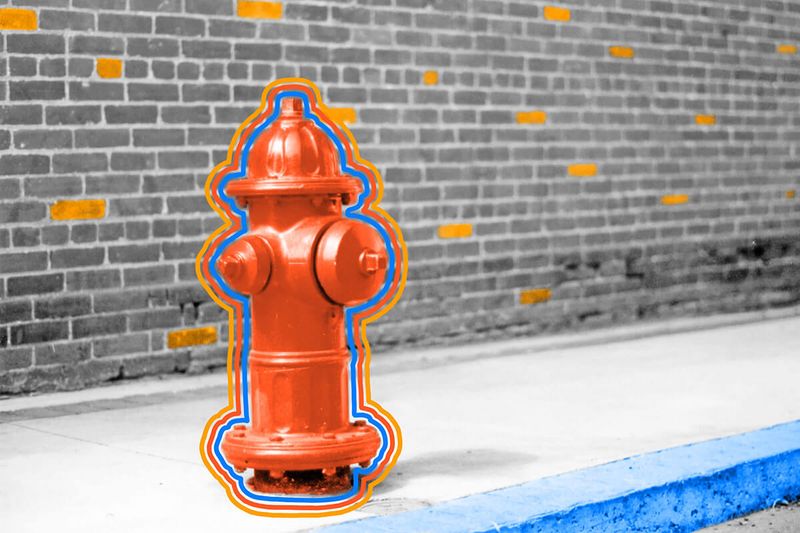
For early Americans, fire was a feared necessity; it warmed homes, provided hot meals, and offered late-night reading light. But fire could also destroy entire communities, which was probably the inspiration behind the invention of the fire hydrant — though we may never really know the full story, thanks to a fire in 1836.
At the time, Americans had been eagerly filing patents for nearly five decades thanks to the Patent Act of 1790, recommended to Congress by President George Washington himself. By the 1830s, the Patent Office housed nearly 10,000 patents — an impressive but risky collection considering they were all original documents with no copies.




Oops, incorrect!
It's a fibWhile bright hues don’t hurt visibility, fire hydrants are color-coded based on how much water they produce per minute. Red hydrants produce the slowest flow at 500 gallons per minute, compared to blue hydrants, which top out at 1,500 gallons. (Orange and green spigots fall in between.)
On December 15, 1836, a fire in the basement of Blodgett’s Hotel (which then housed the Patent Office, U.S. Post Office, and a branch of the local fire department) smoldered from the embers of ashes that had been stored alongside firewood in a wooden box. Firefighters stationed in the building responded to the growing blaze, but couldn’t do much with the department’s dilapidated hoses. The former hotel — and every document inside — was gone in under 20 minutes. Assigned the impossible task of reconstructing its records, the Patent Office put out a call to inventors to mail in any documentation they had of their awarded patents, but only around 2,800 patents were restored. Those that couldn’t be reproduced were voided. In the years since, some scholars have pointed to Frederick Graff Sr., an early 19th-century Philadelphia engineer, as the possible inventor of the fire hydrant. However, another innovator by the name of Birdsill Holly Jr. was awarded a patent in 1869 for his “modern” fire hydrant, which was soon adopted in cities around the U.S. and Europe. Today, the United States Patent and Trademark Office takes up five buildings in Alexandria, Virginia, and many patents are applied for and stored digitally — making them much less likely, thankfully, to be destroyed by fire.

Numbers Don't Lie
More Interesting Reads




______ is the only U.S. president to be awarded a patent.
Ready to reveal?
Confirm your email to play the next question?
Abraham Lincoln is the only U.S. president to be awarded a patent.

The 1890 census was also lost in a fire.
Family historians know the frustrating difficulty of tracing ancestors through time, only to lose track of them between 1880 and 1900 thanks to two fires that destroyed nearly all of the 1890 census. Counting nearly 63 million people, that census was the first of its kind; while census-takers had been performing the population count every decade since 1790, the 1890 count was the first to use an electrical tabulation system with data punched into cards. And unlike with prior censuses, the only records were forwarded on to Washington, D.C., despite the former protocol of leaving some copies with local county clerks. Six years after the count’s close, a fire destroyed some of the data in March 1896, though the general population schedules — the personal information that most genealogists sift through today — remained intact. But a second fire at the U.S. Commerce Building in January 1921 dramatically changed that picture; while some of the census documents were initially considered salvageable, water and mold damage soon rendered most illegible. By the mid-1930s, the government destroyed the remaining documents despite public outcry — a controversy that would set in motion the creation of the National Archives.

Nicole Garner Meeker is a writer and editor based in St. Louis. Her history, nature, and food stories have also appeared at Mental Floss and Better Report.
top picks from the Inbox Studio network
Interesting Facts is part of Inbox Studio, an email-first media company. *Indicates a third-party property.