
Original photo by lady_in_red13/ Shutterstock

Human hearts have a big job: moving oxygen and nutrients throughout our bodies. But as much credit as the heart gets, it doesn’t work alone — the adult human circulatory system includes arteries, veins, and capillaries in a network that’s more than 60,000 miles long

Larger animals have slower heartbeats than smaller creatures.

Ready to reveal?

Oops, incorrect!

It's a fact

Elephant hearts beat 25 to 35 times per minute, drastically slower than mouse hearts, which pump 450 to 750 times per minute. Scientists believe size is a factor in how fast the heart works; in bigger bodies, it has to work more efficiently to power every cell without wearing out.

In terms of distance, the blood vessels in our bodies are lengthy enough to circle the globe twice, with mileage to spare. What’s more, about 80% of that distance comes from just capillaries, the smallest blood vessels that connect veins and arteries. With each heartbeat, the circulatory system is a multifunctioning wonder, working simultaneously to oxygenate blood, remove waste from our organs, and transport hormones and nutrients to their necessary destinations. Meanwhile, this system also stabilizes our bodies by helping to fight off disease and regulate body temperature.

Not all living creatures have circulatory systems, and among those that do, they can look drastically different. Vertebrates — mammals, amphibians, reptiles, and birds — have “closed” circulatory systems, meaning that blood is transported through the body sealed within arteries and veins. Invertebrates (think snails, crabs, and octopuses) have “open” systems with no veins, where blood flows freely throughout the entire body cavity and is directly absorbed by the organs. And some animals, such as jellyfish, anemones, and corals, have no blood or circulatory systems at all, instead relying on the water they live in to supply the oxygen and nutrients they need.

Numbers Don't Lie

Numbers Don't Lie

Average number of human heartbeats per day
100,000
Gallons of blood that pass through the human heart daily
2,000
Number of main blood type groups — A, B, AB, and O
4
Percentage of the U.S. population with type O blood, aka universal blood donors
6.6

Blood cells are created within ______, the spongy center of bones.

Ready to reveal?

Confirm your email to play the next question?

Blood cells are created within bone marrow, the spongy center of bones.

Placeholder Image

One incredibly rare blood type is nicknamed “golden blood.”

Most people who require blood in medical emergencies are able to get the help they need thanks to blood bank donations. However, some people have such rare blood types that they’re unlikely to receive blood thanks to the near-impossibility of finding a match. That’s the case for people with “golden blood,” an incredibly uncommon blood type that lacks antigens — the proteins in red blood cells that help the immune system determine between harmful and beneficial cells. (Matching antigens is important during blood transfusions because it keeps the body from rejecting donated blood.) Technically called Rhnull, this blood type is so rare that doctors have identified fewer than 50 people with it since first discovering the type in 1961. People with Rhnull have miraculous blood cells that are able to save lives in tricky cases where patients have less-common antigens, though undergoing medical care themselves is complex, and often requires doctors to lean on a small network of fellow donors to obtain the blood they need.

Nicole Garner Meeker
Writer

Nicole Garner Meeker is a writer and editor based in St. Louis. Her history, nature, and food stories have also appeared at Mental Floss and Better Report.

Original photo by Peter Ekvall/ Alamy Stock Photo

Decades before doctors began to publicize the harmful effects of cigarettes, a 30-year-old Austrian executive decided to invent a refreshing alternative. In 1927, Eduard Haas III was managing his family’s baking goods business — the Ed. Haas Company — when he expanded the product line to include round, peppermint-flavored treats known as PEZ Drops. The German word for peppermint is “pfefferminz,” and Haas found the name for his new candies by combining the first, middle, and last letters of the German term. Clever advertising built national demand for the candy, which adopted its iconic brick shape in the 1930s and eventually nixed the “Drops.” PEZ were packaged in foil paper or metal tins until Haas hired engineer Oscar Uxa to devise a convenient way of extracting a tablet single-handedly. Uxa’s innovation — a plastic dispenser with a cap that tilted backward as springs pushed the candy forward — debuted at the 1949 Vienna Trade Fair. 

PEZ once came in a chlorophyll flavor.

Ready to reveal?

Oops, incorrect!

It's a fact

There are currently 10 PEZ flavors available in the U.S., but other flavors are sold around the world — and still others have been discontinued. Among the flavors you can’t find anymore are liquorice, coffee, and, yes, chlorophyll.

A U.S. patent for the dispenser was obtained in 1952, but Americans of the day showed little interest in giving up smoking. So PEZ replaced the mint pellets with fruity ones and targeted a new demographic: children. In 1957, after experimenting with pricey dispensers shaped like robots, Santa Claus, and space guns, PEZ released a Halloween dispenser that featured a three-dimensional witch’s head atop a rectangular case. A Popeye version was licensed in 1958, and since then PEZ has gone on to produce some 1,500 different novelty-topped dispensers. An Austrian original that was revolutionized in America, PEZ is now enjoyed in more than 80 countries — and it’s still owned by the Ed. Haas Company.

Numbers Don't Lie

Numbers Don't Lie

Pressure (in pounds) the raw ingredients in PEZ undergo to become tablets
3,000
PEZ dispensers used to create the world’s largest PEZ dispenser sculpture, a replica of London’s Big Ben
9,404
Price (in dollars) a Prince Harry and Meghan Markle set of PEZ dispensers earned in a 2018 charity auction
9,893
Minimum amount of individual PEZ candies eaten annually in the United States
3 billion

The all-time bestselling PEZ dispenser features ______.

Ready to reveal?

Confirm your email to play the next question?

The all-time bestselling PEZ dispenser features Santa Claus.

Placeholder Image

Hollywood almost made an animated PEZ movie.

The Lego Movie exceeded all box office expectations by becoming the fourth-highest-grossing domestic film of 2014. Producers immediately started brainstorming about other nostalgia-inducing objects that could anchor an animated comedy. Envision Media Arts found a worthwhile property in PEZ, greenlighting a feature and hiring a screenwriter in 2015, yet no director or cast was ever announced. According to the Envision Media Arts website, “PEZ” remains in development. In the meantime, anyone seeking a big-screen PEZ tribute can revisit the 1986 classic Stand by Me. In the Rob Reiner-directed film, 12-year-old Vern Tessio (Jerry O’Connell) contends, “If I could only have one food to eat for the rest of my life? That’s easy, PEZ. Cherry-flavor PEZ. No question about it.”

Jenna Marotta
Writer

Jenna is a writer whose work has appeared in The New York Times, The Hollywood Reporter, and New York Magazine.

Original photo by Sean Pavone/ Shutterstock

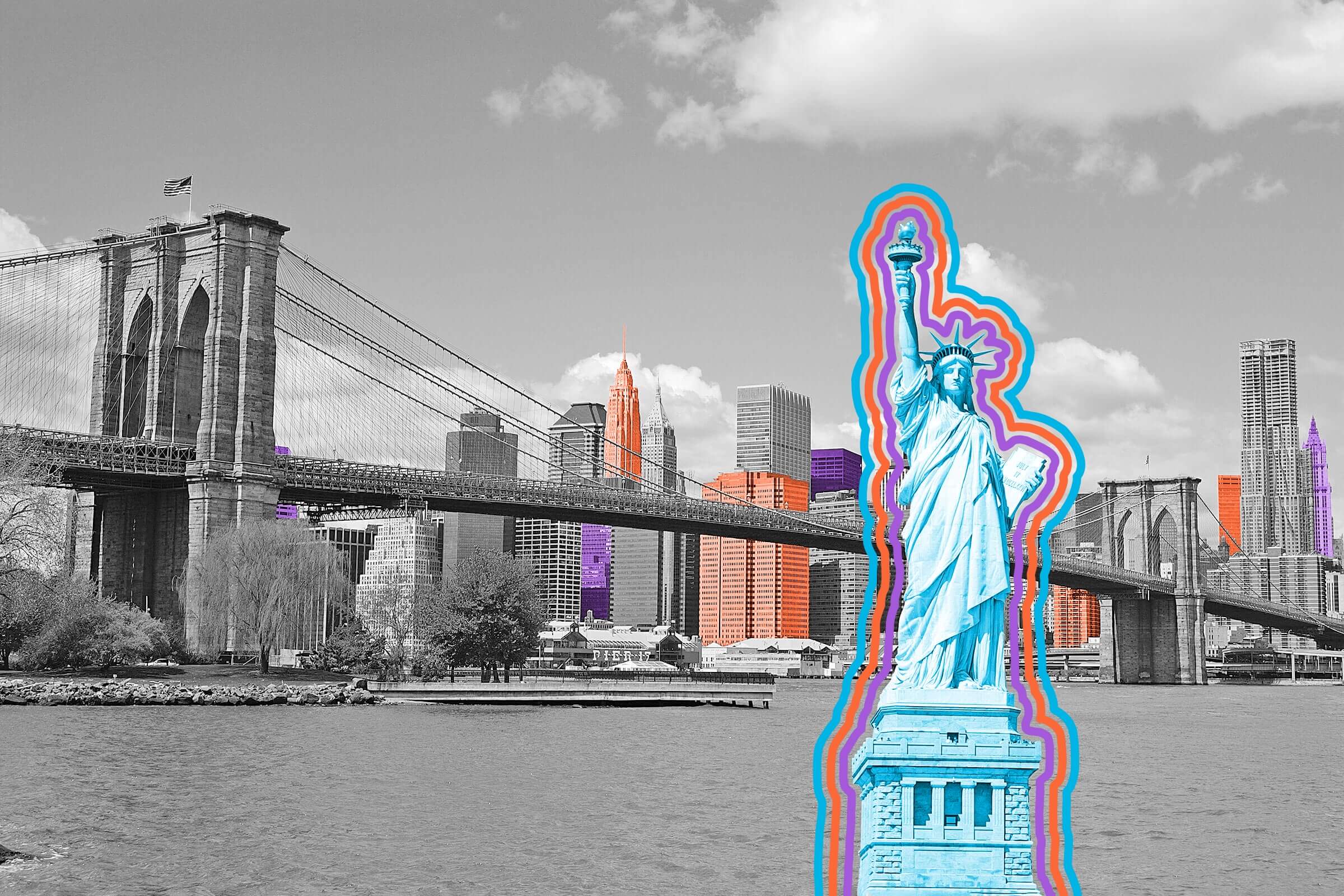
Lady Liberty has pushed her torch high into the New York City skyline since 1886, but at one time, the grand statue did more than just inspire Americans — it was also a lighthouse. The same year French sculptor Frédéric-Auguste Bartholdi oversaw completion of his copper creation (formally named “Liberty Enlightening the World”), President Grover Cleveland approved a plan for the statue to be lit as a lighthouse. Engineers believed the Statue of Liberty’s torch, at 305 feet above sea level, could act as a navigational tool for ships approaching the New York Harbor, and set to work installing nine electric lamps within the torch, plus more along Lady Liberty’s feet and in the statue’s interior. 

The Statue of Liberty’s design was once patented.

Ready to reveal?

Oops, incorrect!

It's a fact

French sculptor Frédéric-Auguste Bartholdi was issued a U.S. patent for his Statue of Liberty design in 1879, seven years before the statue was completed. The design patent protected Bartholdi from replicas of all sizes (including miniature versions), but lasted only 14 years.

At 7:35 p.m. on November 1, 1886, engineers flipped on the power switch, washing the Statue of Liberty in light for the first time. However, the lights stayed on for just one week due to a lack of funding, and it took two weeks of darkness before the U.S. Lighthouse Board could secure an emergency budget. Even once the lights were turned back on, some questioned the statue’s efficacy as a lighthouse: Newspapers reported that while the lights were initially planned to reach 100 miles or more out at sea, in reality the torch was visible just 24 miles from the harbor. By the early 20th century, the lighthouse was considered “useless” for boat navigation, and on March 1, 1902, the U.S. War Department, with approval from President Theodore Roosevelt, extinguished the light permanently. 

Numbers Don't Lie

Numbers Don't Lie

Pounds of copper used to create the Statue of Liberty
62,000
Average number of visitors to the Statue of Liberty each year
4.3 million
Stairs visitors climb to reach the Statue of Liberty’s crown from the main lobby
377
Crates used to pack the Statue of Liberty in 1885 when it was shipped from France
214

The island on which the Statue of Liberty stands was originally called ______.

Ready to reveal?

Confirm your email to play the next question?

The island on which the Statue of Liberty stands was originally called Bedloe’s Island.

Placeholder Image

Lady Liberty’s original torch was destroyed in an explosion.

Despite being nearly 140 years old, most of the Statue of Liberty’s copper frame is original. However, one portion, the torch, was replaced in the 1980s due to extensive damage caused by an explosion. In 1916, amid World War I, German saboteurs attempted to stop the U.S. from supplying Britain with ammunition, stores of which were held on Black Tom Island, not far from Lady Liberty in the New York Harbor. The saboteurs set the stockpile ablaze, resulting in an enormous explosion equivalent to a 5.5 magnitude earthquake, which was felt as far as Philadelphia. The Statue of Liberty took more than $100,000 in damage from shrapnel (about $2.8 million today), including structural mangling of the torch that led to its permanent closure (it was once open to visitors). In 1984, Lady Liberty underwent a multiyear restoration that included replacing the severely damaged torch, and today sightseers can see the original up close on ground-level at the Statue of Liberty Museum on Liberty Island.

Nicole Garner Meeker
Writer

Nicole Garner Meeker is a writer and editor based in St. Louis. Her history, nature, and food stories have also appeared at Mental Floss and Better Report.

Original photo by Ryoji Iwata/ Unsplash

There are more people on Earth today than ever before — nearly 8 billion, to be exact — which represents a full 7% of all 117 billion people estimated to have ever lived throughout the course of human history. The figure comes from the Population Reference Bureau, which released its first estimate in 1995 and has updated it occasionally in the years since. As with most math on this scale, the calculus wasn’t easy. That’s partly because our knowledge of history is ever-evolving: When the bureau initially calculated the number, modern Homo sapiens were thought to have first appeared around 50,000 BCE, but recent discoveries put the actual date closer to 200,000 BCE.

All the cattle on Earth weigh more than all the humans.

Ready to reveal?

Oops, incorrect!

It's a fact

With a biomass of about 386 million tons, humans weigh a lot — but we don’t weigh as much as our bovine neighbors. An estimated 1.3 billion cattle share the planet with us, and their biomass comes out to an absolutely beefy 716 million tons.

Three main factors go into the math: how long humans are thought to have been walking the Earth, the average population during different eras, and the number of births per 1,000 people during said eras. As you might imagine, the growth has been astronomical — there were just 5 million humans in 8000 BCE, 300 million in 1 CE, and 450 million in 1200. And while the bureau acknowledges that this is “part science and part art,” even being off by a few billion gives us a ballpark figure to imagine all the people who came before us.

Numbers Don't Lie

Numbers Don't Lie

World population in 1900
1.6 billion
Population of Vatican City, the world’s least-populous country
825
Years of human civilization
6,000
Domestic chickens in the world
18.6 billion

The world’s most populous city is ______.

Ready to reveal?

Confirm your email to play the next question?

The world’s most populous city is Tokyo.

Placeholder Image

India is projected to overtake China as the world’s most populous country.

The United Nations estimates that will happen within the next five years, though new projections suggest it may happen even sooner. When the U.N. first made its report in 2019, India was home to 1.37 billion people and China had a population of 1.43 billion. China’s birth rate has been declining in recent years, however, hence the updated timeline. Once India becomes the world’s most populous country, it’s projected to maintain that position for the rest of the century.

Michael Nordine
Staff Writer

Michael Nordine is a writer and editor living in Denver. A native Angeleno, he has two cats and wishes he had more.

Original photo by Chris Willson/ Alamy Stock Photo

In 1998, a fur-covered robot hit store shelves just in time for the holiday shopping season, creating a frenzy among parents. Manufacturer Tiger Electronics had released the first real-life robotic pet: Furby. Partially resembling a hamster (thanks to its scruffy acrylic fur) and an owl (complete with pointed ears and a beak), the computerized toy greeted children and sang to them in Furbish, an entirely made-up language. Furby’s main hook was all about interaction; it could be startled by loud noises, responded to petting, and danced when it was happy, just like a real animal might. But the most innovative feature was that the small robots could supposedly learn English, a gimmick that created a whirlwind of conspiracies, including the idea that Furby was an international spy.

Furby was the first robotic toy to use artificial intelligence.

Ready to reveal?

Oops, incorrect!

It's a fact

A slew of robotic toys emerged around 2000, heralding the millennium with computerized novelties. But Furby was considered the first of its kind to use (rudimentary) artificial intelligence, equipped with sensors that allowed it to respond to humans and other Furbys.

Because Furby was the first toy of its kind, most people didn’t understand how it “learned” language, and the initial fervor was so intense that it led the National Security Agency to ban the toys from its premises; it was also banned from the Norfolk Naval Shipyard and the Pentagon. NSA agents believed the robots were embedded with recording devices that could allow them to listen in on sensitive topics and later replay classified conversations. Tiger Electronics refuted the ban, explaining that while the toy was unique, “Furby [was] not a spy,” going so far as to reveal that the toys were pre-programmed with around 200 words — meaning they didn’t actually learn anything — and that they slowly unveiled their vocabulary the longer a child played. Meanwhile, the outlandish Furby fears (including the belief that it could launch a space shuttle) didn’t slow its popularity; more than 40 million of the revolutionary robots were sold in the first three years.

Numbers Don't Lie

Numbers Don't Lie

Original retail price for a Furby in 1998
$35
Tiger Electronics’ estimated development budget for the first Furby
$5 million
Number of AA batteries needed to power a Furby
4
Height (in inches) of a first-generation Furby
8

Furby creators originally named the toy ______.

Ready to reveal?

Confirm your email to play the next question?

Furby creators originally named the toy Furball.

Placeholder Image

Furbys were also banned from flights.

Today, personal electronics sometimes seem like the only way to cope with the grueling ordeal of air travel, helping us pass the time with an in-flight movie or music. But that wasn’t always the case — not so long ago, the Federal Aviation Administration (FAA) prohibited using CD players, laptops, and even Furbys on airplanes. The 1990s ushered in a wave of portable electronics, and with their popularity came a theory that many devices could interfere with a plane’s navigation system, creating chaos in the skies. In an effort to protect passengers and pilots, the FAA banned the use of many electronics during takeoff and landing, including the incredibly popular robotic toy, which had to have its batteries removed before takeoff. No plane control issues were ever attributed to a Furby on board, though there likely was one benefit to powering down the robots while in air: their silence, since many people found their constant chatter grating.

Nicole Garner Meeker
Writer

Nicole Garner Meeker is a writer and editor based in St. Louis. Her history, nature, and food stories have also appeared at Mental Floss and Better Report.

Original photo by Everett Collection/ Shutterstock

Although her aviation career lasted just 17 years, Amelia Earhart remains one of the most famous people ever to take to the sky. In addition to being renowned for her many firsts — including being the first woman to fly solo across the Atlantic and the first person to fly alone from Hawaii to the mainland U.S. — she’s known for her 1937 disappearance and the many theories it spawned. Less well-known but considerably more fun to imagine is the time she took Eleanor Roosevelt on a nighttime joyride from Washington, D.C., to Baltimore on April 20, 1933. The brief flight took place with both of them in their evening wear following a White House dinner party.

Some people believe that Amelia Earhart was a spy.

Ready to reveal?

Oops, incorrect!

It's a fact

According to this fanciful theory, Earhart didn’t disappear at all — she started a new assignment for President Franklin Roosevelt, a close personal friend of hers, that entailed keeping a watchful eye on Japanese activities. Some even believe she was later captured by Japan.

“I’d love to do it myself. I make no bones about it,” the First Lady told the Baltimore Sun after the flight. “It does mark an epoch, doesn't it, when a girl in an evening dress and slippers can pilot a plane at night.” In fact, Roosevelt herself had recently received a student pilot license and briefly took over the controls of the twin-engine Curtiss Condor, borrowed from Eastern Air Transport at nearby Hoover Field. Eleanor's brother Hall also ditched the dinner party in favor of the flight that night, as did Thomas Wardwell Doe, the president of Eastern Air Transport, and Eugene Luther Vidal (head of the Bureau of Air Commerce) and his wife Nina Gore, parents of author Gore Vidal. When the plane returned after the short journey, the Secret Service guided everyone back to the White House table for dessert. Needless to say, they all had quite the story to tell at their next dinner party. Roosevelt and Earhart remained friends for the rest of Earhart’s life, sharing an interest in women’s causes, world peace, and of course, flying.

Numbers Don't Lie

Numbers Don't Lie

Distance (in miles) of Earhart’s solo 1935 flight from Hawaii to California
2,408
Years Roosevelt spent writing “My Day,” a syndicated newspaper column
27
Women who received their pilot license before Earhart
15
Honorary degrees received by Roosevelt (four more than her husband)
35

Amelia Earhart’s first plane was nicknamed “______.”

Ready to reveal?

Confirm your email to play the next question?

Amelia Earhart’s first plane was nicknamed “the Canary.”

Placeholder Image

Harry S. Truman considered Eleanor as a potential vice president.

Truman ascended to the presidency following the death of Franklin Roosevelt just a few months into the latter’s unprecedented fourth term in 1945. Though he went without a vice president for his first four years in office, Truman “indicated that she [Eleanor] would be acceptable to him as a vice-presidential candidate,” according to the Franklin Delano Roosevelt Presidential Library. Eleanor declined the role due to a lack of interest in elective office. Instead, Alben W. Barkley took the reins as Truman’s veep during his second term, and Eleanor served as United States delegate to the United Nations General Assembly, where she helped draft the Universal Declaration of Human Rights.

Michael Nordine
Staff Writer

Michael Nordine is a writer and editor living in Denver. A native Angeleno, he has two cats and wishes he had more.

Original photo by Glasshouse Images/ Alamy Stock Photo

In the spring of 1847, American newspapers printed horrifying reports about an ill-fated group of pioneers who had become trapped in the Sierra Nevada over the winter. With few provisions and facing unbearable cold, nearly half of the group’s 81 members perished before rescue parties could find them, four to five months later. Eventually, the Donner Party’s tragic tale became embedded in American history, but it could have had a much greater impact had a young Illinois lawyer chosen to join the group.

Wagon wheel tracks from the Oregon Trail are still visible.

Ready to reveal?

Oops, incorrect!

It's a fact

Before the Transcontinental Railroad, wagons were the only way for emigrants to journey west over land. From 1840 to 1880, hundreds of thousands traced their way across the prairies, and the evidence remains. Today, ruts from wagon traffic are still visible from Missouri to Oregon.

In the 1840s, emigrants were itching to go west in search of gold, new beginnings, and a glimpse of the West Coast’s famed beauty. So it wasn’t strange that Abraham Lincoln, then working as a lawyer, helped at least one traveler settle his affairs before beginning the journey. An Irish entrepreneur named James Reed had known Lincoln from their days serving together in the Black Hawk War in 1832. According to the historian Michael Wallis, Reed — a founder of the Donner Party — extended an invitation to the 37-year-old lawyer and his family to join the voyage. Lincoln was likely tempted: He reportedly had a lifelong interest in visiting California. But his wife, Mary Todd, was adamant they should remain in Illinois considering the difficulty of 2,000 miles of wagon travel with a young son and a baby on the way. The Donner Party departed Springfield, Illinois, without the Lincolns on April 15, 1846. Mary Todd was present as the wagons pulled away, waving farewell to an expedition that would go on to face extreme peril. Abraham Lincoln, however, traded his dream of westward travel for political ambitions that took him much further in history when he became the 16th President 15 years later.

Numbers Don't Lie

Numbers Don't Lie

Number of wagons in the Donner Party at its peak
23
Number of travelers who trekked the Oregon Trail between 1841 and 1861
300,000+
Speed (in mph) of an oxen-drawn wagon
2-3
Average annual snowfall (in feet) at Donner Pass
34

The Oregon Trail’s primary starting point was ______.

Ready to reveal?

Confirm your email to play the next question?

The Oregon Trail’s primary starting point was Independence, Missouri.

Placeholder Image

Abraham Lincoln created the Secret Service.

In a strange twist of fate, one of President Abraham Lincoln’s final acts was the creation of the Secret Service. Signed into law on April 14, 1865 — the same day Lincoln was assassinated at Ford’s Theatre — the Secret Service was established as a group of investigators with an entirely different mission than their purpose today. During the 1800s, one-third of all American currency was counterfeit, a problem so staggering that Lincoln created a commission to find a fix. The solution was an investigative squad that could bust the bogus banknote problem, giving way to the first iteration of the Secret Service. The Secret Service initially served under the Department of the Treasury, though officers would occasionally provide security for the President if other law enforcement was unavailable. It would take another President’s assassination — William McKinley’s in 1901 — for Congress to assign the Secret Service to permanent presidential detail, though the department is still responsible for investigating financial crimes and fraud today.

Nicole Garner Meeker
Writer

Nicole Garner Meeker is a writer and editor based in St. Louis. Her history, nature, and food stories have also appeared at Mental Floss and Better Report.

Original photo by Eric Nopanen/ Unsplash

If you’ve confused “Takin’ Care of Business” with “Makin’ Carrot Biscuits” or “Bennie and the Jets” with “Betty in a Dress,” you’ve been tricked by a mondegreen. As Merriam-Webster explains, this phenomenon occurs when a word or phrase “results from a mishearing of something said or sung.” You can thank American writer Sylvia Wright for the term, which she coined in a 1954 Harper’s essay. When Wright was a child, her mother read to her from the book Reliques of Ancient English Poetry. A favorite entry featured the line, “And laid him on the green,” which Wright misheard as “And Lady Mondegreen.” 

Sir Elton John names many of his pianos after famous female performers.

Ready to reveal?

Oops, incorrect!

It's a fact

John has christened pianos after Nina Simone, Diana Krall, Aretha Franklin, American jazz singer Blossom Dearie, and Trinidadian pianist Winifred Atwell.

A mondegreen occurs when there’s a communication hiccup between the syllables you hear and the meaning your brain assigns to them. Mondegreens are especially common when you hear music but cannot see the singer’s face, like when listening to the radio. (For example, when you interpret “Our Lips Are Sealed” as “Alex the Seal.”) They’re also more likely to happen when the singer has an accent. But although mondegreens are perhaps most famously associated with song lyrics, they can also happen when everyday words and phrases are misheard. Occasionally, a misconstrued phrase is so common that it enters our lexicon. Such was the case with “spitting image,” which originated as “spit and image” (“spit” once meant “a perfect likeness”), and “nickname,” which began life as “an ekename” (“also-name”).   

Numbers Don't Lie

Numbers Don't Lie

Most Oscar nominations for Best Original Song received by one person: Sammy Cahn (between 1943 and 1976)
26
Words in the longest title of any musical album, Chumbawamba’s 2008 “The Boy Bands Have Won … (etc.)”
156
Approximate number of members of the Songwriters Hall of Fame inducted since the group’s founding in 1969
400
Year “Jingle Bells” became the first song played in space, by NASA’s Gemini 6A crew
1965

“I want a piece of bacon” is a frequently heard mondegreen for The Ramones’ 1978 hit “______.”

Ready to reveal?

Confirm your email to play the next question?

“I want a piece of bacon” is a frequently heard mondegreen for The Ramones’ 1978 hit “I Wanna Be Sedated.”

Placeholder Image

Bob Dylan claims he wrote “Blowin’ in the Wind” in 10 minutes.

The lyrics of one of the most famous songs of the civil rights era allegedly came to Bob Dylan very quickly, while he was sitting at a cafe in New York City’s Greenwich Village. Dylan was partly inspired by Delores Dixon’s rendition of the enslavement-era protest song “No More Auction Block for Me.” Fittingly, Dixon was the lead vocalist of the New World Singers, the first band to record “Blowin’ in the Wind,” in 1962. The following year, Dylan performed the song himself on his sophomore album, The Freewheelin’ Bob Dylan; Peter, Paul and Mary then covered the track in front of 250,000 people at the March on Washington for Jobs and Freedom in August 1963. Both Dylan and Peter, Paul and Mary’s versions of “Blowin’ in the Wind” are now part of the Grammy Hall of Fame. When some people listen to the song’s opening line — “The answer, my friend” — they hear “The ants are my friends,” a mondegreen that inspired its own book title.

Jenna Marotta
Writer

Jenna is a writer whose work has appeared in The New York Times, The Hollywood Reporter, and New York Magazine.

Original photo by ESB Professional/ Shutterstock

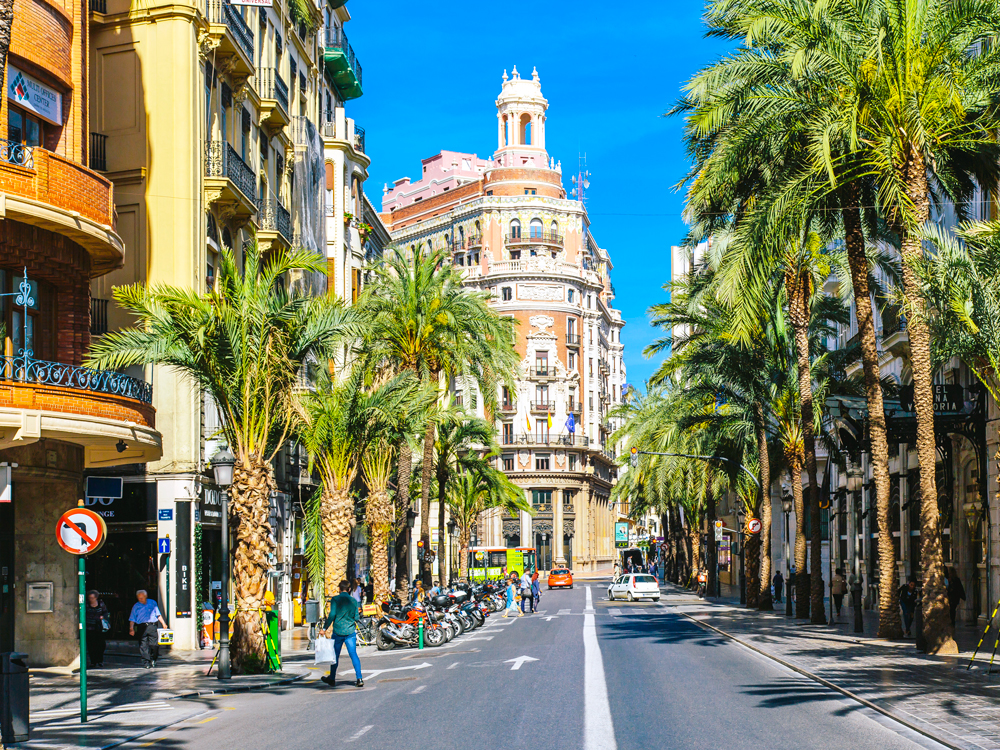
There are some places in the world you just have to see to believe, and Venice is near the top of the list. Its incredible architecture coupled with its precarious placement in the Laguna di Venezia make it a truly one-of-a-kind location — which is also part of a problem. Today, Venice is a victim of a phenomenon known as “overtourism,” where interested travelers overwhelm a location or populace. In the case of Venice, some 30 million tourists arrive at the city every year — sometimes staying just for the day — but the local population numbers only around a quarter million. To combat this, Venice’s municipal authorities announced a controversial plan: a €5 entry fee for day-trippers entering the city. 

American tourists outnumber that of any other country.

Ready to reveal?

Oops, incorrect!

It's a fib

Although the U.S. produces many tourists, China is by far the world’s leader. According to pre-pandemic data in 2017, some 87.8 million American tourists traveled abroad, whereas China sent nearly double that amount at 143 million (with the U.S. being a popular destination).

Although this makes Venice the first city in the world to charge an entry fee, overtourism has caused considerable damage to Venice — a city that also desperately needs to adapt to the growing threat of climate change. In 2021, Venice banned cruise ships from its city center due to extensive damage to the surrounding area, and UNESCO has previously threatened to list Venice as “at risk” due to poor preservation

The entry fee affects day-trippers over the age of 14 who are arriving at peak times of the year and are not staying in the city at night. The city’s councilor of tourism said the fee aims to “find a new balance between the rights of those who live, work, and study in Venice, and those who visit the city,” noting that Venice was “setting [itself] up as global frontrunners.” It remains to be seen if other victims of overtourism will join the race.

Numbers Don't Lie

Numbers Don't Lie

Number of islands that make up the entire city of Venice
118
Year Venice joined the Kingdom of Italy after being an Austrian possession
1866
Percent of Venice that was underwater during the 2019 flood, when tides were high
80
Distance (in centimeters) that St. Mark’s Basilica is above sea level, the lowest point in the city.
65

______ is widely regarded as the most-visited city in the world.

Ready to reveal?

Confirm your email to play the next question?

Hong Kong is widely regarded as the most-visited city in the world.

Placeholder Image

Some 11 million piles form the foundation of Venice.

How did early Venetians build an entire city on a lagoon? Carefully, and with some 11 million wooden piles (also called poles). The muddy lagoon that Venice calls home is incredibly soft ground incapable of supporting the weight of your average human, let alone the stone architectural wonders that fill the city. To fix this, Venetians forced millions of wooden piles made of oak, larch, and alder (which are known for being water resistant) into the mud. Packed tightly together, these wood piles had no access to air, which kept the wood from rotting, and the large amounts of silt and soil sped up the petrification process, turning the wood into something more akin to stone. Yet these piles don’t quite support the weight of Venice directly; instead, they compact the mud by forcing out water and making the ground stronger. Atop the piles, early Venetians placed wooden planks, limestone, and then bricks to support the weight of their beautiful — and immense — buildings.

Darren Orf
Writer

Darren Orf lives in Portland, has a cat, and writes about all things science and climate. You can find his previous work at Popular Mechanics, Inverse, Gizmodo, and Paste, among others.

Original photo by Iain Masterton/ Alamy Stock Photo

A sidetracked teenager changed the course of art history when she skipped an 1871 portrait-sitting. James McNeill Whistler (1834–1903) — a Massachusetts-born artist living in London — was commissioned to paint Maggie Graham, the 15-year-old daughter of a member of Parliament. Although James had prepared a canvas during his initial studio sessions with Graham, his creative process moved too slowly for her liking. When she failed to appear, James asked his mother, Anna McNeill Whistler, then living with him in London, to be his subject. 

Ready to reveal?

Oops, incorrect!

It's a fact

Rather than intentionally crafting a tender maternal tribute (he was more of a proponent of “art for art’s sake”), James focused on fine-tuning the saturation of select colors with “Arrangement in Grey and Black No. 1 (Portrait of the Artist's Mother).” Artistic circles adopted the shorthand “Arrangement in Grey and Black No. 1,” while the public preferred “Whistler's Mother.” Originally, the painting was somewhat divisive, receiving lackluster placement in the Royal Academy of Arts’ annual exhibition. But in 1891, the piece earned a place in history as the first artwork by an American to be bought by the French state, via the Musée du Luxembourg. During the Great Depression, the painting gained popularity on a 13-city U.S. tour; 1 million people visited it in Chicago alone. Back in Paris, the painting continued to relocate, becoming the Louvre’s first American painting in 1922 before the Musée d’Orsay’s 1986 acquisition. “Whistler’s Mother” has been called “the most important American work residing outside the United States.”

Numbers Don't Lie

Numbers Don't Lie

Height (in feet) of a statue of Anna McNeill Whistler in Ashland, Pennsylvania
8
Total area (in square feet) of “Arrangement in Grey and Black No. 1”
25
Age (in years) of Anna McNeill Whistler when she sat for the painting
67
Months it took Whistler to paint “Arrangement in Grey and Black No. 1”
3

“Whistler’s Mother” has a sister painting depicting the Scottish essayist and historian ______.

Ready to reveal?

Confirm your email to play the next question?

“Whistler’s Mother” has a sister painting depicting the Scottish essayist and historian Thomas Carlyle.

Placeholder Image

James McNeill Whistler won a lawsuit against an art critic who panned one of his paintings.

In the summer of 1877, the famed British critic John Ruskin encountered Whistler’s “Nocturne in Black and Gold, The Falling Rocket” at London’s Grosvenor Gallery. The oil painting was a lush, abstract vision of a fireworks show in Cremorne Gardens, overlooking the Thames River. That July, Ruskin — a painter himself — shared his opinion of the work in his periodical Fors Clavigera: “I have seen, and heard, much of Cockney impudence before now; but never expected to hear a coxcomb ask two hundred guineas for flinging a pot of paint in the public’s face.” Whistler, who was in serious debt, responded by suing Ruskin for libel; excerpts from the two-day trial found their way into Whistler’s 1890 book The Gentle Art of Making Enemies. Despite emerging victorious, Whistler received far less than the £1,000 and court costs he requested: just a single farthing, the smallest coin denomination, worth 1/48 of a shilling. The lawsuit plunged Whistler further into bankruptcy, yet he kept the farthing on his watch chain for the rest of his life. “Nocturne in Black and Gold, The Falling Rocket” now belongs to the Detroit Institute of Arts.

Interesting Facts
Editorial

Interesting Facts writers have been seen in Popular Mechanics, Mental Floss, A+E Networks, and more. They’re fascinated by history, science, food, culture, and the world around them.