
Original photo by Ara Barradas/ iStock

The human body is an amazing powerhouse fueled by important organs like the heart, lungs, and brain. However, some of its most vital work is done by a body part you might not expect — our taste buds, a set of microscopic organs that do more than help us savor our food. Scientists believe human taste buds also have a bigger purpose: protecting us from poisoning. These microscopic sensors tell our brains that food is safe to eat based on flavor, encouraging us to consume sweets (potential sources of calories and energy) and alerting us to spit out bitter or unpalatable substances that could make us sick. 

You might like (or dislike) foods based on your genes.

Ready to reveal?

Oops, incorrect!

It's a fact

Food preferences are tied to culture and exposure, but scientists believe genetics may also play a role. Mutations in the DNA that power taste receptors can impact how taste buds perceive sweetness, bitterness, and even the flavor of coffee, cilantro, and other foods.

Taste buds are such hardworking organs that their cells die off quickly. As they work, they age and lose sensitivity, which is why the body regenerates them about every two weeks. However, taste buds aren’t all replaced at once; on any given day, about 10% of the sensors expire, while 20% to 30% are in the process of developing, leaving us with 60% of the buds active to analyze the food we consume. 

Want to examine your taste buds? Contrary to popular belief, it’s not as easy as sticking out your tongue. That’s because the visible bumps aren’t sensors themselves; instead what you see are the papillae, which cover the taste buds. Each papillae can house hundreds of taste sensors, with the average adult having between 2,000 and 10,000 — a number that generally decreases with age. However, there’s one upside to losing some taste sensitivity as we get older: Foods we once avoided in childhood, like Brussels sprouts, become a bit more palatable.

Numbers Don't Lie

Numbers Don't Lie

Percentage of Americans who are supertasters, aka people with elevated taste bud sensitivity
25%
Year umami flavor was “discovered” by Japanese chemist Kikunae Ikeda
1908
Reduction in taste bud sensitivity to sweet and salty foods when on a flight
30%
Average age when taste buds become less sensitive, causing some taste loss
60

Catfish have taste buds on their ______.

Ready to reveal?

Confirm your email to play the next question?

Catfish have taste buds on their whiskers.

Placeholder Image

Taste buds aren’t just on your tongue.

It makes sense that taste buds are generally found in our mouths; after all, they help encourage us to eat and can sense potential poisons. However, researchers have found that taste buds don’t just exist on our tongues — they can be found all over the body in unexpected places. Taste buds can be found in our stomachs, and in 2007, researchers at Mount Sinai School of Medicine discovered sweet-sensing taste buds inside the intestines. It’s believed that those sensors monitor glucose and help the body control blood sugar. Taste buds also exist in the muscled walls of our lungs, where they work to protect breathing; upon sensing a bitter substance, the taste buds tell the body’s airway to open, a breakthrough some researchers say could be used to develop more effective asthma medications.

Nicole Garner Meeker
Writer

Nicole Garner Meeker is a writer and editor based in St. Louis. Her history, nature, and food stories have also appeared at Mental Floss and Better Report.

Original photo by Viktollio/ Shutterstock

Fire seems intrinsically linked to life on Earth. The fires of the Earth’s molten core formed the land we live on, forests are at their healthiest when they burn in a controlled manner to make way for new life, and even the legendary R&B group Earth, Wind & Fire paid homage to the stuff. In fact, Earth is the only place we know of where fire occurs. That’s because fire requires three things to exist: heat, oxygen, and combustible material. This “fire triangle” is only possible on Earth, as far as we know, because of the planet’s high levels of free oxygen. Travel to other planets and moons in the solar system, and there isn’t enough (or any) oxygen for fire to exist. As for the sun, which some people imagine as a giant ball of fire, it’s actually a giant collection of gas that glows thanks to the complex nuclear fusion occurring in its core. 

Humans discovered fire 20,000 years ago.

Ready to reveal?

Oops, incorrect!

It's a fib

Fire has been a constant companion for Homo sapiens. Scientists estimate that widespread fire use is generally found in the fossil record some 200,000 years ago, but evidence from a few archaeological sites pushes that back to 500,000 years or more.

While fire may not exist in any other place in the solar system (as far as we’re aware), that doesn’t mean humans can’t export the stuff. NASA has experimented with fire in microgravity for more than a decade — both to discover its behavior and also design fire-resistant space material. Turns out fire in microgravity behaves much differently, appearing more sluggish (likely due to low oxygen) and forming strange, orb-like flames. So while it’s not impossible for fire to exist beyond the confines of Earth, it’ll need a lot of help from future astronauts to export it to the moon, Mars, and beyond.

Numbers Don't Lie

Numbers Don't Lie

Year the U.S. Forest Service introduced Smokey Bear to promote fire prevention
1944
Degrees (Fahrenheit) the hottest part of a candle flame can reach
2,552
Maximum loudness (in decibels) of a typical fire alarm; about as loud as a chainsaw
120
Number of books lost when the Library of Alexandria caught fire, according to Roman philosopher Seneca
40,000

The U.S.’s first volunteer firefighting service was created by founding father ______.

Ready to reveal?

Confirm your email to play the next question?

The U.S.’s first volunteer firefighting service was created by founding father Benjamin Franklin.

Placeholder Image

The hottest place ever recorded on Earth was seven times hotter than the sun.

Human control of fire has come a long way since its ancient origins, and today scientists are hard at work trying to recreate the very plasma that fuses at the center of the sun. Known as nuclear fusion reactors, these incredibly complex machines could help humanity kick its diet of fossil fuels while simultaneously providing nearly limitless, clean energy. Fusion reactors do this by recreating the physics at the center of stars, but because Earth isn’t nearly as dense as a star, scientists must make machines that can get really, really hot. This heat helps particles overcome their natural resistances and fuse, forming a new element while releasing lots of energy. In 2022, a fusion reactor in South Korea recorded a scorching temperature of 100 million degrees Celsius, seven times hotter than the core of the sun. This reaction lasted for only 30 seconds, but within that half-minute, that terrestrially bound mini star was the hottest place ever recorded on Earth. This is only the beginning of how hot things will get — scientists estimate that when the International Thermonuclear Experimental Reactor, the world’s largest fusion reactor, goes online in 2025, it’ll eventually reach temperatures of 150 million degrees Celsius.

Darren Orf
Writer

Darren Orf lives in Portland, has a cat, and writes about all things science and climate. You can find his previous work at Popular Mechanics, Inverse, Gizmodo, and Paste, among others.

Original photo by LHBLLC/ Shutterstock

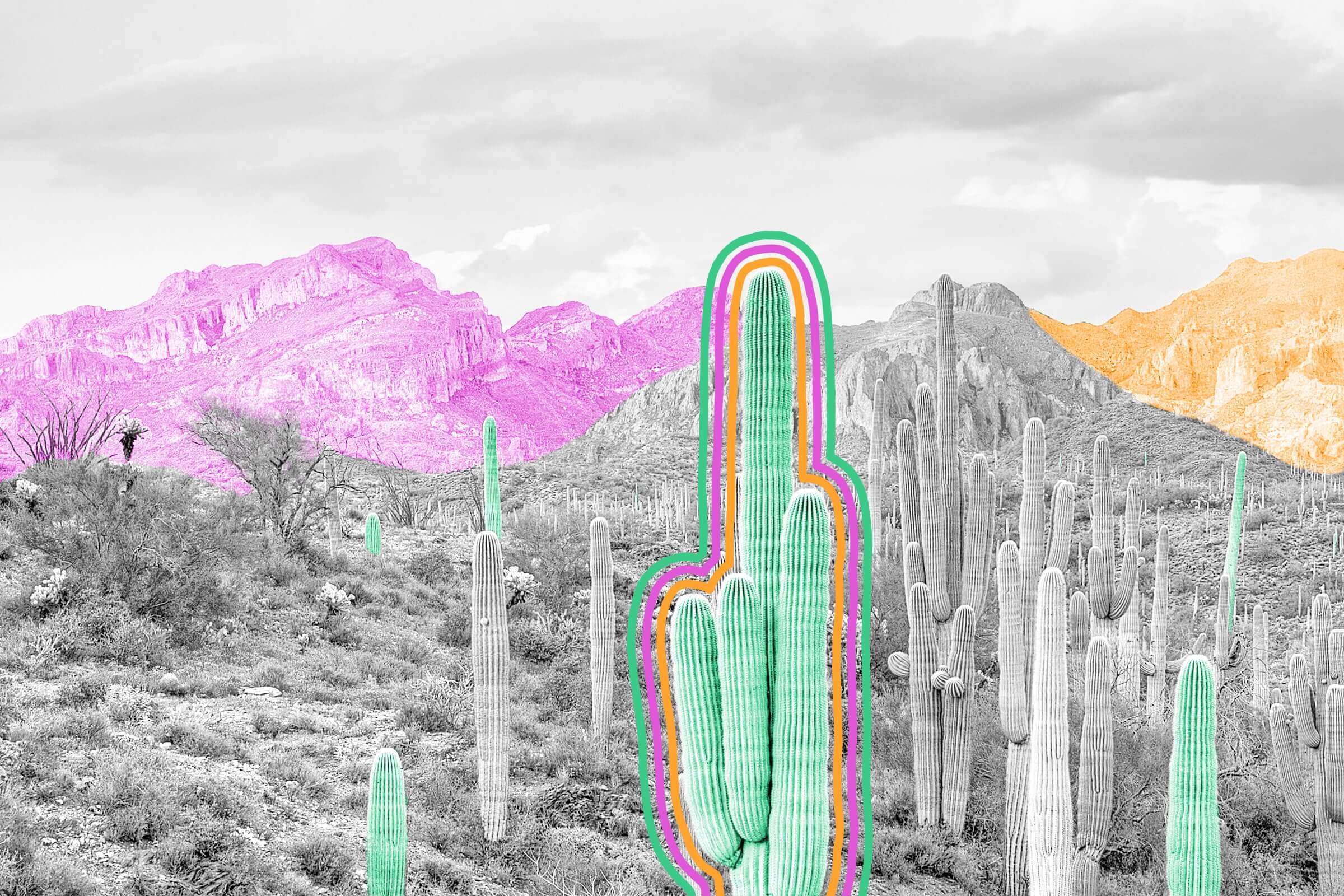
It’s not easy to be a cactus — surviving in a scorching environment with little water is a pretty tough task for most plants. Some cacti, like the saguaro, have adapted by taking their sweet time to grow. In fact, saguaro cacti often reach just 1.5 inches in the first 10 years of their lives. Growing their iconic arms — often featured in old Western films and desert art landscapes — can take 50 years, or even up to 100 years in drought-like conditions.

Many saguaros do not flower until they reach 35 years old. And although they produce some 40 million seeds over their lifetime, odds are that just one of their cacti descendants will survive to adulthood after battling arid conditions, trampling, human interference, and invasive species that threaten their environments. Reaching their maximum size — upwards of 45 feet tall and more than 2 tons in weight — can take 175 to 200 years, close to the end of a saguaro’s lengthy lifespan. But there is perhaps one consolation involved in that long journey: Saguaros are the largest cactus species in the U.S.

All cacti have prickly spines.

Ready to reveal?

Oops, incorrect!

It's a fib

As a whole, cacti are known for their signature spines, but not all species have them. Some — like peyote or the Christmas cactus (often grown as a houseplant) — are entirely spineless.

These slow-growing giants are found wild only in the Sonoran Desert, which stretches from southeastern California across southwestern Arizona and into Mexico. Despite their vulnerabilities, saguaro are important plants in the Sonoran ecosystem, providing fruit for birds, nectar for bats and other pollinators, and superb nesting spots for wildlife — which is why these colossal cacti are legally protected native plants in Arizona.

Numbers Don't Lie

Numbers Don't Lie

Height (in feet) of the largest recorded saguaro cactus
78
Estimated species of cacti globally
2,000
Species of cacti found wild outside the Americas
1
Diameter (in centimeters) of Blossfeldia liliputana, the world’s smallest cactus
2.5

The scientific name for the saguaro — Carnegiea gigantea — is named for philanthropist ______.

Ready to reveal?

Confirm your email to play the next question?

The scientific name for the saguaro — Carnegiea gigantea — is named for philanthropist Andrew Carnegie.

Placeholder Image

There’s a special census for saguaro cacti every 10 years.

How do scientists know how many saguaros exist in the U.S.? Turns out, they count and record them, in a fashion similar to how the federal census estimates the nation’s population of humans. Scientists at Saguaro National Park in Arizona first began the cactus count in 1990 as a way to track species health and numbers, syncing the enumeration with the federal census. Every 10 years, scientists and volunteers count the number of cacti in randomly selected areas of the park to calculate how many saguaro likely exist in the preserve as a whole. The work is labor-intensive, requiring census-takers to hike to desolate areas of the park and record each cactus’ GPS coordinates, height, number of arms, and other information. In 2020, that work totaled more than 3,500 hours from staff and a group of more than 500 volunteers. The most recent report shows the saguaro population nearly doubled from the 1990 count, totaling around 2 million in 2020, though it’s possible up to 20% of baby saguaro could be missed, since they’re so small and difficult to spot.

Nicole Garner Meeker
Writer

Nicole Garner Meeker is a writer and editor based in St. Louis. Her history, nature, and food stories have also appeared at Mental Floss and Better Report.

Original photo by Zoonar GmbH/ Alamy Stock Photo

Baseball, apple pie, and shopping — all three are American favorites. So it may be a bit surprising that one of the country’s largest shopping destinations is overseen by our neighbors to the north. That’s right: The Mall of America is owned by Canadians. Despite its name, the supersized shopping complex — found just outside Minneapolis in Bloomington, Minnesota — was developed by the Triple Five Group, a Canadian retail and entertainment conglomerate. Notably, while the Mall of America is truly humongous, it was once surpassed in sheer size by the West Edmonton Mall, a Canadian shopping center built by the same company in the 1980s, which reigned for decades as the largest mall in North America.

There’s no heat in the Mall of America.

Ready to reveal?

Oops, incorrect!

It's a fact

Imagine heating a building the size of nine Yankee Stadiums. The astronomical cost is one reason the Mall of America doesn’t have central heating. Instead, the shopping complex remains a balmy 70 degrees thanks to 1.2 miles of skylights, warmth from store lights, and human body heat.

Managing a shopping center of such gargantuan size is no small feat. Initial construction on the 4.2 million-square-foot Mall of America, located on the site of the former Minnesota Twins and Vikings stadium, took three years. When the doors opened in 1992, the space contained 330 stores and was staffed by an estimated 10,000 employees. In the decades since, the entertainment destination has grown, increasing to 5.6 million square feet and stuffed with 520 stores and 60 restaurants. For those who aren’t into shopping, there’s more to do than just wait around in the food court — today, the Mall of America is home to a 13-screen movie theater, an indoor theme park, a mini-golf course, and the largest aquarium in the state of Minnesota.

Numbers Don't Lie

Numbers Don't Lie

Live plants inside the Mall of America, along with 300 real trees, used for air purification
30,000
Number of shoppers who entered the mall on its opening day in 1992
150,000
Visitors to the mall each year, generating around $2 billion in sales
40 million
Number of parking spaces at the Mall of America
12,750

The world’s largest mall by total area, featuring more than 1,200 shops, is in ______.

Ready to reveal?

Confirm your email to play the next question?

The world’s largest mall by total area, featuring more than 1,200 shops, is in Dubai.

Placeholder Image

You can shop at a mall in Turkey that’s more than 500 years old.

While it may not have an Auntie Anne’s, the Grand Bazaar in Istanbul offers an eclectic mix of goods and snacks — after all, it’s known for being one of the world’s largest covered markets. It’s also considered one of the earliest shopping malls, with more than 4,000 stores, its own post office, and its own police station, making it essentially a miniature city. Construction on the mall, which stretches across Istanbul’s historic center, began in the 1450s. The dedication across the centuries to completing the trading space was for good reason — it became a major hub for Ottoman Empire merchants, in part because Istanbul geographically links the Asian and European continents. In its 500-plus years, the Grand Bazaar has survived calamities such as fires and earthquakes, and it remains a destination for modern shoppers from around the globe.

Nicole Garner Meeker
Writer

Nicole Garner Meeker is a writer and editor based in St. Louis. Her history, nature, and food stories have also appeared at Mental Floss and Better Report.

Original photo by Savvapanf Photo/ Shutterstock

"Thirty Days Hath September" may be a useful mnemonic device, but there are times when that poem might have led you astray. In 1752, September was only 19 days long in the U.K., due to the Calendar (New Style) Act of 1750. That parliamentary move transferred the country from the Julian calendar to the Gregorian calendar — the former having overestimated each year's length by about 11 minutes.

Back in 1582, Pope Gregory XIII had declared that all countries under the dominion of the Catholic Church needed to adopt the Gregorian calendar, but many Protestant nations — such as England — resisted the pope's demands. During the 18th century, as international trade and diplomacy increased, Britain and its colonies began to view the adherence to a now-antiquated Julian calendar — first implemented in Rome by Julius Caesar in the first century BCE — as more spiteful than practical. When the U.K. finally converted to the Gregorian calendar in 1752, they jumped straight from September 2 to September 14, skipping the 11 days in between to make up for the errors of the Julian calendar. Though protests against the law arose among some anti-reformers — who purportedly rallied behind the slogan "Give us back our 11 days!" — the calendar was adopted without any further delay. 

New Year's Day used to occur in March.

Ready to reveal?

Oops, incorrect!

It's a fact

The Babylonians of ancient Mesopotamia celebrated the new year in March, because the holiday was tied to the vernal equinox. The concept of a January 1 new year was introduced by the Romans in 153 BCE, though that date wasn't adopted globally until Pope Gregory's reforms in 1582.

Eastern Orthodox nations, such as Russia and Greece, also initially resisted the papal decree, waiting to transition to the Gregorian calendar until 1918 and 1923, respectively. By then, so much time had passed that those two countries skipped 13 days to bring their calendars up to speed. Russia's stubbornness also affected Alaska — upon being sold to the U.S. in 1867, the former Russian territory leapt straight from October 6 to October 18.

Numbers Don't Lie

Numbers Don't Lie

Days in the longest recorded year in history (46 BCE)
445
Fastest time (in minutes) to eat all the chocolates from an advent calendar
1:27:84
Times the Earth, Wind & Fire song “September” went platinum
6
Year Batman’s nemesis Calendar Man first appeared in the comics
1958

Prior to being named for Julius Caesar, July was once known as ______.

Ready to reveal?

Confirm your email to play the next question?

Prior to being named for Julius Caesar, July was once known as Quintilis.

Placeholder Image

Kodak used to operate on a 13-month calendar.

The concept of a 13-month, 28-day-per-month calendar is known as the International Fixed Calendar. The idea was proposed by statistician and railway adviser Moses B. Cotsworth in 1902, and was seriously considered for adoption by the League of Nations in the 1920s. This 13-month calendar introduced a new month named Sol, which fell between June and July, and also featured an extra holiday falling on the final day of the year, known as “Year Day.” Though never officially used by any country, it was highly popular with Kodak founder George Eastman — so much so that his company utilized it beginning in 1928. Eastman went on to open an office for the International Fixed Calendar League in Kodak’s Rochester headquarters. Unfortunately for Kodak, the calendar failed to catch on, and the company ultimately gave up the concept in 1989.

Bennett Kleinman
Staff Writer

Bennett Kleinman is a New York City-based staff writer for Inbox Studio, and previously contributed to television programs such as "Late Show With David Letterman" and "Impractical Jokers." Bennett is also a devoted New York Yankees and New Jersey Devils fan, and thinks plain seltzer is the best drink ever invented.

Original photo by Ng Wai Lam/ Shutterstock

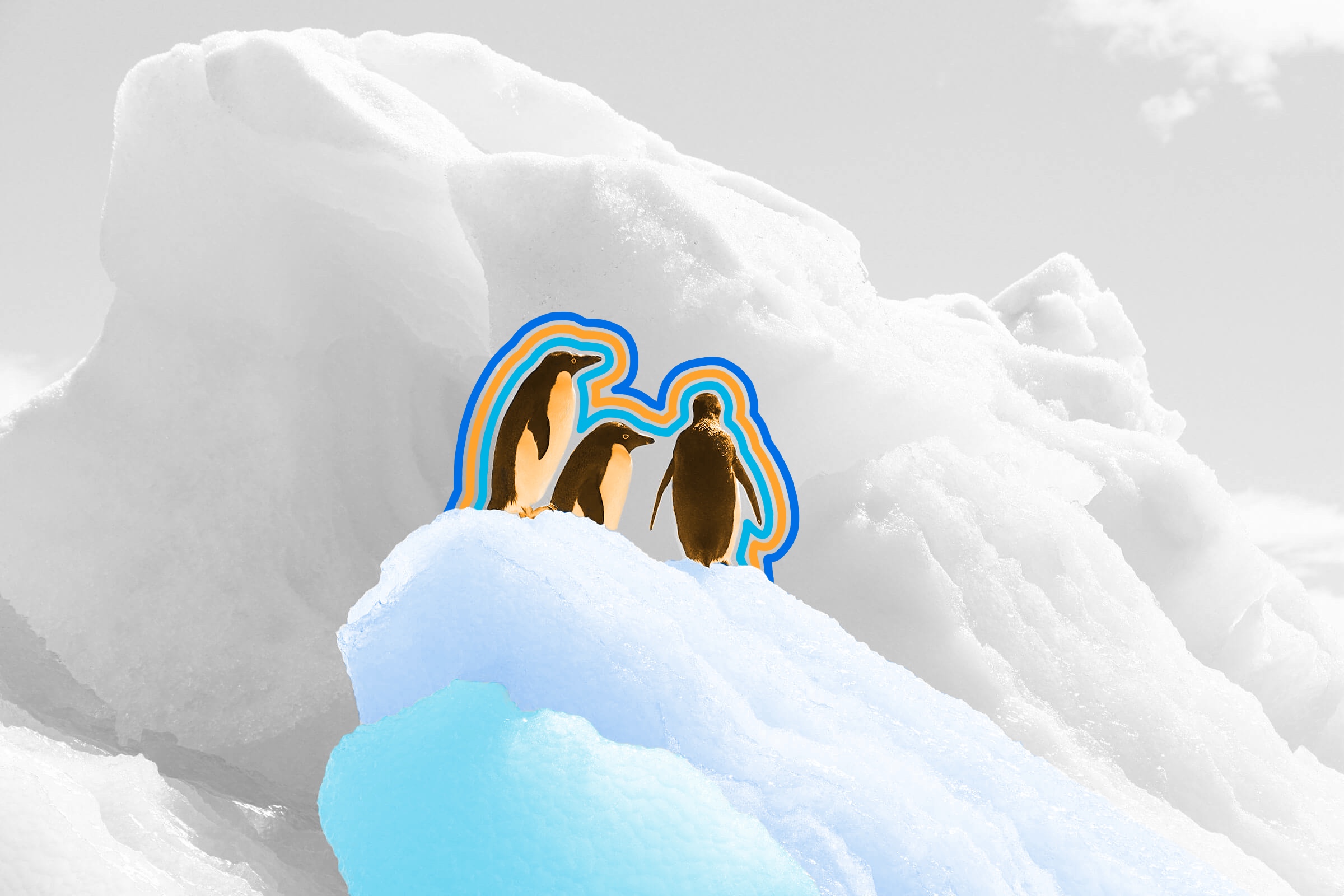
Antarctica is best known as the barren southernmost continent, home to glistening glaciers and snow-packed peaks that never seem to melt. But despite being surrounded by an endless supply of frozen water, the coldest continent on Earth is also one of the driest — so dry, in fact, it’s technically considered a desert.

Although the parched landscapes of Death Valley or the Sahara may spring to mind when we visualize a desert, the ecosystem classification has more to do with precipitation than temperature. True deserts typically receive less than 9.8 inches of rainfall per year. Antarctica, which averages just 2 inches of annual precipitation, meets this definition; at 5.5 million square miles, it reigns as the world’s largest and coldest desert. In comparison, Africa’s Sahara desert — the world’s largest hot desert — spans just 3.6 million square miles; its dusty sand dunes receive about an inch more rainfall than Antarctica does per year.

You can buy land in Antarctica.

Ready to reveal?

Oops, incorrect!

It's a fib

You can explore Antarctica as a tourist, but owning a chunk of land on the southernmost continent is impossible. The Antarctic Treaty, signed by 56 countries since 1959, bans ownership of the landmass, and requires it to be used only for “peaceful purposes.”

Antarctica’s harsh climate doesn’t equally share its annual allotment of rain, and some areas are practically devoid of showers. The McMurdo Dry Valleys, a snow-free region located west of the McMurdo Sound, are considered one of the driest places on Earth. Some researchers believe the flat-topped hills haven’t seen measurable precipitation or flowing water in 14 million years — an extreme drought that’s unlikely to end any time soon thanks to the placement of nearby mountains, freezing temperatures, and unforgivingly strong winds that can reach up to 200 miles per hour.

Numbers Don't Lie

Numbers Don't Lie

Year that two different expedition groups claimed to catch the first glimpse of Antarctica
1820
Length (in miles) of the Lambert Glacier, the world’s longest, found in Antarctica
250
Species of land mammals that live on Antarctica
0
Tourists who visited Antarctica in the 2022-2023 season, compared to 56,000 in 2019
105,000

Scientists estimate that 70% of Earth’s ______ can be found in Antarctica.

Ready to reveal?

Confirm your email to play the next question?

Scientists estimate that 70% of Earth’s fresh water can be found in Antarctica.

Placeholder Image

Antarctica has a red waterfall.

Photos of Antarctica may trick you into believing the icy continent exists in shades of only blue and white, but a 1911 discovery of a red waterfall proves otherwise. Around 112 years ago, Australian geologist Griffith Taylor came across an Antarctic waterfall spewing blood-red water from deep within a glacier. Taylor believed the red water was caused by red algae, though this theory was later debunked. The rust-colored water in what’s now known as Blood Falls actually stumped scientists for the better part of a century, until water samples suggested that iron might be the cause. The saline brine feeding the falls — a liquid so salty it is incapable of freezing — is rich with the mineral. When the brine emerges from the falls and is exposed to oxygen, it immediately oxidizes, turning its red hue — a not-so-scary explanation for one of nature’s more intriguing phenomena.

Nicole Garner Meeker
Writer

Nicole Garner Meeker is a writer and editor based in St. Louis. Her history, nature, and food stories have also appeared at Mental Floss and Better Report.

Original photo by mikkelwilliam/ iStock

Time seems like a simple enough concept — 60 seconds in a minute, 60 minutes in an hour, and so on. That is, except for a little something called “gravitational time dilation.” First explored in Albert Einstein’s general theory of relativity, the idea is almost confusingly simple — the farther away you are from a massive object (e.g., a planet), the faster time travels. The more massive the object, the slower time travels, which is why things get very wonky around supermassive black holes like the one at the center of our galaxy. 

Albert Einstein first proposed the idea of time travel.

Ready to reveal?

Oops, incorrect!

It's a fib

The concept of time travel was popularized by early science fiction. The first mention of it (at least as a voyage controlled by technology) comes from H.G. Wells, whose 1895 novel “The Time Machine” was published years before the arrival of Einstein’s famous theory of relativity.

These differences in how time flows are minuscule on Earth, so they don’t really affect us — the top floor of the Burj Khalifa, the world’s tallest building, does not operate with a special time-dilated clock. Yet technically, even our heads experience time just a bit differently than our feet. In 2010, the U.S. National Standards and Technology (NIST) even performed an experiment using optical atomic clocks that could measure a change in time dilation within less than 1 meter. 

Although imperceptible to our minds, precision technologies such as GPS need to factor in time dilation in order to work at all. So the next time you use Google Maps, consider giving a shout-out to Einstein and his mind-bending theory of the universe. 

Numbers Don't Lie

Numbers Don't Lie

Speed (in mph) Doc Brown’s DeLorean needs to reach before traveling through time in “Back to the Future”
88
Speed of light (in miles per second), which makes for an eight-minute journey from the sun to Earth
186,000
Year Stephen Hawking’s “A Brief History of Time” was published
1988
Number of satellites in the Global Positioning System constellation
31

The massive object at the center of our galaxy is a supermassive black hole named ______.

Ready to reveal?

Confirm your email to play the next question?

The massive object at the center of our galaxy is a supermassive black hole named Sagittarius A*.

Placeholder Image

Scientists used a total solar eclipse to prove Einstein’s general theory of relativity.

Today Albert Einstein is known best for his general theory of relativity, a conception of gravity that revolutionized physics. But when he published the theory in 1916 in the German science journal Annalen der Physik, the idea got its fair share of pushback. At the time, Einstein wrote, “Every coachman and every waiter is debating whether relativity theory is correct. Belief in this matter depends on political affiliation.” Then came Arthur Eddington, a British astronomer, who conducted an amazing experiment only months after World War I ended. On May 29, 1919, Eddington observed a solar eclipse — more specifically, a star cluster called Hyades in the Taurus constellation visible during the darkness of totality — to see how the starlight was affected by the sun’s mass. After spending months crunching the numbers, Eddington proved Einstein correct; the starlight had been bent in the manner he predicted. The German physicist soon became a scientific rock star the world over, and our perception of the universe was never the same.

Darren Orf
Writer

Darren Orf lives in Portland, has a cat, and writes about all things science and climate. You can find his previous work at Popular Mechanics, Inverse, Gizmodo, and Paste, among others.

Original photo by Chronicle/ Alamy Stock Photo

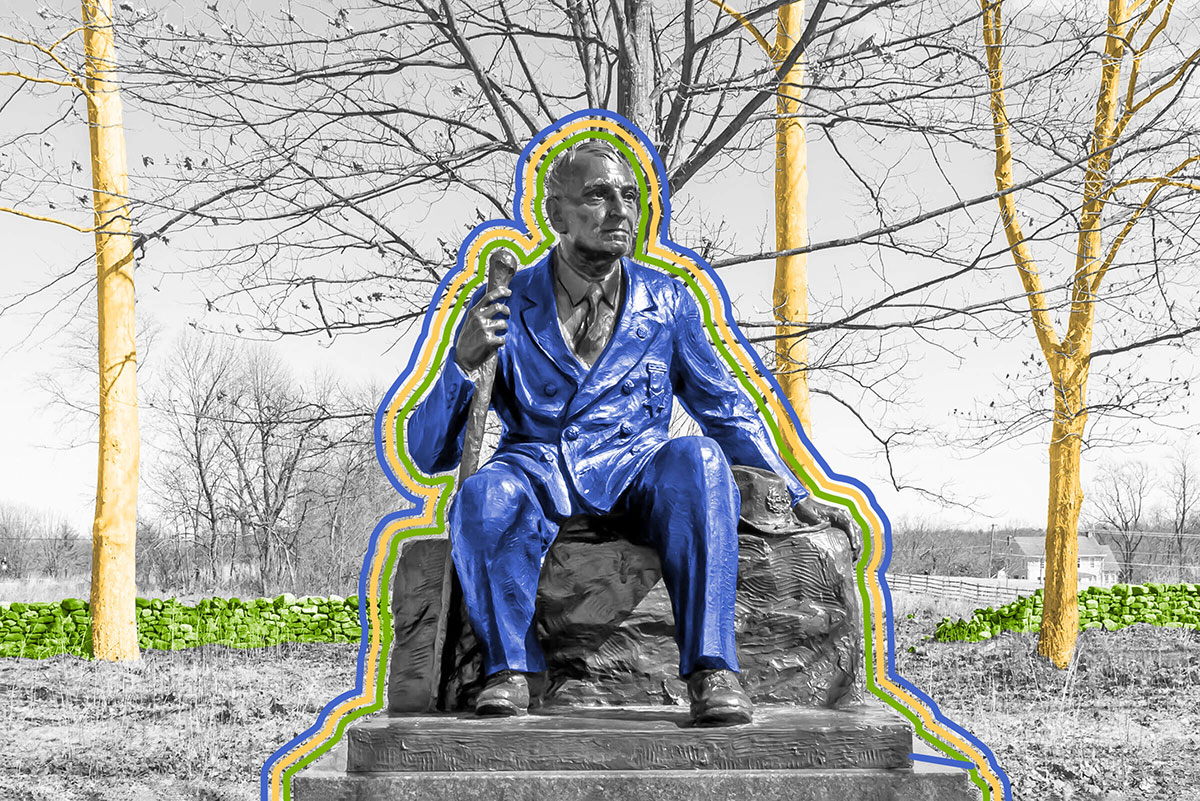
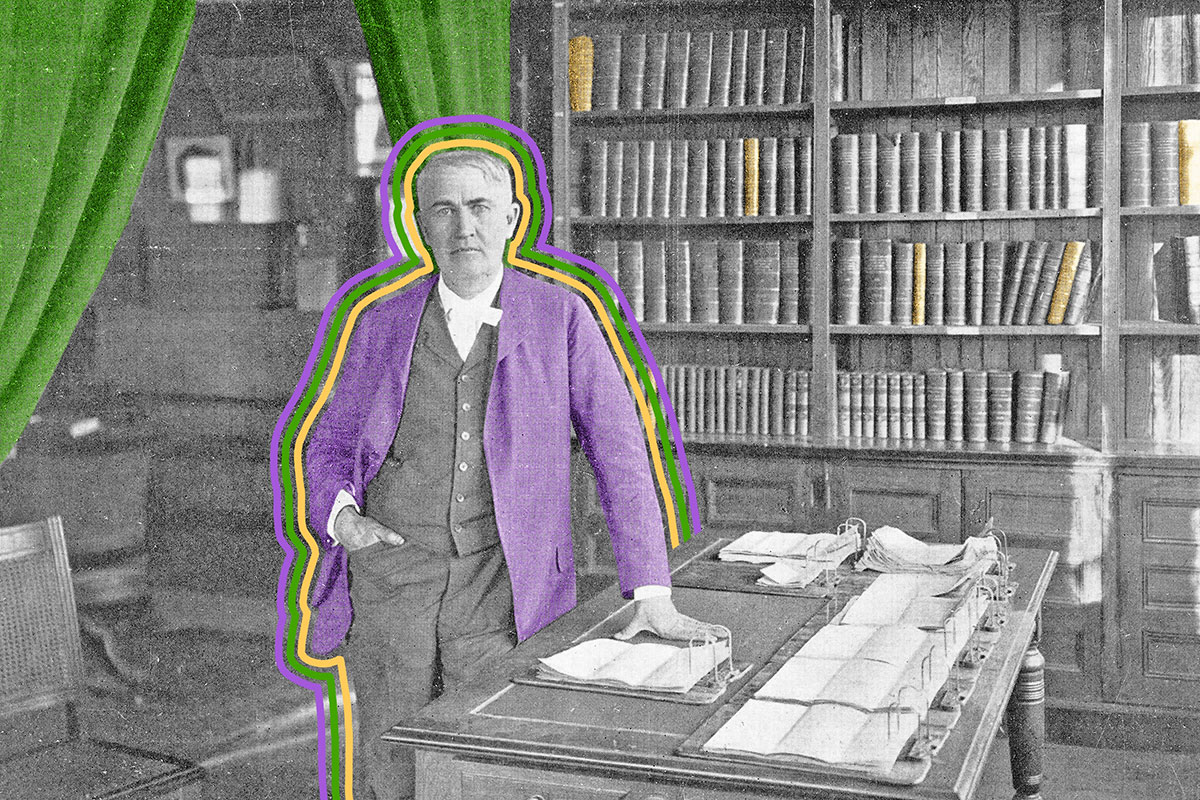
Not everyone gets to meet their idols. Henry Ford, one of America’s manufacturing greats, did — and was even lucky enough to become friendly with his hero. The automobile creator long looked up to serial inventor Thomas Edison, and in 1891, toward the start of his career, landed a job as a night engineer at the Edison Illuminating Company in Detroit. Eventually, the two inventors crossed paths at a work party, where Edison supposedly inspired Ford to further pursue his experimental automobiles. Ford had recently created his first prototype, the Ford Quadricycle, and eventually left the company to work on prototypes that became the Model T. But that wasn’t where their relationship ended — Edison and Ford quickly became friends, corresponding regularly, dedicating speeches to one another, and even purchasing neighboring estates in Florida. So it’s no surprise that the Henry Ford Museum in Dearborn, Michigan, features artifacts from both inventors, though some are unusual — such as a test tube that supposedly contains Edison’s final breath.

Thomas Edison invented the incandescent lightbulb.

Ready to reveal?

Oops, incorrect!

It's a fib

Credit for Edison’s best-known invention is somewhat misplaced; he did make improvements to the incandescent bulb, but he didn’t create it. Inventors tinkered with the bulbs for at least 40 years before Edison received his patent, which added bamboo filaments to help bulbs last longer.

Legend has it that Ford, who had an eccentric bent and was interested in life after death, obtained the vial by asking Edison’s son Charles to capture his dear friend’s final breath. However, that tale is a bit hyperbolic. Historians believe that the tube was actually given to Ford as a sentimental gesture in honor of his friend. According to a letter written by Charles Edison in 1953, a set of empty test tubes was close to his father’s death bed when the inventor died in 1931. Charles requested that the attending doctor seal the tubes with paraffin wax, potentially capturing his father’s last breaths, and later gifted one to Ford. The test tube at the Henry Ford Museum is not the only one of its kind — Edison’s estate includes a collection of 42 test tubes that supposedly contain the inventor’s final breath.

Numbers Don't Lie

Numbers Don't Lie

Year of Edison’s first patent for an invention, the electric vote recorder
1869
U.S. patents awarded to Thomas Edison
1,093
Year Ford left Edison’s company to launch the Ford Motor Company
1899
Times Henry Ford ran for public office, losing a 1918 race for U.S. Senate
1

Henry Ford once designed a plastic car made from ______.

Ready to reveal?

Confirm your email to play the next question?

Henry Ford once designed a plastic car made from soybeans.

Placeholder Image

Thomas Edison and Henry Ford once camped with a President.

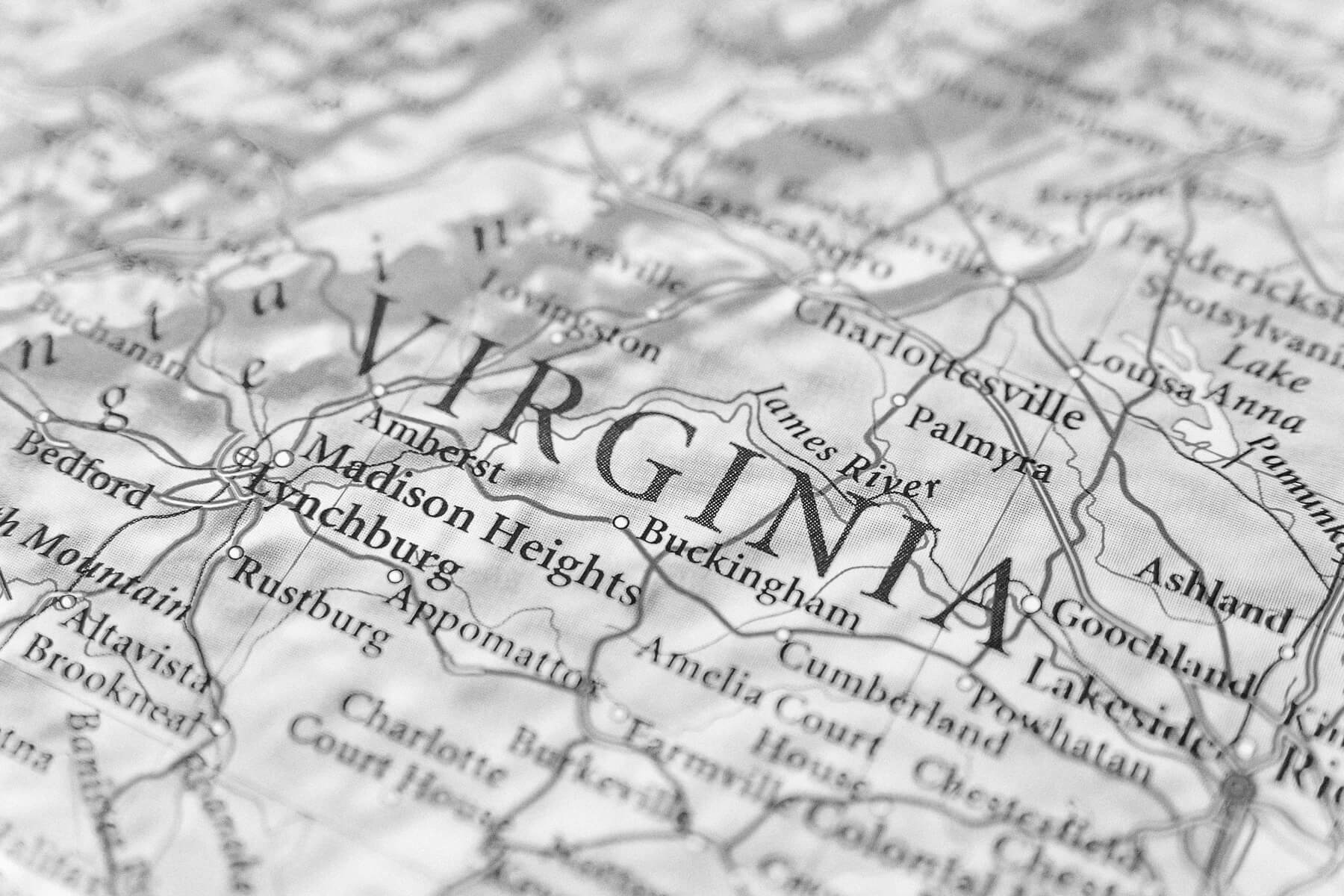
If you’ve ever hit the open road with your best friend, you might be more like Henry Ford and Thomas Edison than you know. Together with two other friends — naturalist John Burroughs and tire manufacturer Harvey Firestone — they set out on a series of summer camping trips. Between 1914 and 1924, the group (who called themselves “the Four Vagabonds”) trekked along the eastern coast, camping in the Adirondacks, Catskill Mountains, and throughout Virginia, Tennessee, and North Carolina, among other places. On one adventure in July 1921, the group (minus Burroughs) invited Warren G. Harding, then-sitting president of the United States, to camp in Maryland, in a spot the crew dubbed “Camp Harding.” However, the adventures of the Four Vagabonds weren’t just for fun; they were part of a media campaign that often depicted the businessmen as “roughing it” when in reality they often slept at hotels and had a large staff accompanying them to cook meals.

Nicole Garner Meeker
Writer

Nicole Garner Meeker is a writer and editor based in St. Louis. Her history, nature, and food stories have also appeared at Mental Floss and Better Report.

Original photo by Brett Sayles/ Pexels

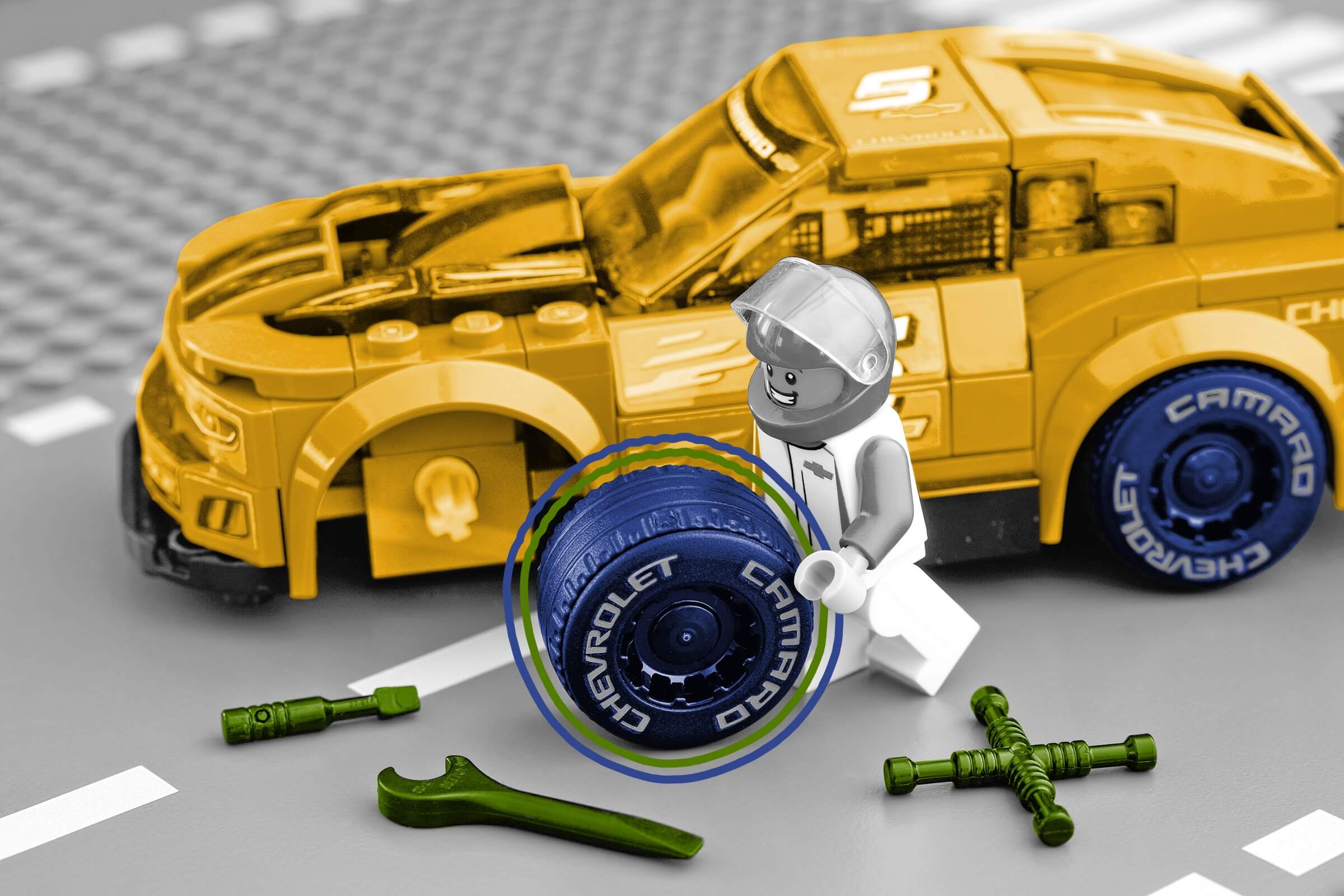
If you saw a Jeep with a rubber duck on its dashboard, you probably wouldn’t think anything of it — until you saw several other Jeeps with ducks on their dashboards, too. This quirky, quacky tradition, known as “Jeep ducking” or “Duck Duck Jeep,” started with one friendly Jeep owner placing a rubber duck on another Jeep. Like the “Jeep wave,” in which Jeep owners acknowledge one another on the road by waving with two or four fingers, the “Jeep ducking” tradition quickly caught on among Jeep fans.

Jeeps are known for having hidden Easter eggs in their design.

Ready to reveal?

Oops, incorrect!

It's a fact

Since 1997, Jeep has incorporated hidden design elements into its vehicles, including silhouettes of the brand’s iconic vehicle and grille, Morse code, animals, maps, and even a spider with a speech bubble that reads, “Ciao, Baby!”

The tradition was started in July 2020 by a Canadian Jeep owner named Allison Parliament. During the height of the COVID-19 pandemic, Parliament wanted to leave a note for the fellow owner of a Jeep Wrangler, but she didn’t have any paper on hand. She did, however, have a rubber duck. So she wrote a cheerful note — “Nice Jeep, have a great day” — on the duck, and placed it on the Jeep. When the Jeep’s owner caught her leaving the duck, he suggested they take a picture and post it on social media. The hashtag #DuckDuckJeep soon went viral as media outlets reached out to interview the woman behind the kind gesture, and the publicity spurred other Jeep owners to start exchanging ducks. Parliament’s spontaneous act of kindness started a trend that quickly spread throughout Canada and the United States, as well as dozens of other countries, including Australia, China, and India. Parliament passed away on June 22, 2024, but her joyful and spontaneous tradition lives on, continuing to connect Jeep enthusiasts worldwide.

Numbers Don't Lie

Numbers Don't Lie

Starting price for a Jeep Wrangler in 2024
$31,995
Percentage of Jeep owners who participate in ducking
20%
Weeks Jim Henson’s “Rubber Duckie” spent on the Billboard Hot 100 in 1970
7
Members in the Official Ducking Jeep Facebook group as of August 2024
80,000

______ is known as “Rubber City” because of its long history of rubber and tire manufacturing.

Ready to reveal?

Confirm your email to play the next question?

Akron, Ohio, is known as “Rubber City” because of its long history of rubber and tire manufacturing.

Placeholder Image

Rubber ducks were originally chew toys.

In the mid-19th century, Charles Goodyear’s innovative process of vulcanization made it possible to strengthen and waterproof rubber, transforming not only the automotive industry, but the toy industry as well. Toy manufacturers began producing a variety of rubber toys in different shapes, including the original rubber duck. But the first rubber ducks didn’t float, because they were made of solid rubber and intended as children’s chew toys. It wasn’t until the 1940s that Russian American sculptor Peter Ganine patented a design for an “uncapsizable duck,” which sold in the millions. His design evolved into the vinyl version of the classic yellow duckie we know today. 

Kristina Wright
Writer

Kristina is a coffee-fueled writer living happily ever after with her family in the suburbs of Richmond, Virginia.

Original photo by Evheniia Vasylenko/ iStock

Smell is one of humanity’s most important, and often overlooked, senses. It’s intimately tied to taste and memory, and plays a pivotal role in detecting danger, whether from fires or rotten food. It may even play a role in how we choose our mates.

One little-known aspect of smell is how it fluctuates throughout the day. According to research conducted by Brown University and published in the journal Chemical Senses in 2017, our sense of smell is somewhat regulated by our circadian rhythm, the internal biological process that regulates a human’s wake-sleep cycle. (If you’ve ever traveled across the ocean, the resulting jet lag is a disruption of this rhythm.)

Smell in humans begins declining after the age of 30.

Ready to reveal?

Oops, incorrect!

It's a fib

When we’re born, humans can only sense certain smells, such as a mother’s body. However, our sense of smell really takes off at the age of 8, and is usually stable until around age 50. After that, our nose powers decline, and drop off precipitously after the age of 70.

The Brown study analyzed 37 teenagers for a week, and measured their sense of smell against their levels of the sleep-inducing hormone melatonin. A rise in melatonin meant that the body’s nighttime circadian rhythm was kicking in, essentially saying, “It’s time to sleep.” The results showed that the teens’ sense of smell was at its highest in the evening, around 9 p.m., or what the researchers called the beginning of “biological night.” Conversely, their sense of smell was at its lowest between the hours of 3 a.m. and 9 a.m., when the body has little need for sniffing. Scientists can only guess at why the body kicks its olfactory receptors into high gear at 9 p.m. — it may help humans ensure satiety following the last meal of the day, scan for nearby threats before sleeping, or act as a means for encouraging that aforementioned mate choice.

Numbers Don't Lie

Numbers Don't Lie

Estimated percentage of people who are anosmic, meaning they have no sense of smell
5
Year the first modern perfume was created, for Queen Elizabeth of Hungary
1370
Estimated frequency (in days) at which human olfactory receptor cells are replaced
60
Years ago that olfactory receptors emerged in nature, in fishlike animals known as lancelets
550 million

The animal with the strongest sense of smell is the ______.

Ready to reveal?

Confirm your email to play the next question?

The animal with the strongest sense of smell is the African elephant (Loxodonta).

Placeholder Image

Humans are more sensitive than dogs when it comes to certain scents.

The human nose often takes a backseat to other famous sniffers in the animal kingdom. Dogs, pigs, and elephants have nasal biology jam-packed with olfactory receptors, which makes them particularly gifted at smelling scents. But no two odors are exactly alike, and research from Rutgers University argues that the human nose — with our measly 400 different kinds of olfactory receptors — can actually sniff out smells important to humans better than even the most skillful bloodhound. For example, human noses are more sensitive to amyl acetate, a main odorant found in bananas, because ripe fruit was important for our survival thousands of years ago. For dogs, finding such fruit was much less important, and thus biologically deprioritized. Human noses can also sniff out the smell of fresh rain on dirt, a scent known as “petrichor,” better than a shark can smell blood in the sea, likely due to our essential need for fresh water. So don’t write off your sense of smell — instead, take pride in what your nose knows.

Darren Orf
Writer

Darren Orf lives in Portland, has a cat, and writes about all things science and climate. You can find his previous work at Popular Mechanics, Inverse, Gizmodo, and Paste, among others.