
Although it may sound like something from the handbook of an oppressive regime, there are several generally tolerant countries that require parents to pick from a list of government-approved choices for baby names. Iceland, Denmark, Portugal, and Hungary are among these nations, although parents with a strong preference for something unique can apply for exceptions.
New Zealand's registrar-general once approved a request for the name "Number 16 Bus Shelter."
The news of this approval was revealed during a 2008 court case involving 9-year-old Talula Does The Hula From Hawaii, who was granted a pathway to changing her own unconventional name.
Other countries have no such lists, but possess rules about what falls within the boundaries of acceptability. In New Zealand, for example, the Office of the Registrar-General will reject names that reflect an official title (such as "King") or have nonnumerical or nonalphabetic characters (such as "/"). Germany's Standesamt will deny attempts to bestow the names of inanimate objects (e.g., "telephone") or common surnames on children. Saudi Arabia's interior ministry has banned names that contradict the kingdom's cultural sensibilities or are simply deemed "too foreign" (examples include names such as "Linda"). And the governments of numerous other countries, from Mexico and Australia to France and Italy, will step in to nix a moniker that could offend others or threaten a child's emotional well-being.
The United States isn't exempt from such oversight into family matters either, as there are naming restrictions in place that vary by state. Several states forbid obscene and derogatory names, and others prohibit the inclusion of numbers, symbols, or even accented letters (which means no way, "José"). A few have limits on the number of characters permissible in the full or individual first, middle, and last names. Otherwise, the land of the free largely lives up to its billing in the baby-naming department.
Since 2017, the most popular name for baby boys in the United States has been Liam.
Advertisement
Some popular names were invented by famous authors.
While many names in the Western world are drawn from traditional European choices and religious texts, others were spawned by the minds that composed some of our most treasured works. William Shakespeare is responsible for several, including Jessica from The Merchant of Venice. Jonathan Swift brought us Vanessa from his poem “Cadenus and Vanessa,” and Henry Wadsworth Longfellow did the same with the poem “Evangeline.” Partial credit goes to Johanna Spyri and J. M. Barrie, whose respective creations of Heidi and Wendy from Peter Pan gave life to stand-alone versions of existing nicknames. And while it’s a stretch to say that the title character of The Picture of Dorian Gray inspired a legion of like-named babies, Oscar Wilde at least deserves honorable mention for introducing that moniker to the public domain.

Interesting Facts
Editorial
Interesting Facts writers have been seen in Popular Mechanics, Mental Floss, A+E Networks, and more. They’re fascinated by history, science, food, culture, and the world around them.
Advertisement
top picks from the Inbox Studio network
Interesting Facts is part of Inbox Studio, an email-first media company. *Indicates a third-party property.
Original photo by Gergitek Gergi tavan/ Shutterstock
The sun is the most reliable way to create the gorgeous light display we call a rainbow, but it’s not the only way. After all, the moon illuminates the Earth, too — and rainbows are essentially an optical illusion caused when water droplets split light into its ROY G. BIV components. But seeing a “moonbow” isn’t exactly easy.
The moon experiences four types of moonquakes: deep moonquakes (likely caused by tides), meteorite impacts, thermal expansion when the moon’s frigid crust is warmed by the sun, and shallow moonquakes. This last type of moonquake can even top 5.5 on the Richter scale.
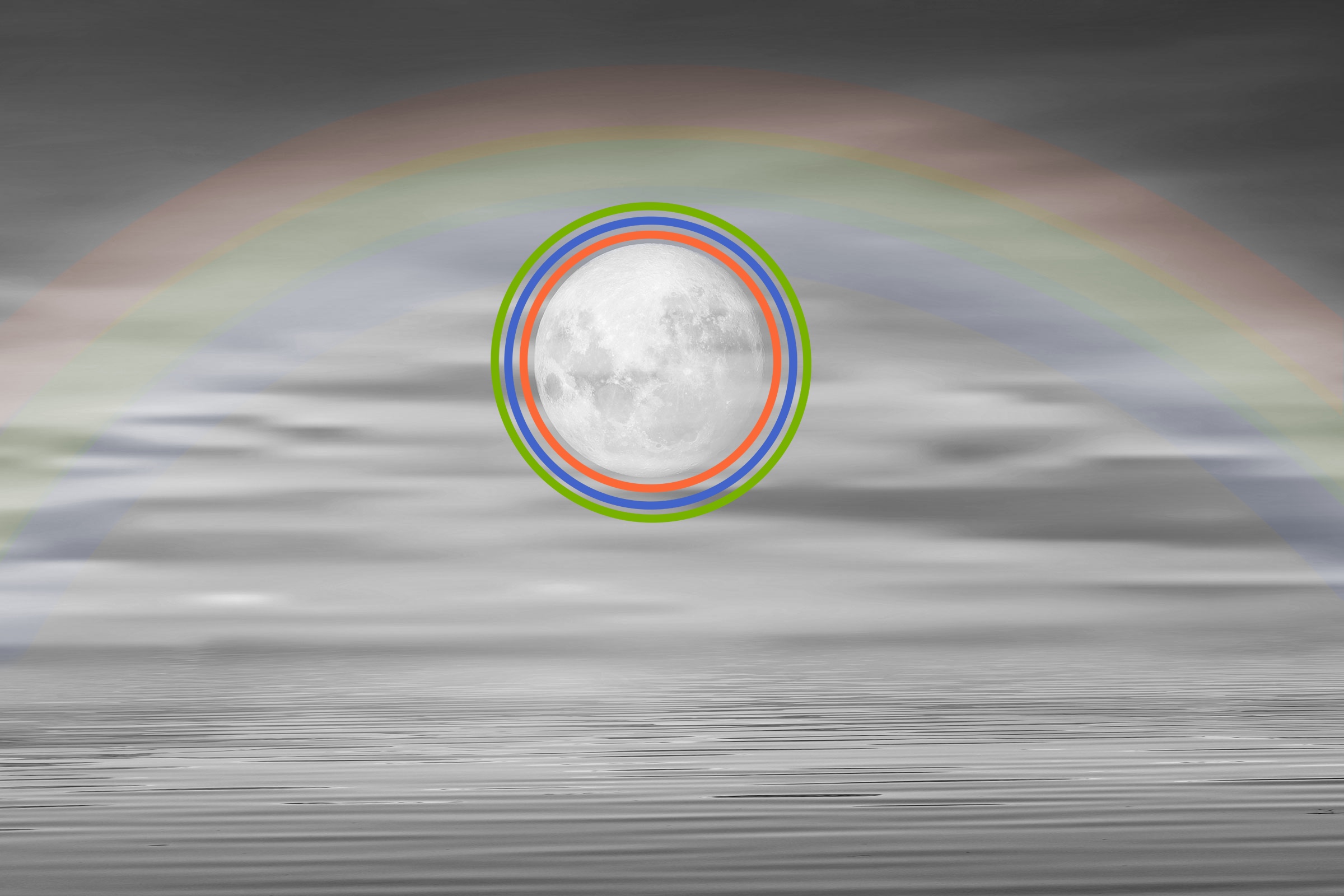
How rare is this nighttime meteorological phenomenon? Well, Aristotle wrote around 350 BCE in his treatise Meteorologica that “it was formerly thought that [rainbows] never appeared by night as a moon rainbow. This opinion was due to the rarity of the occurrence… we have only met with two instances of a moon rainbow in more than fifty years.” So, pretty rare. That’s because for a moonbow to form, you need a variety of conditions to be Goldilocks-level perfect. First, the moon must be low in the sky, and can’t exceed 42 degrees from the horizon. The moon must be full or near full, and you can’t be hanging around any artificial light — sorry, no moonbows in cities. Finally, just like rainbows, moonbows need water droplets in the atmosphere, so waterfalls are often a good spot to go hunting for moonbows. Just don’t expect to see the dazzling array of color typical of a daytime rainbow. Because the moon isn’t as bright as the sun, less light is refracted, and a moonbow usually looks white (at least to human eyes). But if you have a camera handy, long exposure photos will reveal a moonbow in all its colorful glory.
Hawaii is widely regarded as the “rainbow capital of the world.”
Advertisement
The song “Over the Rainbow” was almost cut from “The Wizard of Oz.”
Featured in the sepia-toned opening minutes of 1939’s The Wizard of Oz, the song “Over the Rainbow” is officially the greatest song of the 20th century — at least according to a 2001 survey by the Recording Industry Association of America. But for a song so beloved in the 85 years since its debut, it’s shocking to discover that Judy Garland’s legendary ballad was almost cut from the film. While considered by many to be one of the greatest films ever made, The Wizard of Oz experienced a famously “cursed” production, involving several directorial changes, dangerous stunt work, and more. After filming finally wrapped in 1939, MGM producers realized that the “curse” wasn’t lifted — the movie was a full half-hour too long. So top brass started cutting scenes with impunity, including whole dance numbers and even entire reprisals of “Over the Rainbow.” Still not satisfied with the running time, the executives even cut Dorothy’s original ballad in a June 16, 1939, preview of the film. Incensed by the decision, associate producer Arthur Freed told studio head Louis B. Mayer, “The song stays — or I go.” Mayer relented, and “Over the Rainbow” went on to delight audiences for nearly a century.
Interesting Facts
Editorial
Interesting Facts writers have been seen in Popular Mechanics, Mental Floss, A+E Networks, and more. They’re fascinated by history, science, food, culture, and the world around them.
Advertisement
top picks from the Inbox Studio network
Interesting Facts is part of Inbox Studio, an email-first media company. *Indicates a third-party property.
Space stretches out in all directions (at least as far as we can tell) for some 46 billion light-years, but it doesn’t take all that long to get to where it begins. In fact, if you had a car that could somehow drive skyward toward the Kármán line — the barrier that marks the beginning of space — you’d arrive there in little more than an hour (and that’s while cruising at a leisurely 60 mph). The Kármán line, named after Hungarian American physicist Theodore von Kármán, was set by the Fédération aéronautique internationale (FAI), a world governing body for air sports, and exists at 62 miles above sea level.
While the slice of the atmosphere where we live and breathe, called the troposphere, is warming, the stratosphere (the layer above the troposphere) is cooling. This is due to the troposphere trapping heat and the depletion of stratospheric ozone.
But Earth’s atmosphere doesn’t just abruptly end — it slowly fades away, making the definition of “space” a bit murky. NASA, for example, classifies anything 50 miles above sea level as space, even though the outermost layer of the Earth’s atmosphere, the exosphere, stretches much farther. In fact, the International Space Station (ISS) actually travels within the Earth’s thermosphere (the layer below the exosphere), at about 250 miles above sea level. But just because these areas are part of the Earth’s atmosphere doesn’t mean they can’t be considered space. Air density in the thermosphere and exosphere is so low, most agree that these regions contain essentially the same conditions as space. If you wanted to take your hypothetical space car completely beyond Earth’s atmosphere, all the way to the region known as “outer space,” it’d be an epic road trip to the end of the exosphere, some 6,200 miles from Earth.
The highest posted speed limit in the U.S. (85 mph) is in the state of Texas.
Advertisement
At sea level pressure, the ozone layer would be only 3 millimeters thick.
The ozone layer in the Earth’s atmosphere protects all life on Earth from harmful UV radiation. Without it, life on this planet simply wouldn’t be possible. The ozone layer is so important — and so fragile — that when scientists discovered a hole in the ozone layer over Antarctica in 1985, the world sprung into action to restrict the use of aerosols containing chlorofluorocarbons, or CFCs. Although described as a “layer,” the ozone is actually spread throughout the lower atmosphere, reaching peak concentrations around the 16-mile altitude mark. The ozone is measured using Dobson units, named after Oxford University meteorologist Gordon Dobson, who devised a method to measure ozone in a column of air if it was squeezed into a single layer. At 300 Dobson units, the ozone layer would measure about 3 millimeters (a thickness of about two pennies) if squeezed into a layer under sea level pressure. You, me, and every living thing on Earth — past, present, and future — owe our existence to this small-but-mighty atmospheric shield.
Interesting Facts
Editorial
Interesting Facts writers have been seen in Popular Mechanics, Mental Floss, A+E Networks, and more. They’re fascinated by history, science, food, culture, and the world around them.
Advertisement
top picks from the Inbox Studio network
Interesting Facts is part of Inbox Studio, an email-first media company. *Indicates a third-party property.

The U.S. has more than 300 types of honey, but there’s one you won’t find among store shelves: mad honey. Upon visual inspection, mad honey offers up a clue that it’s a bit different. Created when bees feast almost exclusively on nectar and pollen from flowering rhododendron bushes, the natural sweetener often has a reddish hue. It also has a slightly bitter taste, though another unusual characteristic that appears shortly after consumption is what gives mad honey its name: It causes hallucinations.
The U.S. is home to around 4,000 types of bees, though the species we rely on for pollination and honey production isn’t native to the continent. English colonists likely brought the first honeybees to Virginia in 1622.
Mad honey is a rarity, found mostly among high-altitude honeycombs in the mountains of Turkey and Nepal. Harvesting it can be dangerous — Himalayan giant honeybees tend to create hives among cliffs and rugged outcrops — and consumption can be, too. Pollen and nectar from several species of rhododendrons in these areas contain grayanotoxins, a poison that helps the plants ward off hungry herbivores. While small doses of grayanotoxins can cause euphoria and lightheadedness in humans, larger doses can cause hallucinations, vomiting, temporary paralysis, and even death.
Those sometimes-disastrous reactions haven’t stopped humans from seeking out the sticky substance, though. Some practitioners of folk medicine have long believed that small doses of the toxin-laced honey can be beneficial for human healing. Microdoses of mad honey have been used to treat high blood pressure, diabetes, and arthritis — don’t try this at home — but researchers are unsure how beneficial the stuff is for anyone other than its original creators (bees).
North Dakota is the top honey-producing U.S. state.
Advertisement
Mad honey has been used to slow advancing armies.
While today the word “honeytrap” brings to mind Cold War espionage and spy films, at one time in history, honey actually was used to bait and subdue enemy armies. The first known incident is preserved in writings by Xenophon of Athens, a military commander, historian, and student of the philosopher Socrates. According to Xenophon’s account, a Greek army he commanded in 401 BCE unknowingly consumed mad honey in northeast Turkey, becoming disoriented for days before the effects wore off. In 65 BCE, Mithridates VI of Pontus had combs containing mad honey purposely planted in the path of Roman soldiers to disable their defenses in battle. Even American soldiers have accidentally dined on tainted honey; according to Civil War lore, Union troops marching through the Appalachian mountains reportedly consumed mad honey, possibly made from local rhodies or mountain laurel plants, but with effects that were just as dizzying and disorienting.
Nicole Garner Meeker
Writer
Nicole Garner Meeker is a writer and editor based in St. Louis. Her history, nature, and food stories have also appeared at Mental Floss and Better Report.
Advertisement
top picks from the Inbox Studio network
Interesting Facts is part of Inbox Studio, an email-first media company. *Indicates a third-party property.

Original photo by Andrew Woodley/ Alamy Stock Photo
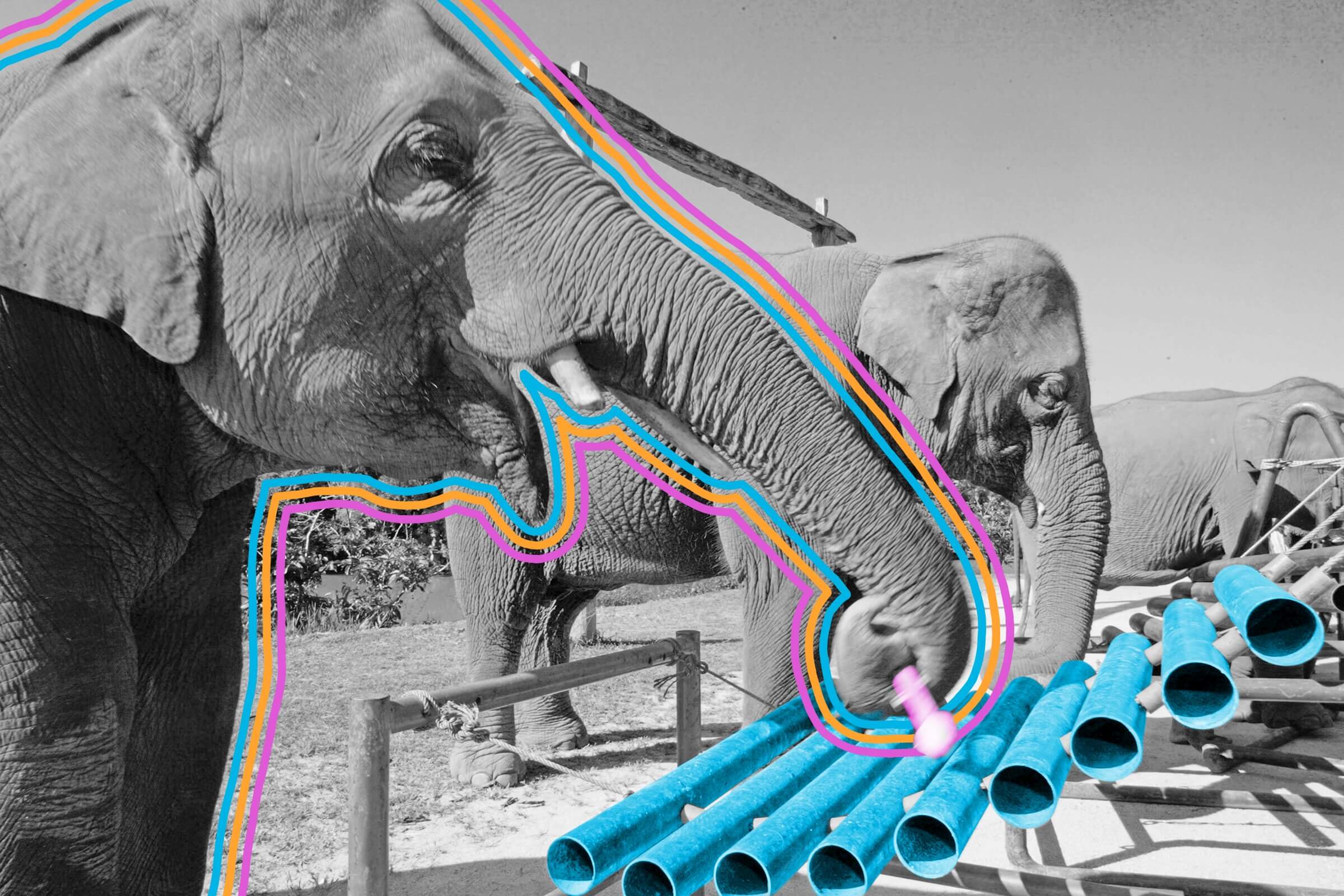
In 2000, musician Dave Soldier and conservationist Richard Lair co-founded the Thai Elephant Orchestra, a group of elephants who live — and make music — at a conservation center near the city of Lampang in northern Thailand. Back in 1957, scientist Bernhard Rensch posited that elephants could remember melodies and distinguish between basic scales. This inherent musical ability inspired Soldier (who also goes by David Sulzer in his professional life as a neurobiologist) to give elephants a chance to perform music of their own. He developed the concept with Lair, who believed it would be a great way to raise necessary funds and interest for elephant conservation.
A baby elephant can walk within one hour after being born.
The average baby elephant is able to stand within just 20 minutes of being born and is also capable of walking in as little as just one hour. After two days, elephant babies are so deft on their feet, they’re able to keep pace with the rest of the herd.
The Thai Elephant Orchestra released their eponymous debut album in 2001, featuring six young elephants performing improvisational music. The band went on to release two more albums: 2004’s Elephonic Rhapsodies, and 2011’s Water Music. The tunes usually revolve around local Thai music traditions and incorporate giant, steel-enforced drums specially built for the elephants to whack. Some elephants can even play the harmonica by blowing air through their trunks. According to Soldier’s website, the orchestra features as many as 16 elephants at any time, and a group of four elephants performs for several minutes each day for guests at the conservation center.
These elephants are so musically gifted that in 2012, a human orchestra performed an arrangement of their original compositions for a live audience in New York City. After the performance, when asked to guess the composer, audience members speculated that the music had been written by such great talents as John Cage or Antonín Dvorák. To the delight of everyone, the geniuses behind the music were later revealed to be a group of elephants.
The easiest way to tell African and Asian elephants apart is by the shape of their ears.
Advertisement
A medieval engineer invented an elephant clock.
Ismail al-Jazari was among the most prolific inventors of the 12th and 13th centuries, so much so that his work was a major influence on Leonardo da Vinci. One of his most clever creations was a beautifully intricate elephant clock, which was illustrated in his 1206 manuscript The Book of Knowledge of Ingenious Mechanical Devices. The clock was built atop the back of a copper elephant and used a mechanism called a ghatika: a bowl designed to slowly sink into a tank of water. The bowl was attached to a figure of a scribe by a rope, and as the bowl sank and tugged on the rope, the scribe moved in a circular motion to indicate the number of minutes past the hour. Once the bowl was full of water, it triggered a ball to fall and collide with a fan, which rotated to show how many hours had passed since sunrise. The ball would then activate a mallet to collide with a cymbal, triggering the whole vessel to tilt and begin the cycle again.
Bennett Kleinman
Staff Writer
Bennett Kleinman is a New York City-based staff writer for Inbox Studio, and previously contributed to television programs such as "Late Show With David Letterman" and "Impractical Jokers." Bennett is also a devoted New York Yankees and New Jersey Devils fan, and thinks plain seltzer is the best drink ever invented.
Advertisement
top picks from the Inbox Studio network
Interesting Facts is part of Inbox Studio, an email-first media company. *Indicates a third-party property.

Other than being members of the class Mammalia, humans and elephants might seem to have little in common. But these seemingly disparate creatures, separated by 80 million years of evolution, have some stunning similarities. One of the most intimate (and adorable) is a behavior shared between newborn human babies and elephant calves. Just like a human infant sucks their thumb, a newborn elephant will do the same with its trunk, and for the same reason — comfort.
Elephants are known for their trunks, but plenty of other animals have them too, such as anteaters, shrews, and even a species of antelope. The most prominent example is the tapir, which looks like a pig with a trunk, though it’s more closely related to horses and rhinos.
During the first six months of life, our brains are biologically wired to suck on things, since that’s the primary way infants receive sustenance from their mothers. Thumb-sucking is also a way for babies to self-soothe during times of stress. For elephants, it’s a very similar situation. Since sucking is associated with food and their mothers, elephant calves will suck their trunks much like a natural pacifier — a pacifier with more than 40,000 muscles. An elephant calf also sucks its trunk to learn how to subtly manipulate this immensely important protuberance, and uses the technique as an enhanced form of smelling. So while much has changed since humans and elephants parted ways during the Late Cretaceous, there’s at least one stunning (and very cute) similarity.
The country with the largest population of elephants is Botswana.
Advertisement
Elephants have the longest gestation period of any mammal.
Humans have a relatively long gestation period for mammals (especially compared to the Virginia opossum, which is pregnant for only 12 days), but a few animals outlast even us Homo sapiens. Manatees remain pregnant for 13 months, and giraffes can carry their young for two months beyond that, but all mammals pale in comparison to the African elephant, which has a gestation period of 22 months. There are two reasons for this nearly two-year-long pregnancy — one obvious, the other less so. The first is size. The African elephant is the largest land-dwelling mammal on Earth, and it takes time to grow such an enormous creature from a small clump of cells into a calf that weighs more than an average adult man. The second reason relates to an elephant’s amazing intellect, which includes a brain that is shaped similarly to our own but is three times larger. An elephant’s brain contains some 250 billion neurons, and the temporal lobe is particularly well developed because it allows elephants to create complex mental maps stretching hundreds of miles. Without this impressive memory, elephants couldn’t find their way back to life-sustaining watering holes year after year. So while an elephant pregnancy might seem incredibly long, it’s definitely time well spent.
Darren Orf
Writer
Darren Orf lives in Portland, has a cat, and writes about all things science and climate. You can find his previous work at Popular Mechanics, Inverse, Gizmodo, and Paste, among others.
Advertisement
top picks from the Inbox Studio network
Interesting Facts is part of Inbox Studio, an email-first media company. *Indicates a third-party property.
Original photo by Maxim Tatarinov/ Alamy Stock Photo
Foods tend to get their names from their appearance or ingredients, though not all are so clear-cut. Take, for instance, the egg cream, a beverage that has delighted the taste buds of New Yorkers (and other diner patrons) since the 1890s. If you’ve never sipped on the cool, fizzy drink known for its chocolate flavor and foamy top, you should know: There are no eggs or cream in a traditional egg cream drink.
Frosty milkshakes are diner standards, served with a side of burgers and fries, though the earliest version of the drink didn’t include ice cream. Invented in the late 1800s, the first milkshakes were a blend of eggs, cream, and whiskey.
According to culinary lore, the first egg cream was the accidental invention of Louis Auster, a late-19th- and early-20th-century candy shop owner in New York’s Lower East Side. Auster’s sweet treat arrived in the 1890s, at a time when soda fountains had started selling fancier drinks, and it was a hit — the enterprising inventor reportedly sold upwards of 3,000 egg creams per day by the 1920s and ’30s. However, Auster kept his recipe well guarded; the confectioner refused to sell his formula, and eventually took his recipe to the grave. The origins of the drink’s name have also been lost to time. Some believe the name “egg cream” came from Auster’s use of “Grade A” cream, which could have sounded like “egg cream” with a New York accent. Another possible explanation points to the Yiddish phrase “echt keem,” meaning “pure sweetness.”
Regardless of the misleading name, egg creams are once again gaining popularity in New York, though you don’t have to be a city dweller to get your hands on the cool refreshment. Egg creams can be easily made at home with just three ingredients: milk, seltzer, and chocolate syrup.
Servers at soda fountains of the early 20th century were called “soda jerks.”
Advertisement
Chocolate syrup was once marketed as a health tonic.
Centuries before it became a dessert, chocolate was employed medicinally. In Mesoamerica, where chocolate originated, cacao was used among Indigenous communities to treat indigestion, fatigue, and even some dental problems. Europeans of the 17th century also consumed chocolate for health purposes, hoping to cure a variety of ailments. By the late 1800s, pharmaceutical publications widely advertised chocolate powders and syrups, promoting them as healthful aids that also masked the bitter flavors of other medications. Brands like Hershey’s began marketing their syrups and chocolates to everyday consumers as health tonics that were wholesome and nutritious — even “more sustaining than meat.” Eventually, however, regulations against dubious health claims and patent medicines, combined with equipment improvements and declining sugar prices, set the stage for chocolate to be considered more treat than tonic, even as some health claims for it have endured.
Nicole Garner Meeker
Writer
Nicole Garner Meeker is a writer and editor based in St. Louis. Her history, nature, and food stories have also appeared at Mental Floss and Better Report.
Advertisement
top picks from the Inbox Studio network
Interesting Facts is part of Inbox Studio, an email-first media company. *Indicates a third-party property.
Although crying to make yourself happier seems counterintuitive, shedding some tears can be one of the best ways to restore your emotional equilibrium. A 2014 study found that emotional crying activates the parasympathetic nervous system, which regulates the body’s “rest and digest” actions. Crying also elevates levels of endorphins and oxytocin, which helps dull both emotional and physical pain. And the physical act of crying — taking in big gulps of air — cools the brain and helps regulate your mood. All in all, “having a good cry” can actually be good for you.
Humans are the only animals that cry emotional tears.
Shedding emotional tears is a solely human characteristic. Although other animals produce tears, scientists believe it’s only for providing moisture or clearing the eyes of irritants.
Of course, whether crying makes you feel better can also be dependent on the situation. Tears are known to inspire interpersonal benefits by signaling to others that you’re in need of support. Unsurprisingly, studies have shown that people who receive support after crying are more likely to feel happier than if they’re shamed for crying. So while the physical act of crying can help our bodies return to an emotional homeostasis, it’s the support of friends and loved ones that makes those good feelings stick.
Chemicals that irritate the eyes and make humans cry are called lachrymators.
Advertisement
Humans tear up when laughing because it’s physiologically similar to crying.
Although crying is often associated with sadness, tears are actually a complex biological response — after all, humans also shed tears of joy. Evidence suggests that the same part of the brain controls both laughing and crying; some of this evidence comes from studies that have shown that patients with a condition known as pseudobulbar affect (PBA) experience both uncontrollable bouts of crying and laughter caused by lesions located on a specific part of the brain. Although scientists aren’t 100% certain why people cry when they’re laughing, one prevailing theory is that in both instances the body is attempting to regulate a high emotional state and simply doesn’t discriminate between immense sadness and immense joy.
Darren Orf
Writer
Darren Orf lives in Portland, has a cat, and writes about all things science and climate. You can find his previous work at Popular Mechanics, Inverse, Gizmodo, and Paste, among others.
Advertisement
top picks from the Inbox Studio network
Interesting Facts is part of Inbox Studio, an email-first media company. *Indicates a third-party property.

Octagon, octopus… most words that begin with the Latin prefix “Oct” have some connection to the number eight. But what about October? While the modern calendar considers the autumn month to be the 10th of the year, it wasn’t always that way. For the ancient Romans, who created the earliest form of the calendar we use now, October was originally the eighth month.
Cultures around the globe track time differently; take, for example, the Ethiopian Ge’ez calendar, which gives each month 30 days and runs about seven years behind the Gregorian calendar. After December, the year’s five or six remaining days create a mini month called “Pagume.”
Today’s calendar follows a 12-month cycle, though the earliest iterations only had 10 months. In ancient Rome, the year began in March and ran through December, with the first four months named for Roman deities. The next six months had more straightforward, numerical names that referenced their place in the year. The remaining weeks of winter (which would eventually become January and February) were largely ignored on paper; when the harvest season ended, so did the calendar, until the next spring planting season rolled around.
Over time, the calendar expanded by two months; January and February were added around 700 BCE, and by about the middle of the fifth century BCE, they had become the starting months of the year. When Julius Caesar introduced the Julian calendar, he didn’t adjust the number-named months to more appropriate places, though later Roman emperors tried, using names that didn’t stick. Domitian, who ruled from 81 to 96 CE, called October “Domitianus” after himself, and decades later, Commodus dubbed the month “Herculeus” after one of his own titles. Some historians believe the attempts to rename October (and the other months of the year) were widely disregarded because the leaders themselves were generally disliked, though another theory might explain it best: Like many people today, Romans of the past just weren’t fans of change.
World Octopus Day, celebrating eight-armed cephalopods, is on October 8.
Advertisement
There was a year when October only had 21 days.
Eager trick-or-treaters counting down to Halloween know October has 31 days, though there was a time in history when the month ran 10 days short. In 1582, Pope Gregory XIII introduced the Gregorian calendar, an upgrade from the Julian calendar that had fallen 10 days out of sync and was thus messing with the timing of religious holidays. Switching to the new calendar fixed the issue, but it required a one-time drop of 10 days to get back on track. The pope decreed the calendar would skip them in October, the month with the fewest holy days. After October 4, the calendar jumped to October 15, omitting the days in between and causing a flurry of issues: Some citizens in Frankfurt rioted against the change, many countries delayed or refused to swap to the new calendar, and participating regions had to recalculate rents and wages for the shortened month. Over the next few centuries, most countries around the globe adopted the Gregorian calendar, though some held out longer than others. Greece became the last European country to officially adopt the calendar, in 1923.
Nicole Garner Meeker
Writer
Nicole Garner Meeker is a writer and editor based in St. Louis. Her history, nature, and food stories have also appeared at Mental Floss and Better Report.
Advertisement
top picks from the Inbox Studio network
Interesting Facts is part of Inbox Studio, an email-first media company. *Indicates a third-party property.

On March 5, 1973, several hundred people gathered at a farm in tiny Ossineke, Michigan, to witness a burial they would remember for the rest of their lives. One local grocery store closed its doors so employees could attend; even Michigan Governor William G. Milliken dropped by to pay his respects. Was this a funeral for a native son who made good, or perhaps a beloved civic leader? No, it was a ceremony to bid arrivederci to some 30,000 frozen pizzas that may have been harboring dangerous toxins.
Hawaiian pizza (with pineapple and ham toppings) originated in Hawaii.
This particular combination of toppings was the brainchild of Greek immigrant Sam Panopoulos, who introduced the Hawaiian pizza at his restaurant in Ontario, Canada, in 1962.
This bizarre scene stemmed from the discovery of swollen mushroom tins at Ohio's United Canning Company two months earlier. After FDA tests revealed the presence of bacteria that causes botulism, calls to United Canning's extended branch of customers eventually reached frozen-pizza maker Mario Fabbrini. When two test mice croaked after eating his mushroom pizza, Fabbrini believed he had no choice but to recall his wares from store shelves and swallow the estimated $60,000 in losses. Attempting the pizza equivalent of turning lemons into lemonade, he announced intentions for a grand "funeral," and arranged for a series of pickup trucks to dump his 30,000 unwanted mushroom pies into an 18-foot hole. After placing a flower garland on the grave — red gladioli to symbolize sauce, white carnations for cheese — Fabbrini served fresh (mushroom-free) pizza to anyone brave enough to partake.
Further tests later showed that the mice had died not from botulism, but from peritonitis, and it was unclear whether their deaths were pizza-related casualties. Sadly, the $250,000 Fabbrini later won in a lawsuit against United Canning and two other defendants wasn’t enough to fully revive his business, and Fabbrini sold the company in the early 1980s. Nevertheless, much like that sauce stain that never entirely disappears from your shirt, the story of the Great Michigan Pizza Funeral endures for those who know where to look.
Mushrooms are the only nonanimal food product that serves as a significant source of vitamin D.
Advertisement
Atari once buried truckloads of its inventory, including a notoriously awful "E.T." video game.
Video gamers of a certain age may remember the disaster that was “E.T. the Extra-Terrestrial,” an Atari 2600 game based on the blockbuster Steven Spielberg movie. Given just five weeks to have the game in stores by the 1982 Christmas season, designer Howard Scott Warshaw developed an ambitious but deeply flawed product, resulting in a poorly reviewed title that contributed to the company’s $563 million in losses in 1983. That September, Atari deposited 13 truckloads of various game cartridges and computer equipment into the city landfill at Alamogordo, New Mexico. Although contemporary newspapers reported on the event, the legend that lingered was that of Atari secretly dumping their unsold “E.T.” inventory under the cover of darkness to bury the memory of what some called the worst video game ever made. In April 2014, the landfill was excavated as part of the making of the documentary Atari: Game Over; it was called “the first excavation of video games in the history of humanity.” Cartridges of the “E.T.” game were found alongside other titles, such as “Pac-Man” and “Centipede,” as well as decrepit computer parts. Yet unlike Mario Fabbrini and his mushroom pizzas, this story has a happy ending: The sale of items retrieved in the landfill helped raise more than $100,000 for the city of Alamogordo, and Warshaw earned a measure of redemption by receiving a standing ovation after Atari: Game Over screened at Comic-Con that year.
Tim Ott
Writer
Tim Ott has written for sites including Biography.com, History.com, and MLB.com, and is known to delude himself into thinking he can craft a marketable screenplay.
Advertisement
top picks from the Inbox Studio network
Interesting Facts is part of Inbox Studio, an email-first media company. *Indicates a third-party property.