
Original photo by Alla Iatsun/ Shutterstock

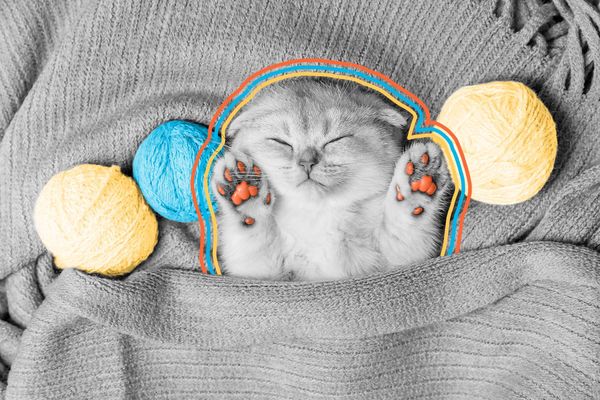
Ancient Egyptians are often said to have worshipped cats. They didn’t — though it is accurate to say their felines were beloved and pampered, sometimes bedazzled in gold accessories, and occasionally allowed to eat directly from dinner plates at meals. Cats first made their appearance in Fertile Crescent farming communities around 8,000 years ago, and they initially earned their keep as household protectors from rodents, snakes, and scorpions. Eventually, the Egyptians grew to see cats’ protectiveness and companionship as the same traits held by their deities, particularly Bastet, a goddess often depicted as a cat or lion who was honored with temples and pilgrimages. All in all, the Egyptians bonded so well with their cat companions that they mourned their pets after death, and both cat owners and family members would publicly express their grief by shaving off their eyebrows. Some historians believe that the mourning period lasted until a new set of eyebrows grew in (which could be as long as three or four months).

No one knows the original name of the Sphinx in Giza.

Ready to reveal?

Oops, incorrect!

It's a fact

The Great Sphinx of Giza is known for its cat-shaped body, but the sculpture has a secret: its own name. There's no record of what the ancient Egyptians called it. The name used today comes from Greek mythology, and likely emerged 2,000 years after the statue was carved.

The ancient Egyptians are often credited with domesticating felines, though in 2004, archaeologists found a 9,500-year-old cat buried in Cyprus — suggesting cats may have been living alongside humans earlier than previously thought. Still, Egyptians likely helped transform cats from the tiny, wild creatures they once were to the lazy furballs we now snuggle with; some historians believe the Egyptians selectively bred housecats, helping their numbers flourish and giving them the temperaments we now enjoy (or at least tolerate) today.

Numbers Don't Lie

Numbers Don't Lie

Average number of hours a domesticated cat can sleep each day
15
Age (in years) of Cream Puff, the world’s oldest cat
38
Height (in feet) of the Sphinx, one of the world’s largest statues
66
Speed (in miles per hour) of the Egyptian mau, the fastest domestic cat
29

The ancient Greeks kept pet ______ for pest control.

Ready to reveal?

Confirm your email to play the next question?

The ancient Greeks kept pet ferrets for pest control.

Placeholder Image

Most cats are lactose intolerant.

If the ancient Egyptian love for cats has inspired you to pamper your feline friend, you may have considered offering up a saucer of milk. However, many vets recommend steering clear of this kind of dairy indulgence, since most cats are lactose intolerant. While kittens rely on milk from their mothers, cats typically wean around six weeks old, quickly losing their ability to produce lactase enzymes that help their stomachs break down the sugars in milk. That means cats can experience uncomfortable symptoms, like stomach pains, if they consume dairy, just like lactose-intolerant humans. Instead, many vets recommend just offering up clean drinking water. Though if you’re feeling particularly festive, you can crack open a bottle of nonalcoholic wine made specifically for felines.

Nicole Garner Meeker
Writer

Nicole Garner Meeker is a writer and editor based in St. Louis. Her history, nature, and food stories have also appeared at Mental Floss and Better Report.

Original photo by Bobbushphoto/ iStock

While driving Route 66 offers its share of thrills — or kicks, if you prefer — for motorists following the path of their California-dreamin' predecessors, a lengthy drive gets monotonous no matter how historic the thoroughfare. Which is why road-trippers rejoiced when a quarter-mile stretch of the famed highway outside Albuquerque, New Mexico, was rebuilt in 2014 to play the uplifting notes of "America the Beautiful" for cars that rolled by.

Route 66 is no longer recognized as a U.S. highway.

Ready to reveal?

Oops, incorrect!

It's a fact

Although the historic route is still marked by signs in many areas, its existence as a U.S. highway ended when the American Association of State Highway and Transportation Officials decertified the road in June 1985.

This bit of motor magic relied on the premise that sounds are recognized as musical notes if they vibrate at a specific frequency; a thump vibrating 330 times per second, for example, is a clear E note to our ears. With that in mind, a series of rumble strips — road indentations normally used to alert lane-drifting drivers — were pressed into the right side of this length of highway at carefully calculated intervals to produce a precise sequence of notes. When a vehicle drove over the rumble strips at exactly 45 mph, the unmistakable strains of what many consider an alternate national anthem could be heard wafting from below.

Sadly, while much of Route 66 has been preserved, the music-producing segment was left to die a slow, dissonant death. Drivers began reporting that some of the rumble strips had been paved over by 2020, and by July 2023, there were additional reports that the short-lived “musical highway” had seemingly been silenced for good.

Numbers Don't Lie

Numbers Don't Lie

Miles covered by Route 66 in its inaugural year of 1926
2,448
Altitude (in feet) at the highest elevated point of Route 66
7,335
Approximate percentage of Route 66 that can still be driven
85%
Number of seasons the adventure drama “Route 66” aired on TV
4

"The Mother Road" was a name given to Route 66 by author ______.

Ready to reveal?

Confirm your email to play the next question?

"The Mother Road" was a name given to Route 66 by author John Steinbeck.

Placeholder Image

The celebrated song "Route 66" could have been called "Interstate 40."

Shortly after the end of World War II, songwriter Bobby Troup and his wife Cynthia left their home in Pennsylvania and headed west on Interstate 40 to embark on a new life in California. Troup later recalled that Cynthia suggested he write about their journey along I-40, an idea he rejected since their path would soon switch to Route 66 for the remainder of the drive. However, a more recent interview with a granddaughter indicates that it was Troup who floated the idea of an I-40 song, with his traveling companion suggesting they wait for the upcoming highway change. At least both agreed that it was the missus who came up with the idea to “get your kicks on Route 66,” and Troup went on to complete the catchy ditty that was later recorded by the King Cole Trio en route to becoming a celebrated entry in the Great American Songbook.

Tim Ott
Writer

Tim Ott has written for sites including Biography.com, History.com, and MLB.com, and is known to delude himself into thinking he can craft a marketable screenplay.

Original photo by Daniel Jones/ Alamy Stock Photo

Among the highlights of a Christie's auction in London in September 2001 was the record-breaking sale of a Cadbury's chocolate bar to an unidentified buyer for a whopping £470 ($687). It wasn't one of those giant candy bars that could feed a family of Oompa Loompas for a year; it measured all of 4 inches long. Nor was it some gourmet concoction produced from rare cacao beans and subjected to an oak-barrel aging process as part of an excuse to charge thousands for a tiny taste. Instead, it was a 100-year-old bar that had survived, unopened, from the first British attempt to reach the South Pole, in 1901 — part of a haul of 3,500 pounds of cocoa and chocolate stashed on the RRS Discovery under the command of explorer Robert Falcon Scott.

Hot chocolate is the same thing as hot cocoa.

Ready to reveal?

Oops, incorrect!

It's a fib

Although the terms are used interchangeably, hot chocolate consists of actual chocolate pieces mixed with water, milk, or cream, while hot cocoa is made from powder stripped of its natural cocoa butter and fortified with added sugar.

Why in the queen's name was all that chocolate being carried to the frigid ends of the Earth? Well, chocolate was already renowned for its restorative and stimulating properties, which we now understand to be the effects of sugar and caffeine combined with energy-boosting antioxidants. Additionally, the soothing taste of chocolate provided some creature comforts for the roughly four dozen explorers amid extended exposure to the relentless winds and -40-degree Celsius temperatures of the White Continent.

After that initial attempt to reach the South Pole fell short by about 460 miles, Scott carefully planned a second expedition, which left in June 1910. This time, thanks to the help of his sponsors at Fry's, the captain supplied his men with nightly rations that included 16 grams of cocoa mixed with sugar. Scott and four others successfully staggered to the South Pole in January 1912, but the presence of a tent provided the deflating discovery that they were not the first to do so. The winner of that race — by a month — had been a group led by Norwegian Roald Amundsen, who reportedly brought five times as much cocoa to fuel his push for history.

Numbers Don't Lie

Numbers Don't Lie

Grams of sugar (per serving) in a Cadbury Dairy Milk Chocolate Bar
17
Emperor penguin eggs collected by Scott on his second Antarctic expedition
3
Record-breaking temperature (in degrees Celsius) recorded in Vostok, Antarctica, in 1983
-89.2
Global sales (in U.S. dollars) made by Christie’s in 2022
$8.4 billion

Scott and his crew subsisted on a stew made from pemmican, biscuits, and water, known as ______.

Ready to reveal?

Confirm your email to play the next question?

Scott and his crew subsisted on a stew made from pemmican, biscuits, and water, known as hoosh.

Placeholder Image

Art consisting of a banana taped to a wall sold for $6.24 million in 2024.

Maybe $687 isn’t an altogether unreasonable price tag for a block of chocolate that doubles as a historic artifact, but can the same be said for a $6.24 million work of art consisting of a banana duct-taped to a wall? That’s how much a collector paid in 2024 for an edition of “Comedian” by artist Maurizio Cattelan. The Italian artist first attempted to fashion a banana-inspired sculpture before simply buying a few pieces of the fruit and a roll of tape. One of the resulting editions sold in 2019 for $120,000. At the time, news of the transactions sparked arguments about the meaning of art and wealth inequality, and the edible nature of the object at the center of the controversy invited troublemakers to taste the fuss for themselves. One banana installed at Miami’s Art Basel was swiped and eaten, by a performance artist who undoubtedly sought to take advantage of the publicity already swirling. The second such vandalism occurred a few years later in Korea, courtesy of a student who claimed to have helped himself to the expensive artwork “because he was hungry.”

Tim Ott
Writer

Tim Ott has written for sites including Biography.com, History.com, and MLB.com, and is known to delude himself into thinking he can craft a marketable screenplay.

Original photo by qbdp/ Shutterstock

For the first several thousand years of their existence, doors were largely knob-free; they were typically opened and closed using latches, handles, bars, or leather straps.  The process of entering and exiting a room was revolutionized on December 10, 1878, when a self-taught 16-year-old inventor named Osbourn Dorsey received a patent for a doorknob with an internal door-latching mechanism. This was a massive improvement to existing doorknobs, which lacked internal latches and were generally more difficult to use — some used external bolts or strings and didn’t stay in place as well. However, as modern innovations can take a while to catch on, it took several more years for most people to embrace Dorsey’s upgraded doorknobs and begin having them installed in their homes.

Doors were invented in ancient Rome.

Ready to reveal?

Oops, incorrect!

It's a fib

They were actually invented in ancient Egypt. The earliest known evidence of doors are depictions found in Egyptian tomb paintings dating back 4,000 years.

Although most of us now use Dorsey’s version of a doorknob every day, little else is known about the African American inventor’s life beyond the fact that his mother Christina and siblings Mary and Levi were enslaved prior to his birth in 1862. Before his inventing days, Dorsey either trained or worked as a blacksmith.

Numbers Don't Lie

Numbers Don't Lie

Albums sold by the Doors
100 million+
Decade an oak door, the oldest in Britain, was built in Westminster Abbey
1050s
Height (in feet) of the bay doors at NASA’s Vehicle Assembly Building
456
Estimated number of doors in the world
40 billion

______ was the Roman god of doorways.

Ready to reveal?

Confirm your email to play the next question?

Janus was the Roman god of doorways.

Placeholder Image

The battery was invented in 1800.

Though we may think of them as fairly newfangled inventions inextricably linked to our electronic gadgets, batteries as we know them today were actually invented more than 200 years ago, in 1800. The mind behind this innovation was Alessandro Volta, who was born in 1745 and came up with the chemical battery more than half a century later.

Volta had long been interested in conductivity, having written his paper “On the forces of attraction of electric fire” in 1769, and his invention was preceded by several other relevant experiments. His voltaic pile, as it was called at the time, was a stack of some 30 alternating zinc and silver discs separated by cloth soaked in brine. A current flowed when he connected a wire to both ends, and what he initially dubbed an “artificial electric organ” proved to be a massive success.

Michael Nordine
Staff Writer

Michael Nordine is a writer and editor living in Denver. A native Angeleno, he has two cats and wishes he had more.

Original photo by SARINYAPINNGAM/ iStock

Though they don’t have lungs, trees can “breathe” using the process of photosynthesis, in which they convert carbon dioxide, water, and sunlight into oxygen. In a sense, this is the opposite of what humans do, as we ingest oxygen and produce carbon dioxide. But according to researchers at Colorado State University, one similarity trees do share with humans is that they can also hold their breath.

Trees (and other plants) absorb carbon dioxide through stomata — tiny “breathing pores” located on the leaf’s surface. They also absorb water through their roots as well as sunlight via organelles called chloroplasts. During photosynthesis, that light is converted to energy that helps transform water and CO2 into oxygen, which is released through the stomata. But the process may be temporarily halted if there are toxins in the air, as trees can hold their breath until the pollutants dissipate.

The world’s remotest tree is located 170 miles from its nearest neighbor.

Ready to reveal?

Oops, incorrect!

It's a fact

A lone Sitka spruce is located on Campbell Island — an uninhibited landmass in the subantarctic zone governed by New Zealand. The 30-foot-tall tree was planted around 1900 by former Governor Lord Ranfurly, and is 170 miles from the nearest other trees.

In an article for Discover Magazine, scientists Delphine Farmer and Mj Riches discuss how they stumbled on this theory on a particularly smoky morning in 2020 during a series of wildfires in Colorado. While performing a routine photosynthetic test on some ponderosa pines, the two “were surprised to discover that the tree’s pores were completely closed.” They hypothesized that this was both an active physical response by the plant and also due in part to smoke particles entering and clogging the stomatal pores. Further testing found the pores opened up in less smoky, more favorable conditions — and the tree began to “breathe” again.

Numbers Don't Lie

Numbers Don't Lie

Height (in feet) of the world’s tallest living tree
380.8
Percentage of global land area covered by forests
~31%
Individual tree species located around the world
60,000+
Gallons of water a mature giant sequoia can drink daily
800

The continent with the most forested area is ______.

Ready to reveal?

Confirm your email to play the next question?

The continent with the most forested area is Europe.

Placeholder Image

There’s a tree with rainbow-colored bark.

While tree bark is usually white, tan, or brown, the Eucalyptus deglupta — or rainbow eucalyptus — is a brilliantly colored exception. This eye-catching tree is native to the tropical forests of Indonesia, Papua New Guinea, and the Philippines, making it the only eucalyptus species native to the Northern Hemisphere.

These trees grow to between 197 feet and 246 feet tall, and at first their bark is orange-tinted. But as they begin to shed their outer layer, a striking rainbow pattern emerges from underneath, showcasing streaks of red, green, gray, orange, and purple wood. Each tree undergoes this shedding process in a different manner, meaning each tree’s rainbow pattern is entirely unique. This species is particularly popular in Hawaii, where it’s been imported and planted along roadways in an effort to add even more character to the already stunning landscape of the Hawaiian Islands.

Bennett Kleinman
Staff Writer

Bennett Kleinman is a New York City-based staff writer for Inbox Studio, and previously contributed to television programs such as "Late Show With David Letterman" and "Impractical Jokers." Bennett is also a devoted New York Yankees and New Jersey Devils fan, and thinks plain seltzer is the best drink ever invented.

Original photo by shurkin_son/ Shutterstock

The concept of time has been described as many things: an arrow, a river, a march, anything that moves inextricably forward at a constant, unalterable rate. However, aging doesn’t flow at such a uniform speed. Instead, humans age in fits and starts. A 2024 Stanford University study shows that our bodies age faster around our mid-40s and early 60s than during other stages of life.

The study analyzed data from 108 people who donated blood and other biological samples over several years. By tracking 135,000 different molecules, creating 250 billion data points, scientists discovered that roughly 81% of the studied molecules showed age-related fluctuations, and those moments of rapid aging tended to coalesce around the ages of 44 and the early 60s. According to the scientists, the most surprising data point was rapid aging in the mid-40s. At first, they theorized that menopause or perimenopause could be playing a role in these changes, but they found the molecular changes impacted men just as much as women.

The giant tortoise is the longest-lived vertebrate on Earth.

Ready to reveal?

Oops, incorrect!

It's a fib

Although the Seychelles giant tortoise can live up to nearly 200 years, scientists in 2016 discovered a Greenland shark that was at least 270 years old (and possibly much older), making that species the longest-lived vertebrate on Earth.

The affected molecules also differed between those two aging periods. Both age groups reported changes in molecules related to cardiovascular disease, caffeine metabolism, and skin and muscle growth, but the mid-40s cohort also recorded increased alterations in alcohol metabolism, while people in their early 60s underwent changes to immune regulation and kidney function. Of course, a lifetime of healthy eating, exercise, and plentiful sleep can curtail some of the effects of these periods of aging, so it may be worth paying extra close attention to your health when those milestones arrive.

Numbers Don't Lie

Numbers Don't Lie

Estimated number of centenarians in the U.S. in 2024
101,000
Paul McCartney’s age when he wrote the melody for “When I’m Sixty-Four”
15
Estimated value of the global anti-aging market in 2024
$73 billion
Inches humans shrink in height on average each decade after age 40
0.5

Genomic regions at the end of chromosomes, known as ______, shorten as we age.

Ready to reveal?

Confirm your email to play the next question?

Genomic regions at the end of chromosomes, known as telomeres, shorten as we age.

Placeholder Image

It’s a myth that ancient humans didn’t live to old age.

A well-known (and much appreciated) side effect of modern medicine is its ability to increase a human’s life expectancy, especially in developed countries. In the U.S., for example, life expectancy hovered around 47 years at the turn of the 20th century but skyrocketed to nearly 77 years a century later. Delve even further back into history, and it may seem like humans lived rather short, brutish lives compared to today. However, old age isn’t a modern phenomenon.

Ancient Greeks and Romans, for example, had a life expectancy of just 30 to 35 years, but in the early Roman Republic, for example, you couldn’t even be a senator until the age of 60. In fact, it wasn’t uncommon for people all around the world to live to at least their 50s or 60s in ancient and medieval times. A 2013 study highlighted that between the years 900 CE to 1531 CE, most people who reached adulthood in the region of what is now Cholula, Mexico, lived until at least the age of 50.

The low historical averages we often see reported are largely due to the high infant mortality rates at the time, a once-widespread occurrence that modern medicine has greatly alleviated. While technology has helped more humans reach an older age than ever before, we may be surprised by how many of our ancestors led lengthy lives.

Darren Orf
Writer

Darren Orf lives in Portland, has a cat, and writes about all things science and climate. You can find his previous work at Popular Mechanics, Inverse, Gizmodo, and Paste, among others.

Original photo by Roman Babakin/ Shutterstock

Unless you’re a child of a certain age, you’ve likely long outgrown the silly, whimsical notion that Santa Claus lives in the North Pole. Obviously, he actually resides in Santa Claus Village, which is a real place you can visit. Located in Rovaniemi, Finland, the festive locale is part of the Arctic Circle and remains quite cold year-round. Speaking of year-round, St. Nick is even available for daily visits despite his busy schedule. He isn’t the only person honored there, either; Roosevelt Cottage, which was built decades before the rest of the village, was constructed there in 1950 in honor of former First Lady Eleanor Roosevelt’s visit to the Arctic Circle.

Santa Claus has a pilot's license.

Ready to reveal?

Oops, incorrect!

It's a fact

He received it in 1927 from William P. MacCracken, the U.S. assistant secretary of commerce for aeronautics.

But why has Rovaniemi been designated as Santa’s hometown, you may ask? Finnish folklore and tradition have long associated Santa with Finland’s Lapland region. Though Finns believe Santa’s real home lies in Korvatunturi, a fell in Lapland where Santa and his elves are said to listen to children’s wishes, they also believe its true location must be kept secret, so they chose nearby Rovaniemi as the “official” location for practical reasons. Santa Claus Village — which also has reindeer, more than 100 Siberian huskies, and a post office — opened in 1985 and has been delighting Christmas enthusiasts ever since.

Numbers Don't Lie

Numbers Don't Lie

Reindeer who pull Santa’s sleigh (minus Rudolph)
8
Coldest recorded temperature (in degrees Fahrenheit) in Rovaniemi
-49.54
Population of Rovaniemi
62,000
Box-office gross of 1994’s “The Santa Clause”
$190 million

Santa and Mrs. Claus have ______ passports.

Ready to reveal?

Confirm your email to play the next question?

Santa and Mrs. Claus have Canadian passports.

Placeholder Image

Instead of Santa Claus, Iceland has 13 “Yule Lads.”

Before you start feeling too sad for all the Icelandic children who don’t have a Santa Claus despite living fairly close to him, know this: They have 13 “Yule Lads” instead. Mischievous yet merry, the Jólasveinar (as they’re known in Iceland) begin descending from the mountains to visit children’s homes on December 12. One Yule Lad makes the excursion each night, leaving gifts for good kids and rotting potatoes for those on the naughty list.

The 13 Yule Lads are, in order, Stekkjarstaur (Sheep-Cote Clod), Giljagaur (Gully Gawk), Stúfur (Stubby), Þvörusleikir (Spoon Licker), Pottaskefill (Pot Scraper), Askasleikir (Bowl Licker), Hurðaskellir (Door Slammer), Skyrgámur (Skyr Gobbler), Bjúgnakrækir (Sausage Swiper), Gluggagægir (Window Peeper), Gáttaþefur (Doorway Sniffer), Ketkrókur (Meathook), and Kertasníkir (Candle Stealer). As you may have guessed, their names provide hints as to the particular brand of trouble they cause. This odd family’s matriarch is the cruel troll Grýla, who lives in the mountains and has a penchant for turning misbehaving kiddos into stew.

Michael Nordine
Staff Writer

Michael Nordine is a writer and editor living in Denver. A native Angeleno, he has two cats and wishes he had more.

Original photo by REUTERS/ Alamy Stock Photo

Whether at home on the couch or among the crowds in Times Square, watching the New Year’s Eve ball drop symbolizes a fresh start. But as the ball descends to mark another year gone by, it also harkens back to an era when knowing the exact time was much more difficult. Before the 20th century, timekeeping was significantly less precise; most people noted the time thanks to church bells that rang on the hour, though the system was often inaccurate. For sailors and ship captains, knowing the exact time was key for charting navigational courses, and they used a device called a chronometer to keep track of time onboard ships. That’s why Robert Wauchope, a captain in the British navy, created the time ball in 1829. The raised balls were visible to ships along the British coastline, and they were manually dropped at the same time each day, allowing ships to set their chronometers to the time at their port of departure. At sea, navigators would calculate longitude based on local time, which they could determine from the angle of the sun, and the time on their chronometer. 

The Times Square New Year’s Eve Ball has dropped every year since 1907.

Ready to reveal?

Oops, incorrect!

It's a fib

Nearly, but not quite: The New York ball drop has a stunning record only dimmed by World War II. Revelers gathered in Times Square in 1942 and 1943, but no ball drop took place, thanks to wartime blackouts. Instead, the new year was marked by a minute of silence followed by chimes.

Time balls emerged as a timekeeping feature throughout the world, though evidence of them is hard to find today. The U.S. Naval Observatory in Washington, D.C., installed one in 1845, which would later help history record the precise time of Lincoln’s assassination; it dropped daily through 1936. But the time ball’s reign was short-lived. The devices fell out of fashion by the 1880s, thanks to the availability of self-winding clocks. The concept would eventually be co-opted by The New York Times in 1907, when the newspaper’s formerly explosive New Year’s Eve celebrations were barred from using fireworks. Organizers took a chance by looking back at the time ball’s influence, and decided a lighted midnight drop was the perfect way to honor the occasion.

Numbers Don't Lie

Numbers Don't Lie

Number of Times Square New Year’s Eve Ball designs since 1907
7
Weight (in pounds) of the current Times Square New Year’s Eve Ball
11,875
Year “Dick Clark’s New Year’s Rockin’ Eve” aired for the first time
1972
Typical number of revelers packed into Times Square each New Year’s Eve
58,000

In the 1980s, the Times Square Ball was reconfigured into an ______.

Ready to reveal?

Confirm your email to play the next question?

In the 1980s, the Times Square Ball was reconfigured into an apple.

Placeholder Image

Times Square’s New Year’s Eve confetti is all tossed by hand.

Dropping a deluge of confetti into Times Square on New Year’s Eve is no small feat; preparations for the confetti avalanche take about a year, beginning while the previous holiday’s tissue paper is still being swept up. A large part of organizing the confetti shower is recruiting crews to release the 3,000 pounds that descend on Times Square, since there are no cannons involved — instead, every piece is hand-tossed. Workers are trained in the proper way to fluff and throw the biodegradable paper scraps for maximum impact, which is timed to begin 20 seconds before midnight so that the confetti descends into the crowds below right on cue.

Nicole Garner Meeker
Writer

Nicole Garner Meeker is a writer and editor based in St. Louis. Her history, nature, and food stories have also appeared at Mental Floss and Better Report.

Original photo by Hispanolistic/ iStock

Flight attendants make our journeys through the sky safer and more comfortable. Yet they do more than just serve peanuts and soda; they’re trained to respond to safety and medical emergencies, necessary skills for cruising at 35,000 feet. However, modern flight attendants don’t have to have in-depth medical training the way the first American in-air staff did — the earliest commercial airlines equipped with flight attendants required their staff to be registered nurses.

There are more nurses than doctors in the U.S.

Ready to reveal?

Oops, incorrect!

It's a fact

While doctors often make the diagnoses, it’s nurses who do much of the hands-on work of caring for patients — which is why it’s a good thing there are so many of them. The U.S. has three times as many registered nurses as doctors.

The first flight attendants to board U.S. commercial flights were led by Ellen Church, a nurse who was also a licensed aviator. Unable to find work as a pilot due to gender discrimination, Church found another way into the sky by pitching airlines the concept of the “flight stewardess,” who could use her nursing skills to aid sick or injured passengers while also easing nerves at a time when flying was still somewhat dangerous and often uncomfortable for passengers. Boeing Air Transport tested Church’s idea in May 1930, hiring Church and seven other nurses for flights between San Francisco and Chicago (with 13 stops in between). In air, the attendants were tasked with serving meals, cleaning the plane’s interior, securing the seats to the floor, and even keeping passengers from accidentally opening the emergency exit door. After a successful three-month stint, other airlines picked up Church’s idea, putting out calls for nurses in their early 20s to join the first flight crews — standard requirements until World War II, when nurses overwhelmingly joined the war effort, leaving room for more women of all backgrounds to enter the aviation field.

Numbers Don't Lie

Numbers Don't Lie

Year Norwegian aviator Turi Widerøe became the first woman to pilot a commercial flight for a major airline
1969
Estimated number of flight attendants employed in the U.S. as of May 2022
108,480
Number of registered nurses in the U.S. as of 2022
4.3 million
Number of flights that cross U.S. skies each day
45,000+

Most commercial airplanes are painted ______ to reflect sunlight and keep the plane cool.

Ready to reveal?

Confirm your email to play the next question?

Most commercial airplanes are painted white to reflect sunlight and keep the plane cool.

Placeholder Image

Florence Nightingale’s parents opposed her dream of becoming a nurse.

Florence Nightingale is often recognized as the mother of modern nursing, though if her parents had their way, she never would have jump-started the profession as we know it today. At 16 years old, Nightingale became determined to care for the ill and injured, believing it was her calling. Her parents, however, opposed the idea, arguing it was a job inappropriate for a woman of their upper-class standing. Despite being forbidden from pursuing a medical career, Florence enrolled in a German training school for teachers and nurses, eventually returning to London three years later as a hospital nurse. When the Crimean War erupted in 1853, Nightingale’s path through history followed, with her innovative nursing techniques and quest to improve hospital cleanliness eventually seen as a game changer in medical treatment — one that would even be recognized by Queen Victoria.

Nicole Garner Meeker
Writer

Nicole Garner Meeker is a writer and editor based in St. Louis. Her history, nature, and food stories have also appeared at Mental Floss and Better Report.

Original photo by Pictorial Press Ltd/ Alamy Stock Photo

The scientific name Nessiteras rhombopteryx may look more or less like any other. As with many Linnaean labels, the species name rhombopteryx references the creature’s overall appearance — in this case, its diamond-shaped fins. But there’s one key difference here: The creature it describes doesn’t exist (probably). Nessiteras rhombopteryx, or “Ness monster with diamond-shaped fins,” is the proposed taxonomic moniker of the Loch Ness monster, also known as Nessie. As a brief cryptozoology refresher, Nessie is a fabled reptilian monster believed to reside in a lake called Loch Ness in the Scottish Highlands. For nearly a century, people have scoured the lake with binoculars, sonar, and other equipment, hoping to glimpse this anachronistic plesiosaur. Although “confirmed sightings” number more than a thousand, no specimen has ever been captured and cataloged. 

George R.R. Martin has more species named after his books than any other author.

Ready to reveal?

Oops, incorrect!

It's a fib

Although the “Game of Thrones” creator has wasps, beetles, and even a pterosaur named after his characters, no author comes close to J.R.R. Tolkien. In fact, there’s an entire genus of New Zealand wasp named Shireplitis, with species S. bilboi, S. frodoi, and S. samwisei.

And that last part is important. Usually, for a species to receive a scientific name, scientists must have a “voucher specimen” in hand for future reference. However, in a non-peer-reviewed article in the December 1975 issue of Nature, U.S. researcher Robert Rines and British naturalist Sir Peter Scott put forward the name Nessiteras rhombopteryx based on only photographs and sonar data. In the article, the authors argued that “recent British legislation makes provision for protection to be given to endangered species; to be granted protection, however, an animal should first be given a proper scientific name.” In other words, the scientists had to give Nessie a name to save it (if “it” exists at all). 

Although the legend of Nessie is beloved throughout Scotland (bringing in tourist dollars never hurts), not everyone was sold on giving the mythical elusive plesiosaur an air of scientific credibility. About a week after the name’s announcement in December 1975, a Scottish MP rebuffed the pseudo-scientific endeavor, saying there just might be a reason why “Nessiteras rhombopteryx” is an anagram for “Monster Hoax by Sir Peter S.”

Numbers Don't Lie

Numbers Don't Lie

Estimated amount (in USD) the Loch Ness monster legend brings to Scotland’s economy annually
$80 million
Max depth (in feet) of Scotland’s Loch Ness, the largest freshwater lake by volume in Great Britain
754
Number of reported Nessie sightings as of 2024, according to the Loch Ness Sightings Register
1,159
Year an “Inverness Courier” article sparked the modern obsession with the Loch Ness monster
1933

Unconfirmed creatures such as yeti, sasquatches, and Nessie are called ______.

Ready to reveal?

Confirm your email to play the next question?

Unconfirmed creatures such as yeti, sasquatches, and Nessie are called cryptids.

Placeholder Image

The mythological history of the Loch Ness monster dates back to at least 564 CE.

The modern fascination with Nessie dates back to the 1930s, but the legend of a mythical creature lurking in Loch Ness is much older. Some point to first-century CE Pictish carvings of a creature resembling a swimming elephant as the first real evidence of Nessie, but the first written account of some kind of sighting didn’t occur until centuries later. In the seventh century CE, a hagiographer wrote about the exploits of St. Columba, a Catholic missionary credited with spreading Christianity throughout Scotland. According to this hagiography, in 564 CE St. Columba had a confrontation with some kind of “water beast,” and with the power of prayer, he convinced this unknown monster to leave his disciples alone (converting scores of Scots in the process). Filled with supernatural phenomena, the tale is as hard to believe as an ancient family of plesiosaurs lurking somewhere in Great Britain’s largest freshwater lake. But the story does establish a 1,500-year-old relationship between some unknown mythical “water beast” and the Scottish people — a relationship that remains to this day.

Darren Orf
Writer

Darren Orf lives in Portland, has a cat, and writes about all things science and climate. You can find his previous work at Popular Mechanics, Inverse, Gizmodo, and Paste, among others.