
Original photo by Pavel1964/ Shutterstock

Marathons are one of the most difficult tests of human endurance ever devised. Training your body to run 26.2 miles requires constant practice and determination. Running a marathon at midnight would seem to make a hard task even harder, but that’s exactly what happens every June in the Norwegian town of Tromsø, one of the world’s northernmost cities. Thankfully, its position some 200 miles north of the Arctic Circle gives the marathoners a distinct advantage — because even in the middle of the night when the race takes place, the sun is still shining in Tromsø.

Norway has more Winter Olympic medals than any other country.

Ready to reveal?

Oops, incorrect!

It's a fact

Norway is the Winter Olympics king. The Scandinavian country has more than 400 medals — 75 more than the U.S. in second place. It certainly helps that Norway essentially invented skiing, including events like ski jumping and slalom.

From May 21 to July 21, Tromsø experiences constant daylight, meaning that one “day” technically lasts around 1,600 hours. This particular race, fittingly named the Midnight Sun Marathon, draws some 6,000 participants and takes place around the summer solstice, when the sun’s vertical rays strike their northernmost position over the Tropic of Cancer. Tromsø — and other cities and towns north of the Arctic Circle — experience these long stretches of day in the summer (and long stretches of night in winter) because of the Earth’s axial tilt. The Northern Hemisphere is tilted toward the sun during the northern summer, and these northern cities catch the sun’s rays even when the star is shining on the other side of the Earth. But while the Midnight Sun Marathon is certainly a special event, Tromsø has no plans for some sort of “High Noon Moon” marathon during the winter solstice. That’s probably a good idea, since daytime highs in December never reach north of freezing temperatures.

Numbers Don't Lie

Numbers Don't Lie

Pace (in minutes and seconds per mile) of the record-breaking marathon run by Kelvin Kiptum in 2023
4:36
Percentage of Norwegians who support the country’s constitutional monarchy, per a 2017 survey
80%
Tilt (in degrees) of the Earth’s axis
23.5
Year a messenger ran about 25 miles to Athens to report Persian defeat at the Battle of Marathon (per legend)
490 BCE

The world’s northernmost town is ______, located on Norway’s Svalbard archipelago.

Ready to reveal?

Confirm your email to play the next question?

The world’s northernmost town is Longyearbyen, located on Norway’s Svalbard archipelago.

Placeholder Image

Norway has more electric cars per capita than any other country.

Norway is one of the most advanced countries in the world, and when it comes to tackling climate change, it doesn’t take a back seat. In fact, Norway has the highest percentage of electric cars on the road compared to any other country. A 2021 survey found that of all the cars on Norway’s roads, 15.5% of them were electric vehicles (EVs). To put that in perspective, in the Netherlands — the country with the second-highest EV adoption — electric vehicles made up only about 2.8% of cars on the road. Since then, Norway’s numbers have only improved. The New York Times reports that in 2022, 80% of all vehicles sold in Norway were electric cars, by far the highest of any country. Norway is so ahead of the electrification game (by some estimates a full decade ahead of the U.S.) primarily because it began investing in battery-powered vehicles in the 1990s and heavily subsidized the construction of fast chargers and the adoption of EVs more generally.

Darren Orf
Writer

Darren Orf lives in Portland, has a cat, and writes about all things science and climate. You can find his previous work at Popular Mechanics, Inverse, Gizmodo, and Paste, among others.

Original photo by South_agency/ E via Getty Images

A grandson of Napoleon Bonaparte's younger brother Jérôme, Charles Bonaparte lacked his famous relative's ambition for world domination yet displayed a talent for visionary authority that might have impressed the Little Corporal. In the late 19th century, Charles Bonaparte, then a lawyer from Baltimore, came into the orbit of fast-rising New York politician Theodore Roosevelt through their shared interest in civil service reform. Bonaparte later became President Roosevelt's secretary of the Navy and then attorney general, a position that thrust "Charlie the Crook Chaser" into the spotlight as a face of the administration's trust-busting efforts. 

Walt Disney was an informant for the FBI.

Ready to reveal?

Oops, incorrect!

It's a fact

From 1940 until his death in 1966, Disney reportedly relayed information about Hollywood's suspected communists and political subversives to the FBI, for which he was rewarded with permission to shoot "The Mickey Mouse Club" at the bureau's Washington, D.C., office in 1956.

Behind the scenes, the attorney general fumed at the lack of an established investigative team within the Department of Justice, which often led to the borrowing of spare Secret Service agents from the Treasury Department for investigating cases that involved federal law. Congressional leaders also frowned on what they felt was becoming an overreach of the executive branch, and in May 1908, Congress passed a bill that halted the DOJ's ability to commandeer Secret Service personnel. Seizing the opportunity, Bonaparte culled together a "special agent force" of 31 detectives, and on July 26, 1908, he issued an order that directed DOJ attorneys to refer investigative matters to his chief examiner, Stanley Finch.

Bonaparte's oversight of this unit was short-lived, as he exited the federal government at the end of the Roosevelt administration in March 1909. Nevertheless, his special agent force remained in place under new Attorney General George Wickersham, who began referring to the group as the Bureau of Investigation. By 1935, the now-renamed Federal Bureau of Investigation was firmly embedded as a U.S. law-enforcement institution under director J. Edgar Hoover, another authoritarian presence who surely would have piqued the interest of the former French emperor.

Numbers Don't Lie

Numbers Don't Lie

Full-time FBI directors since the agency’s founding in 1908
12
Year the FBI debuted its “10 Most Wanted Fugitives” list
1950
FBI field offices throughout the United States
56
Worldwide gross of the 2004 film “Napoleon Dynamite”
$46 million

The motto of the FBI is “______.”

Ready to reveal?

Confirm your email to play the next question?

The motto of the FBI is “Fidelity, Bravery, Integrity.”

Placeholder Image

Other descendants of the Bonaparte lineage have found success in science, the arts, and finance.

Like the FBI’s founding figure, other members of the Bonaparte family tree managed to forge their own distinguished careers in the outsized shadow of the esteemed military commander. The best-known is Charles-Louis Napoléon Bonaparte, who became president of France in 1848 before taking a page from his uncle and claiming absolute power for 18 years as Emperor Napoleon III. Another nephew, Charles-Lucien Bonaparte, eschewed military glory to become a renowned expert on birds, as illustrated by his four-volume American Ornithology. More recently, René Auberjonois, a descendant of Napoleon’s sister Caroline, enjoyed a long run as a successful character actor in Hollywood, highlighted by roles in Benson and Star Trek: Deep Space Nine. And while it’s highly unlikely the French monarchy will be restored, the current head of the once-royal family, Napoleon’s great-great-great-nephew Jean-Christophe Napoleon Bonaparte, seems to be getting along just fine as the managing partner of a private equity firm.

Tim Ott
Writer

Tim Ott has written for sites including Biography.com, History.com, and MLB.com, and is known to delude himself into thinking he can craft a marketable screenplay.

Original photo by Planet Volumes/ Unsplash+

On October 13, 2023, NASA launched a spacecraft on a six-year journey to reach a metal-rich asteroid known as Psyche, nestled between Mars and Jupiter. The mission’s primary goal is to understand the building blocks of planet formation by analyzing Psyche’s iron composition. But another technology demonstration piggybacked on the mission: The Deep Space Optical Communications experiment used an onboard flight laser transceiver to phone ultra-high definition video back to Earth, as part of an attempt to improve data-beaming capabilities.

Charlie Chaplin created the world’s first cat film.

Ready to reveal?

Oops, incorrect!

It's a fib

Thomas Edison created the first cat film when he released “The Boxing Cats” in 1894. Edison made the film using his kinetograph, a kind of proto-camera.

During those experiments, on December 11, 2023, NASA streamed a preloaded 15-second test video from the spacecraft back to Earth — a journey of some 19 million miles. After 101 seconds, NASA received the high-res video, which displayed graphics including the spacecraft’s orbital path and technical information about the laser system. But the star of the show was undeniably an orange tabby named Taters, the feline companion of a NASA employee, who spent his 15 seconds of fame chasing a laser pointer on a couch. (The technical graphics were superimposed over Tater’s antics.) According to NASA, the successful demonstration proved that such technologies will be “essential to achieving our future exploration and science goals.” After all, Martian astronauts need to binge-watch cat videos, too. 

Numbers Don't Lie

Numbers Don't Lie

Number of hours it takes NASA to contact Voyager 1, the farthest spacecraft from Earth
22.5
YouTube views (as of April 2022) of a ragdoll cat named Puff, the most-viewed cat in history
7.5 billion
Year the first human transmission left the ionosphere and returned to Earth
1954
Max distance (in miles) of the Earth from the asteroid Psyche
372 million

______ are the first and only known animals that can survive exposure to space.

Ready to reveal?

Confirm your email to play the next question?

Tardigrades are the first and only known animals that can survive exposure to space.

Placeholder Image

Lasers wouldn’t exist today without the work of Albert Einstein.

Light amplification by stimulated emission of radiation, otherwise known as lasers, were first developed in the 1960s and subsequently transformed technology. However, their groundbreaking advancements would not have been possible without Albert Einstein. Although this former patent clerk and all-around genius is best known for his theory of general relativity, Einstein also explored the world of light. In 1917, Einstein published a paper that highlighted his quantum theory of radiation, in which (using some complicated physics and equations) he determined how coherent light can be created as atoms discharge in a chain reaction, otherwise known as “stimulated emission of radiation” — or the “ser” in “laser.” It’d take a couple of decades for scientists to nail down how to use mirrors for light amplification, but Einstein’s legacy can now be found in technologies on Earth and beyond.

Darren Orf
Writer

Darren Orf lives in Portland, has a cat, and writes about all things science and climate. You can find his previous work at Popular Mechanics, Inverse, Gizmodo, and Paste, among others.

Original photo by suphanat/ Shutterstock

Calculating time zones can be a maddening mathematical aspect of daily life. Although these zones follow some logic (the middle of the Pacific Ocean is probably a good place to set the international date line, for example), the many and various rules in each country can make it difficult to figure out what time it is around the world. In the U.S. alone, 13 states straddle two time zones. Yet some calculations in other nations are even more complicated. 

The U.S. military created modern time zones.

Ready to reveal?

Oops, incorrect!

It's a fib

Time zones were created by railroad companies in the 1880s. Because of their reliance on schedules, U.S. railroad companies split up the country into four zones rather than work with the dizzying patchwork of preexisting times in every town. Congress made the zones official in 1918.

Many countries — Afghanistan, Iran, Myanmar, and even parts of the province of Newfoundland and Labrador in Canada — use 30-minute deviations from Coordinated Universal Time (UTC), the international time standard for legal and scientific time. But things get even stranger when considering Nepali Standard Time: The landlocked Asian country of Nepal uses a meridian that passes through Gaurishankar, a mountain in the Himalayas, to calculate its time zone. Being 5 hours and 45 minutes ahead of UTC, Nepal is a rare 45-minute deviation, meaning that when it’s noon in Greenwich, England (the basis for UTC), it’s 5:45 p.m. in Nepal. The only other 45-minute deviations in the world are New Zealand’s Chatham Islands and a tiny time zone in western Australia. This weird arrangement doesn’t help coordination between Nepal and India, the country that surrounds Nepal on three sides; India is actually 15 minutes behind Nepal (yes, it’s one of those 30-minute deviation countries). Yet Nepalis are proud of their unique time zone, which they call “Nepali Stretched Time,” and joke that it’s a kind of 15-minute grace period in case they’re late for appointments.

Numbers Don't Lie

Numbers Don't Lie

Height (in feet) of the mountain Gaurishankar
23,406
Number of different time zones currently in use around the world
37
Estimated birth year of Siddhartha Gautama (aka the Buddha), born in Nepal
563 BCE
Number of time zones in China, the world’s third-largest country by area
1

______ has the most time zones (12) of any country in the world.

Ready to reveal?

Confirm your email to play the next question?

France has the most time zones (12) of any country in the world.

Placeholder Image

Nepal’s flag is the world’s only nonquadrilateral national flag.

Although most national flags are rectangles, there are some unusual ones out there. Switzerland and the Vatican both have square national flags, for example. But the true standout among them all is Nepal’s national flag, which features two red-and-blue triangles (called pennons) stacked on top of each other. This arrangement is so atypical that the Nepalese flag is the only nonquadrilateral (four-sided) national flag in the world. The triangles — one adorned with the sun, the other a crescent moon — represent the Himalayan Mountains that run through most of Nepal, as well as the country’s two main religions, Hinduism and Buddhism. Red stands for the country’s national flower, the rhododendron, while blue is meant to be the color of peace. As for those celestial bodies on the flag, they represent the country’s hope to be as long-lasting as the sun and the moon.

Darren Orf
Writer

Darren Orf lives in Portland, has a cat, and writes about all things science and climate. You can find his previous work at Popular Mechanics, Inverse, Gizmodo, and Paste, among others.

Original photo by INTERFOTO/ Alamy Stock Photo

There’s dancing like no one’s watching, and then there’s dancing like you have a plague. Such was the plight of hundreds of denizens of Strasbourg, then part of the Holy Roman Empire and now part of France, where a “dancing plague” lasted for weeks in 1518. First on the dance floor (read: city square) was one Frau Troffea, who danced until she collapsed from exhaustion one extremely hot day in July; after recovering her strength, she resumed her rug-cutting. She and the 30 or so others who joined in over the next week in a variety of public locations seemed unable to stop, as though their movements were involuntary. The “plague” lasted until early September, by which time at least 400 had joined in. Many were injured, and some sadly didn’t live to tell the tale.

The Black Death helped bring about the Renaissance.

Ready to reveal?

Oops, incorrect!

It's a fact

Few events have reshaped the world like the Black Death, which ravaged Europe in the mid-1300s. Italy was among the hardest-hit countries, and a dual fixation on death and the beauty of life became a common motif in the art and literature of the Renaissance.

This wasn’t the only dance plague to occur in medieval and early modern Europe. Similar events took place throughout the Holy Roman Empire as well as in Germany, Switzerland, and France, though none have been documented as thoroughly as the one in Strasbourg. No one is sure, all these centuries later, why any of this happened in the first place — many contemporary explanations were religious and/or superstitious in nature, whereas more modern theories suggest that a mold called ergot might have been responsible. As with many phenomena from ages past, we may never know the full story.

Numbers Don't Lie

Numbers Don't Lie

Year “The Nutcracker” premiered in St. Petersburg
1892
Weeks “Macarena” spent at No. 1 on the Billboard Hot 100
14
Copies sold of the Village People’s “Y.M.C.A.” worldwide
12 million
Views of the official “Cupid Shuffle” video on YouTube
97 million

The technical term for a dancing plague is “______.”

Ready to reveal?

Confirm your email to play the next question?

The technical term for a dancing plague is “choreomania.”

Placeholder Image

Swan Lake was initially considered a failure.

Pyotr Ilyich Tchaikovsky died in 1893, 16 years after what he called the “humiliating disappointment” of what’s now widely considered one of the greatest ballets of all time. Those in attendance at Moscow’s Imperial Bolchoï Theater on March 4, 1877, were apparently unmoved by the debut performance, in part because of a disconnect between the choreography and the composition — choreographer Julius Reisinger was said to have been “overwhelmed” by Tchaikovsky’s score, and the two were never in sync. It also didn’t help that Anna Sobeshchanskaya, who was slated to play the leading role of Princess Odette, had the part taken away from her after an engagement-gone-wrong with a Russian official; the reviews for Pelageya Karpakova, who took over for her, were less than kind. It wasn’t until Marius Petipa and Lev Ivanov helmed a new version two years after Tchaikovsky’s death that Swan Lake’s brilliance was truly recognized.

Michael Nordine
Staff Writer

Michael Nordine is a writer and editor living in Denver. A native Angeleno, he has two cats and wishes he had more.

Original photo by mdogan44/ Shutterstock

If you know anything about nightingales, it’s probably that they sing. Written about by the likes of ancient Greek playwright Aristophanes and English poet John Keats, they’ve also inspired such composers as Beethoven and Stravinsky to pay homage to their melancholy warbling. But not all of their songs are mournful: In fact, male nightingales use some of them to advertise their skills as fathers. One of the many factors female nightingales consider when assessing prospective mates is their suitors’ paternal potential, and a 2015 study on the subject showed that better male nightingale singers are known to feed their children more often than their less-talented peers. “Better” here means singing in a more orderly fashion — repeating the same song types over and over — and varying their song choices, with plenty of buzzes, trills, and whistles.

Most male birds are very involved fathers.

Ready to reveal?

Oops, incorrect!

It's a fact

In contrast to some other animals, most male birds — around 80% of all bird species, in fact — take an active role in raising their young. This begins before the chicks are born, as a father feeds the mother while she incubates the eggs, and it also includes keeping the nest safe from predators.

Whereas it was previously thought that the size of a male’s repertoire was the sole criterion a female considered, in nightingales, the kind of song is crucial as well. Overall, male nightingales are known to be doting fathers — they visit their chicks’ nest as many as 16 times every hour, which is about as often as their mothers do.

Numbers Don't Lie

Numbers Don't Lie

Different sounds a nightingale can produce
1,000
Length (in inches) of a nightingale’s wingspan
8-10
Year Father’s Day was first celebrated
1910
Top speed (in mph) of a nightingale in flight
18

The first state to celebrate Father’s Day was ______.

Ready to reveal?

Confirm your email to play the next question?

The first state to celebrate Father’s Day was Washington.

Placeholder Image

The BBC once faked a duet between a cellist and a singing nightingale.

For decades, the concert was legendary. Taking place on May 19, 1924, it paired cellist Beatrice Harrison with a singing nightingale in her garden, and was broadcast live by the BBC. Millions listened, tens of thousands wrote fan letters, and the concert was replayed every year until 1942. There’s just one problem: The nightingale didn’t actually sing. The concert was not meant to be faked, but it’s thought that the mix of recording equipment and people setting up scared the actual bird away, and an understudy of the human persuasion (likely a notable whistler named Maude Gould) was brought in as a replacement. The good news is that Harrison — a famed performer in her day known as the Lady of Nightingales — repeated the performance in later years, this time with actual nightingales.

Michael Nordine
Staff Writer

Michael Nordine is a writer and editor living in Denver. A native Angeleno, he has two cats and wishes he had more.

Original photo by Oliver Cole/ Unsplash

New York City’s subway system is one of the largest in the world, operating 24 hours a day, seven days a week, in a city of more than 8 million people. Subway cars undergo a lot of wear and tear thanks to their near-constant use, and once no longer useful for human commuters, some of the trams have been sent to accommodate a new type of passenger: fish. More than 2,500 of New York City’s old subway cars have been dispatched to the bottom of the Atlantic Ocean, where they are used as artificial reefs. 

Most of the ocean floor contains coral reefs.

Ready to reveal?

Oops, incorrect!

It's a fib

Coral reefs are vital to ocean ecosystems, but they make up less than 1% of the ocean floor. Despite this limited size, scientists believe coral reefs support up to 25% of all marine species by providing food, shelter, and a safe place for young sea life to grow.

Normally, dumping scrap metal into the ocean would be frowned upon, but reusing old subway cars along the East Coast’s ocean floor has actually benefited some underwater ecosystems. New York’s Metropolitan Transit Authority (MTA) began the reef-building program for its decommissioned subway cars in 2001; the cars were stripped down to their metal hulls before barges dropped them into the ocean between New Jersey and Georgia. While some of the cars have disintegrated, at least 1,000 are made from anticorrosive carbon steel and can last indefinitely underwater, serving as homes for fish, invertebrates, and underwater plants. Proponents of the artificial reef system say the subway cars have allowed ecosystems to flourish where they might not have; the Atlantic’s coastal waters in the area are known for being particularly sandy and lacking many of the natural features necessary for quality aquatic habitats. While the MTA program ended in 2010, it was supported by the fishing and scuba diving tourism industries — and many scientists, who report that subway car reefs have provided 400 times more food for fish per square foot than previously existed.

Numbers Don't Lie

Numbers Don't Lie

Number of subway stations in New York City
472
Length (in miles) of the Great Barrier Reef, the world’s largest coral reef system
1,429
Known species of corals found in the world’s oceans
6,000+
Approximate number of riders who take NYC’s subway system each day
3.2 million

Corals are animals related to ______.

Ready to reveal?

Confirm your email to play the next question?

Corals are animals related to jellyfish.

Placeholder Image

More than 700 scientists have lived in an underwater ocean lab.

Exploring the deep sea is incredibly difficult. Doing so often requires special equipment that counteracts a lack of air and the intense underwater pressure, which is why in 1970, the National Oceanic and Atmospheric Administration (NOAA) debuted its Hydrolab, an underwater research station that gave marine scientists the ability to remain on the ocean floor for days to weeks at a time. More than 700 researchers called the Hydrolab home over a 15-year span, using the tiny three-bunk vessel — which measured just 16 feet long by 8 feet high — to further understand coral reefs and other underwater habitats in the Bahamas, St. Croix, and the U.S. Virgin Islands. NOAA discontinued the Hydrolab program in 1985 following more than 85 missions, replacing the four-person vessel with an improved version called Aquarius. The original Hydrolab was transferred to the Smithsonian in 1986, where it became the largest human-made object ever transported to the museum for exhibition.

Nicole Garner Meeker
Writer

Nicole Garner Meeker is a writer and editor based in St. Louis. Her history, nature, and food stories have also appeared at Mental Floss and Better Report.

Original photo by VI Studio/ Shutterstock

Jalapeños are often the pepper of choice for adding a little spice to any dish — a fact that’s probably been true for millennia. The horticulture of chile peppers in general dates back to between 10,000 and 12,000 years ago, and they may even have been one of the first crops domesticated in America. Chile seeds have been found in 9,000-year-old Mexican archaeological sites, uncovered in 7,000-year-old caves in South America, and described in the myths and rituals of Indigenous cultures in Central and South America. But although there are many members of the Capsicum genus, only one eventually became the predominant pepper for nachos and tacos in the U.S. — and its namesake is the capital of the Mexican state of Veracruz, Xalapa (pronounced with an “h”). 

The world’s hottest pepper is cultivated in the U.S.

Ready to reveal?

Oops, incorrect!

It's a fact

According to Guinness World Records, the world’s hottest pepper is the Carolina Reaper, grown by Ed Currie of the PuckerButt Pepper Company in South Carolina. Currie has cultivated another pepper, “Pepper X,” that rates as even hotter, but its status remains unconfirmed by Guinness.

“Xalapa” comes from the Nahuatl (a language spoken by the Aztecs and other Mesoamerican groups) word xalli, meaning “sand,” and apan, meaning “spring,” and it was from this fertile “spring in the sand” that jalapeños first took root. Even today, residents of Xalapa are known as “Xalapeños,” which simply means “from Xalapa.” Although first domesticated in the Americas, jalapeños made the eastward journey across the Atlantic sometime in the mid-16th century, then spread worldwide through the vast expanse of Spanish and Portuguese empires. Today, their popularity comes in part from their versatility — they’re delicious fresh, roasted, or pickled. They’re also milder than some other popular peppers: Compared to habanero peppers (which, coincidentally, mean “from Havana”), jalapeños are 35 times less spicy, according to the Scoville scale used to measure spiciness. That helps make them the go-to pepper for any Mexican-inspired recipe, at least for those of us who can’t stand the heat.

Numbers Don't Lie

Numbers Don't Lie

Year the town of Xalapa was likely founded
1313
Year NASA successfully grew the first chile peppers in space (on the ISS)
2021
Year U.S. pharmacist Wilbur Scoville created his scale to measure pepper spiciness
1912
Number of species of the genus Capsicum
25

Jalapeños get their heat from a chemical compound called ______.

Ready to reveal?

Confirm your email to play the next question?

Jalapeños get their heat from a chemical compound called capsaicin.

Placeholder Image

Chile peppers trick the body’s nervous system into experiencing heat.

Compounds in chile peppers bind to pain receptors in our tongue and stimulate heat sensors called polymodal nociceptors. Together, they send a chemical signal to the brain that roughly translates as “Pain! Hot!” The brain, thinking the body is experiencing an intense heat increase, springs into action by dilating blood vessels, increasing sweat production, and ramping up respiration — all biological strategies to help lower body temperature. The body also tries to flush out the fiery substance by increasing saliva production and ejecting these compounds through the nose. That’s why your nostrils might run when you chow down on a particularly spicy plate of pork vindaloo. Not all animals experience the same physiological reaction to spicy foods as humans, however. Birds, for example, have fewer taste buds, and don’t have the same pain receptors found in mammals, so our avian friends could munch on a habanero all day without a problem.

Darren Orf
Writer

Darren Orf lives in Portland, has a cat, and writes about all things science and climate. You can find his previous work at Popular Mechanics, Inverse, Gizmodo, and Paste, among others.

Original photo by Svetlana Rey/ Shutterstock

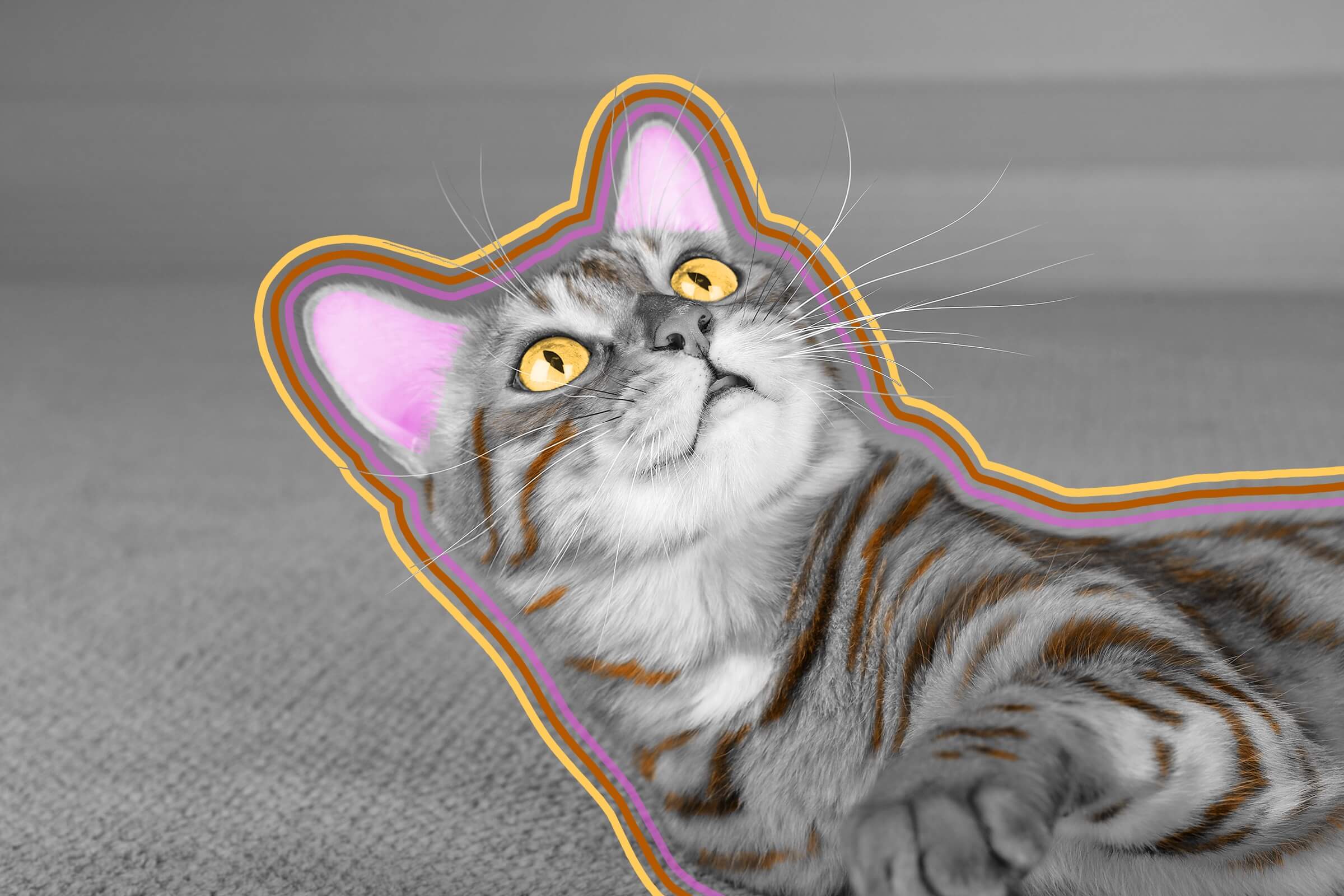
Cats can do a lot of things their human friends can’t: They can purr, sleep all day without consequence, and jump up to six times their own height in a single leap. But perhaps most impressive of all is their ability to see ultraviolet light thanks to UV-transparent lenses in their eyes that allow UV light to reach their retinas. This will come as little surprise to anyone who’s ever noticed their cat staring at seemingly nothing for minutes at a time, but it’s a fascinating insight into how our feline friends view the world all the same. In fact, their UV vision actually allows them to see their prey’s urine trail while hunting and distinguish between their prey and a similarly colored background. 

Cats have more bones than humans.

Ready to reveal?

Oops, incorrect!

It's a fact

Cats have 230 bones in their body, while adult humans have a mere 206 — perhaps yet another reason our furry companions feel so superior to us.

This ability may not help your housecat in any practical ways on a daily basis, as being fed from a can doesn’t require much in the way of hunting, but it’s still a cool evolutionary trick. And cats aren’t the only animals with this ability. Bees, birds, reindeer, and mice have this enhanced vision as well, though for some of them it comes with the trade-off of not being able to see the color red.

Numbers Don't Lie

Numbers Don't Lie

Types of ultraviolet light (UVA, UVB, UVC)
3
Percentage of shared DNA between tigers and cats
95.6%
Record for the most toes on a single cat (most cats have 18)
28
Known mammals other than cats that can’t taste sweetness
7

The technical term for someone who loves cats is ______.

Ready to reveal?

Confirm your email to play the next question?

The technical term for someone who loves cats is ailurophile.

Placeholder Image

Humans have kept cats as pets for at least 9,500 years.

When we think of cats in the ancient world, Egypt tends to come to mind first. Egyptians considered felines sacred and some even mummified their pets, but they weren’t the first to hold cats in such high regard. There’s evidence to suggest they were beaten to the punch by at least 4,000 years: A grave in Cyprus dating back some 9,500 years contained the remains of a human and cat alongside decorative objects such as seashells and polished stones.

Cats aren’t native to the island, meaning they must have been brought there by humans — perhaps “on a kind of Noah’s ark,” as archaeologist Melinda Zeder told National Geographic, theorizing that a number of non-native animals were transported to Cyprus.

Michael Nordine
Staff Writer

Michael Nordine is a writer and editor living in Denver. A native Angeleno, he has two cats and wishes he had more.

Original photo by Photology1971/ iStock

Letting out a well-timed expletive can feel pretty cathartic, but it turns out it can do more than make us feel better — it can also make us stronger. English psychologist Richard Stephens first got curious about the effects of swearing after watching his wife give birth — was it just a reaction to the pain, he wondered, or did cursing actually act as a physical boon?

He first tested his theory in 2009 by having subjects repeat a swear word of their choice while their hand was submerged in ice-cold water. The subjects who cursed lasted an average of 160 seconds — one minute longer than those who used non-swear words.

Crocodiles have the strongest measured bite of any living animal today.

Ready to reveal?

Oops, incorrect!

It's a fact

Saltwater crocodiles clamp their jaws with a force of about 3,700 psi — far surpassing humans (150-200 psi) and even big cats (1,000 psi). The great white shark's estimated bite of nearly 4,000 psi, however, has yet to be directly measured, so crocodiles remain on top for now.

In 2024, Stephens, along with Samford University associate professor Nick Washmuth, released another study showing that cursing during exercise indeed had measurable benefits. Participants were asked to repeat a swear word of their choice every three seconds during a Wingate Anaerobic Power Test — essentially a measurement of muscle performance during short, intense bursts of effort — and for 10 seconds before and throughout the duration of a grip-strength test. The results showed swearing increased peak power by 4.5% during the Wingate test and improved grip strength by 8% compared to using neutral words. During push-ups and planks, swearing every five seconds increased the time subjects were able to continue before total fatigue by 15% and 12%, respectively.

As impressive as that data is, scientists still haven’t been able to pinpoint an explanation. It was initially chalked up to the boost in strength provided by the adrenaline released during one’s fight-or-flight response. But later studies showed that not every participant demonstrated the changes in heart rate associated with the fight-or-flight response. The bottom line, however, remains clear: A timely curse word may not give you superhuman strength, but it could very well give you a crucial edge when you need it most.

Numbers Don't Lie

Numbers Don't Lie

Year of the first recorded use of the modern “F-word”
1503
Strength (in pounds of force) of a coconut crab’s pinch grip strength
742
Push-ups completed by the record holder for most push-ups in one hour by a woman
1,575
Average age U.S. children start using “adult” swear words
11

Our fight-or-flight response is controlled by the ______.

Ready to reveal?

Confirm your email to play the next question?

Our fight-or-flight response is controlled by the sympathetic nervous system.

Placeholder Image

"Gone With the Wind" almost lost one of its most iconic lines because of a swear word.

In the 1939 film adaptation of Gone With the Wind, Clark Gable’s Rhett Butler utters one of cinema’s most enduring parting lines to his wife Scarlett O’Hara (Vivien Leigh): “Frankly, my dear, I don’t give a damn.” Although it’s considered a mild curse word by today’s standards, at the time, “damn” almost didn’t make it past Hollywood’s strict film guidelines known as the Hays Code.

Producer David O. Selznick fought for the film to retain that emotional line — one that was lifted nearly word-for-word from the 1936 novel. Though Selznick was eventually granted special permission to keep the line, it wasn’t before he came up with a list of possible alternatives, including “I don’t give a straw,” “My indifference is boundless,” and “The devil may care — I don’t!”

Nicole Villeneuve
Writer

Nicole is a writer, thrift store lover, and group-chat meme spammer based in Ontario, Canada.