

Original photo by © Oleg Ivanov/Unsplash.com
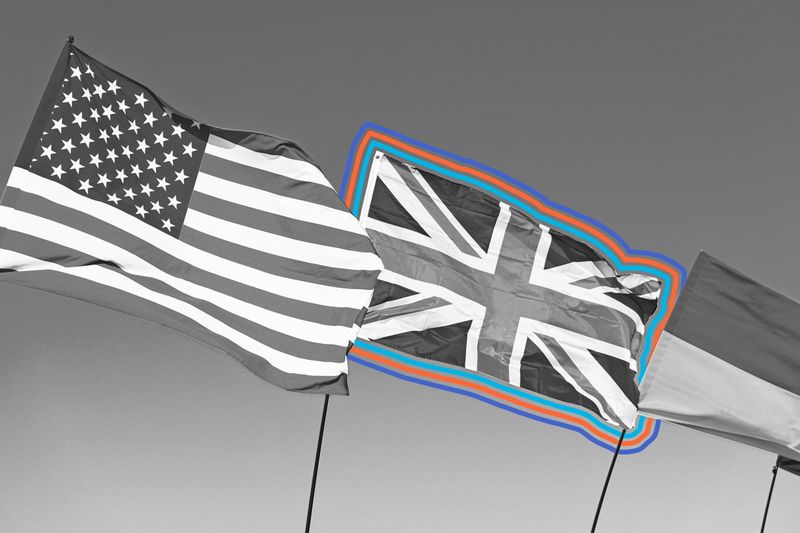
As of 2026, our planet is home to 195 countries, each with its own national flag. These flags come in a wide array of colors and designs, variously representing a nation’s history, geographic features, political beliefs, or core values. But if you take a closer look at the flags of the world, you may notice a pattern among them: a preponderance of red, white, and blue.
Around 30 countries use this exact trio of colors on their national flag (the exact number depends on whether you also include territories and dependencies), including the United States, the United Kingdom, France, Russia, Australia, the Netherlands, Norway, Chile, Cuba, New Zealand, Thailand, Serbia, Slovenia, and more. It’s by far the most common color combination.
So given all the possible color combos in the world, why these three hues? Is it just a coincidence, or something deeper? Here’s a closer look at this curiously common color combination.

The Dye Factor
National and dynastic flags have been in use for centuries. One of the oldest known flags is that of the Zhou dynasty in China, which existed between 1046 and 256 BCE. In Europe, flags that can be considered “national” began to be adopted in the Middle Ages and Renaissance era; England, for example, adopted the Cross of St. George in the 13th century.
Flags were also used by private businesses, naval warships, pirates, and more. And heraldry — the system of symbols, shields, and banners used to identify armies, noble families, and kingdoms — had been firmly established long before national flags appeared. By the end of the 18th century, flags as we know them today had been fixed as easily recognizable national symbols.
All those early designs, whether featured on shields, banners, or flags, have one thing in common: They came long before the invention of synthetic dyes. It wasn’t until 1856 that the then-18-year-old English chemist William Henry Perkin accidentally created mauveine — a brilliant purple dye — while attempting to come up with a treatment for malaria, thus giving birth to the synthetic dye industry. Before that, all dyes came from natural sources.
The colors that dominated European heraldry before Perkin’s invention, therefore, were shaped to a considerable degree by the practical realities of which natural dyes were naturally available, affordable, and durable. Red came from madder root (a plant widely cultivated across Europe as well as Asia, Africa, and the Americas) or from more expensive cochineal or kermes, both obtained from the dried, crushed bodies of insects. White required no dye at all, just straightforward bleaching, while blue came from woad, a plant in the mustard family whose leaves are used to produce blue dyes and pigments.
Together, those natural sources provided strong, widely available, colorfast dyes — making red, white, and blue the workhorses of the medieval dyer’s trade in many parts of the world.
In comparison, rare colors such as purple (which was made from the mucus of murex snails) were extremely costly, while green, orange, and black were difficult to create in colorfast form and tended to fade quickly. So, due to simple practicalities, red, white, and blue became embedded in European heraldry over the centuries — not necessarily through conscious choice alone, but also due to cost and availability. By the time nations began designing flags, those colors were already well-established and strongly affiliated with emblems and crests.
Follow the Flag
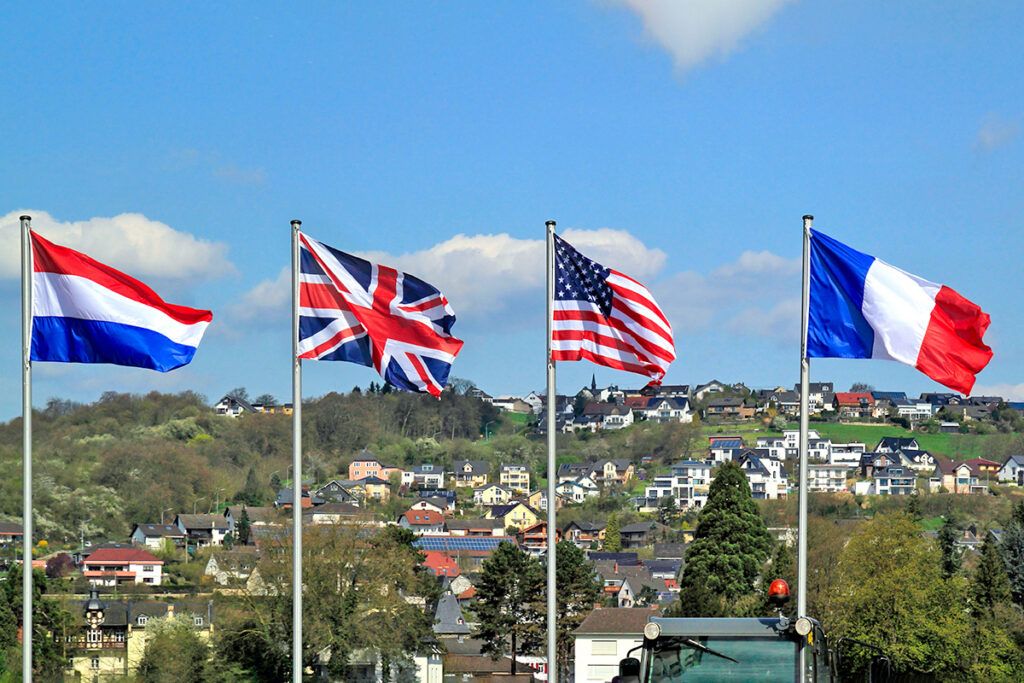
While the practicalities of dyeing played a role, the primary reason red, white, and blue became so prevalent across the globe can be traced to influence and imitation. The Dutch Republic, for example, was the dominant maritime and trading power of the 17th century, and it had adopted a tricolor of red, white, and blue horizontal stripes.
At the time, Dutch influence was widespread, and the republic’s flag became one of the most recognized symbols on Earth, seen on ships in every major port from the Americas to Asia. And when Peter the Great of Russia went to the Netherlands in the late 1600s, he deliberately adopted a similar flag, which in turn influenced other countries including Slovakia, Bulgaria, Croatia, and more — creating a global family of flags with shared color schemes.
Britain’s Union Jack, which dates back to 1606, was similarly influential. Its red, white, and blue design — a combination of the crosses of St. George, St. Andrew, and St. Patrick — was the result of centuries of heraldic tradition. As Britain became a global power and eventually the largest empire in world history, its flag became hugely influential across the planet. Australia, New Zealand, Fiji, and Tuvalu all still feature the Union Jack as an element of their national flags, while the British red, white, and blue inspired many other nations to adopt those three colors or at least some of them.
France’s tricolor of red, white, and blue similarly influenced other flags, particularly due to its association with the French Revolution — further demonstrating how one nation’s flag can affect others on a truly global scale.
Other Popular Colors
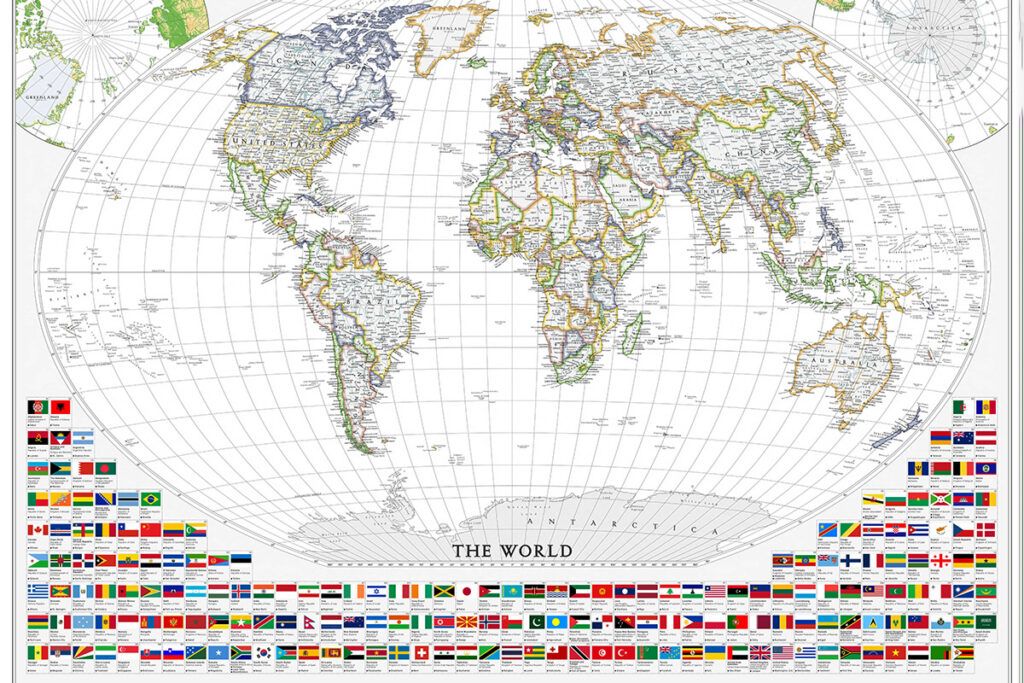
The red, white, and blue found on powerful European flags spread to many other nations across the globe either through conquest, colonization, or deliberate imitation. In some parts of the world, however, those three colors did not have the same influence.
In the Middle East, for example, the four traditional Muslim colors of red, white, green, and black have had far greater influence, and the flags of many Islamic states feature one or more of those colors. Across Asia, meanwhile, many nations have flags bearing religious or political symbols — for example, the Chinese flag has five stars representing the Communist Party, workers, peasants, intellectuals, and soldiers.
In many cases, those flags weren’t influenced in any way by Europe, and in fact they sometimes predate European flags by centuries. But red and white are still the most common colors on Asian flags, followed by green. Blue, however, is notably less popular on Asian flags than it is on the flags of other continents.
So, while red, white, and blue are by far the most common color combination on national flags, there’s a whole world of alternative colors and designs for flag enthusiasts to study and admire.

Tony is an English writer of nonfiction and fiction living on the edge of the Amazon jungle.
top picks from the Inbox Studio network
Interesting Facts is part of Inbox Studio, an email-first media company. *Indicates a third-party property.