

Original photo by PDerrett/ iStock
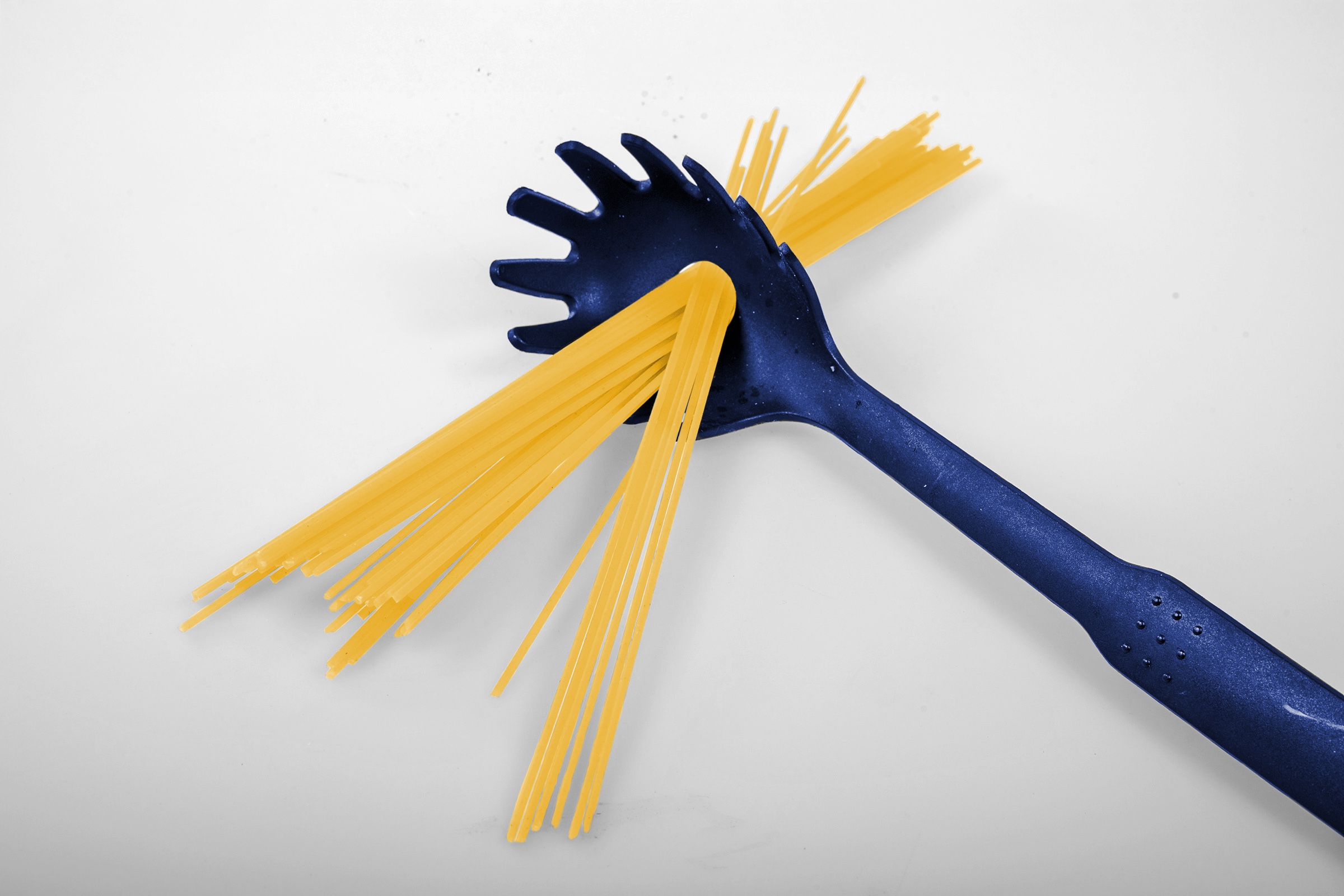
You probably reach for some kind of kitchen utensil every day, whether a fork, spoon, spatula, or cheese grater. These tools seem pretty straightforward, but some conceal clever uses that may go unnoticed. For instance, have you ever used the little loop on your vegetable peeler? Or measured pasta with your serving spoon?
Some of these features were designed intentionally, while others have been happily found to be useful in more ways than one. Here are a few of the ingenious hidden features found on everyday kitchen tools.

Notches on Kitchen Shears
Kitchen shears are an often-overlooked utensil. A good pair can do more than just tear open food packaging in a pinch; they’re an easy way to cut through meat, chop vegetables, finely snip herbs, and even slice up a rustic pizza.
But that’s not all they do. Take a look at the blades on your shears — if one edge has a crescent-shaped cut-out, that’s a bone notch, meant to help stop slippage and cut through bones in poultry or fish.
There’s another neat feature, too: On the inside of the handles, shears often have serrated metal teeth that form a circle, which can be used to twist open a stubborn jar or twist-top bottle or even to crack shelled nuts or shellfish.

Spaghetti Spoon Measuring Holes
That hole in the center of your pronged pasta server isn’t just for drainage when scooping pasta out of boiling water. Depending on the spoon’s design, the opening may also work as a measuring tool for approximating a single serving of dry spaghetti noodles.
Keep in mind, however, that while the latter can be handy, it’s not universal. Pasta servers aren’t made to one specific standard, so the size and shape of the center hole can vary widely. Serving sizes vary too; a standard package of store-bought spaghetti considers a portion to be roughly 2 ounces (with roughly a quarter-sized diameter when held in a bunch), but no one spoon will reliably measure that exact amount every time.

Vegetable Peeler Scoops
Many vegetable peelers are adorned with a small, barely noticeable bump on them. This can usually be found right on the top of older-style straight peelers, while on newer, wider Y-shaped peelers, it’s usually on the side.
This notch is designed to remove potato eyes or other vegetable and fruit blemishes without having to switch to a paring knife. It’s a small but useful detail that can save time and frustration — and maybe a nicked fingertip or two.
It’s simple to use: Place the notch over the unwanted spot and scrape or scoop it away. This works on potatoes, carrots, or any firm fruit or vegetable with imperfections, and you barely even have to break your peeling stride.
More Interesting Reads



Box Graters’ Zesting Side
Many people associate box graters so strongly with cheese that they simply refer to it as a cheese grater. And, yes, a box grater is primarily used for grating cheese. One side grates the long, thick shreds ideal for melting (the most commonly used side), while another shreds cheese or vegetables into finer strands, and another into thin slices. But what about those imperceptibly tiny holes that feel almost dangerous to the touch?
That’s known as the rasp-style grater, and while it can indeed be used for cheese — hard varieties such as parmesan work best — it’s best when zesting citrus. You’ll want to press the rind or other food lightly against this side and move it in short strokes, taking care not to scrape your knuckles. It’s also excellent for grating tough spices such as cinnamon and nutmeg.

Holes in Cutting Board Handles
Many cutting boards have wide handles that make it easier to hang them up or pull them out from inside a cupboard, but they also work as a funnel for transferring chopped food or food scraps. Enterprising home cooks have figured out that if you slide the handle opening over the edge of the counter, you can easily push scraps through the hole and into a garbage or compost bin below — no more fluttering onion skins escaping as you carry your board from point A to point B.
Additionally, you can lift the cutting board over to your cooktop and safely slide prepped ingredients into a pot or pan. The board can also act as a splashguard in the process if the water or cooking oil is already hot.
Of course, not every cutting board has a handle with a hole, nor will the holes always be the ideal shape and size for moving food or waste through. If yours does, however, you may just have a new way to use one of your trustiest tools.

Colander Holes for Herbs
Colanders aren’t just for draining pasta — their perforations can also be used to quickly and neatly strip herb leaves from their stems. Simply feed the stems through the holes from the inside to the outside, pull, and the leaves slide off with minimal effort right into the colander.
You’ll want to use the medium-sized holes on your colander and make sure you’re not using stems or leaves that have gone too limp or woody. It makes for a little bit of extra cleanup, but it may be worth it to avoid taking up drawer space with a one-use tool such as a specialized herb stripper.

Spoon Holders in Saucepan Handles
We’ve all been there: standing over a tomato sauce simmering away on the stove with a trusty wooden spoon in hand. But when you’re done stirring, where do you rest the spoon without leaving a mess on the counter or grabbing an extra dish if you don’t have a specialized spoon rest?
As it turns out, many saucepan handles solve this problem with the small hole at the end of the handle. While that hole is primarily meant for hanging the pot on a hook or peg, it can also double as a spoon rest with teh right setup.
Simply stick the bottom end of the spoon’s handle the slot, leaving it slanted up toward the pot so any drips will fall back in the sauce and not all over your counter. Just be cautious and give the spoon a quick check for any heat transfer before grabbing it to finish your dish.

Nicole is a writer, thrift store lover, and group-chat meme spammer based in Ontario, Canada.
top picks from the Inbox Studio network
Interesting Facts is part of Inbox Studio, an email-first media company. *Indicates a third-party property.