

Original photo by © Dorling Kindersley RF/ Getty Images
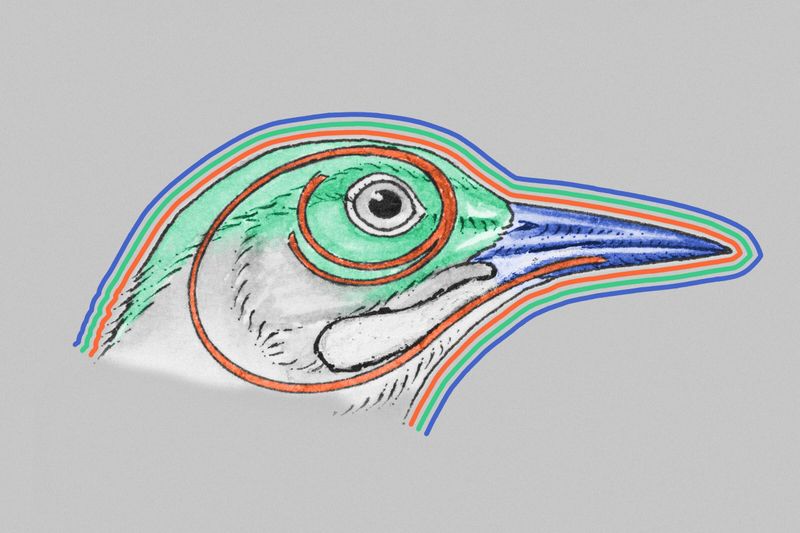
Woodpeckers rank among nature’s most extraordinary engineers, especially when it comes to excavation. They use their beaks to hammer away at tree trunks up to 20 times per second. It’s an ability that raises one obvious question: How do they not knock themselves out? For a while, scientists thought part of the answer lay in the woodpecker’s extraordinarily long tongue — a tongue so long it wraps around the bird’s skull.
A woodpecker’s tongue, when considered in conjunction with the entire hyoid apparatus (a system of bones and muscles that controls tongue movement), originates at the upper beak, runs up the forehead and between the eyes, then loops around the back of the skull before coming out at the base of the lower beak. Some woodpeckers have tongues 4 to 5 inches long, roughly one-third of their total body length. In addition to being extra-long, woodpecker tongues are sticky and covered in tiny barbs at the tip, which helps them extract insects from deep inside tree holes.




Oops, incorrect!
It's a factLemurs — the small, large-eyed primates that live on the island of Madagascar — have a second tongue, known as a sublingua, located underneath their main tongue. It aids in their social grooming rituals.
For decades, scientists believed those long, skull-encompassing tongues served a second remarkable purpose: protecting the woodpecker’s brain from injury through shock absorption. It’s easy to see why biologists and ornithologists found the idea so compelling; the tongue could quite logically act as a shock absorber around the skull.
Engineers have even modeled football and bicycle helmets on this supposed woodpecker anatomy, implementing liners with multiple layers of different materials and densities. Those designs mimic the woodpecker’s cranial anatomy to create helmets that cradle the head more completely and redirect force away from the brain from multiple angles simultaneously.
For a long time, the incorrect theory about woodpecker tongues protecting the brain gained traction and was propagated online. Then, in 2022, researchers demolished the hypothesis using high-speed cameras. Frame-by-frame video analysis showed that woodpecker skulls act like stiff hammers and don't have built-in shock absorption.
So the tongue wrapping, while real and spectacular, has nothing to do with protecting the brain. What actually keeps a woodpecker’s noggin safe is a combination of its small, tightly fitted brain, the brain’s tilted position within the skull, and the very brief duration of each impact — too short for damaging force to accumulate.

Numbers Don't Lie
More Interesting Reads






Woody Woodpecker is the official mascot of ______.
Ready to reveal?
Confirm your email to play the next question?
Woody Woodpecker is the official mascot of Universal Studios.

A blue whale’s tongue weighs the same as an entire adult elephant.
We sometimes underestimate just how massive a blue whale actually is. Many people assume the largest dinosaurs were bigger than anything in existence today, but that’s not true: The blue whale is by far the largest known animal ever to have graced our planet. An adult can grow to more than 100 feet in length and weigh up to 200 tons — about the same as 30 comparatively puny Tyrannosaurus rexes put together.
The blue whale is so huge that its tongue alone can weigh as much as 4 tons, making it the largest and heaviest tongue in the world by far. To put it into perspective, a blue whale’s tongue weighs about the same as an adult Asian elephant. And if one of those magnificent whales were to open its mouth to a bunch of curious humans, its tongue would have enough surface area to comfortably accommodate 50 standing people.

Tony is an English writer of nonfiction and fiction living on the edge of the Amazon jungle.
top picks from the Inbox Studio network
Interesting Facts is part of Inbox Studio, an email-first media company. *Indicates a third-party property.