
Original photo by Ingrid Pakats/ Shutterstock
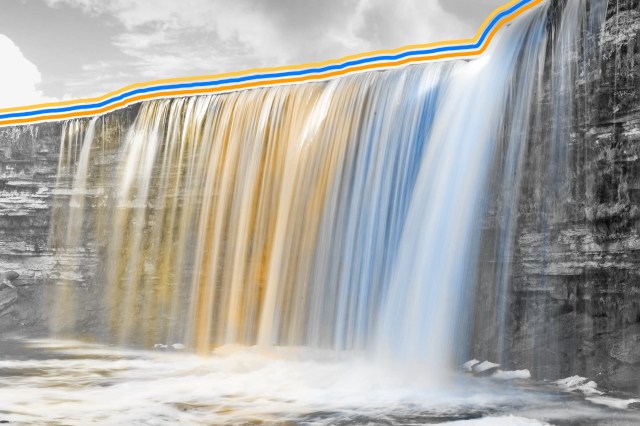
Waterfalls are some of the world’s most amazing wonders. Millions of people flock to these water-rushing giants — with names like Niagara, Yosemite Falls, and Iguaçu — to see them up close and in person. However, the largest waterfall in the world has no ticket counter, no gift shop, and no tourists. In fact, there’s nothing at all to see, because this waterfall is entirely underwater.




Oops, incorrect!
It's a factAt an impressive 541 feet, Cascata delle Marmore is an incredible display of Roman engineering. Although they may be known best for their impressive aqueducts, Romans were also in the waterfall-making business, and built this one in 271 BCE to redirect stagnant water to a nearby river.
Nestled between Greenland and Iceland is a body of water known as the Denmark Strait, and beneath its waves lies the world’s largest waterfall. Known simply as the Denmark Strait cataract (a “cataract” is a type of powerful, flowing waterfall), it cascades 11,500 feet toward the seafloor. This incredible deluge — like other underwater cataracts — is actually a dramatic dance between warm and cold water. In the case of the Denmark Strait cataract, cold water from the Nordic Sea meets the much warmer water of the Irminger Sea southwest of Iceland. The cooler, denser water sinks beneath the lighter, warmer water, dropping more than 2 miles to the seafloor. The resulting waterfall completely dwarfs Venezuela’s Angel Falls, the tallest terrestrial waterfall in the world, by more than 8,000 feet. The Denmark Strait cataract is also a staggering 100 miles wide, nearly 15 times wider than the widest terrestrial waterfall, the Khone Phapheng Falls in Laos, which is only 6.7 miles wide. By every single metric, this underwater avalanche towers over the competition — even though it never rises above sea level.

Numbers Don't Lie
More Interesting Reads




______ is the only waterfall that’s one of the Seven Wonders of the Natural World.
Ready to reveal?
Confirm your email to play the next question?
Victoria Falls is the only waterfall that’s one of the Seven Wonders of the Natural World.

The world’s largest volcano is also (mostly) under the ocean.
Some 590 miles northwest of Honolulu, a small, unassuming island known as Pūhāhonu (Hawaiian for “turtle rising for breath”) covers only a 5-acre expanse. But underneath the sea, Pūhāhonu is actually the very tip of the world’s largest volcano. Pūhāhonu is a shield volcano, a type of volcano named for its overall shape — which resembles a shield laying on the ground — and in 2020, scientists confirmed that its size surpassed that of the previous record-holder, Mauna Loa. At 36,000 cubic miles, it’s almost twice the size of Mauna Loa, which clocks in at only 19,200 cubic miles. Part of the reason Pūhāhonu remained such a well-kept secret is that nearly two-thirds of its bulk is below the ocean floor, and is covered by debris and broken coral. The volcano is so heavy, it has actually caused the Earth’s crust nearby to sink.

Darren Orf lives in Portland, has a cat, and writes about all things science and climate. You can find his previous work at Popular Mechanics, Inverse, Gizmodo, and Paste, among others.
top picks from the Inbox Studio network
Interesting Facts is part of Inbox Studio, an email-first media company. *Indicates a third-party property.