
Original photo by Sue Smith/ Shutterstock
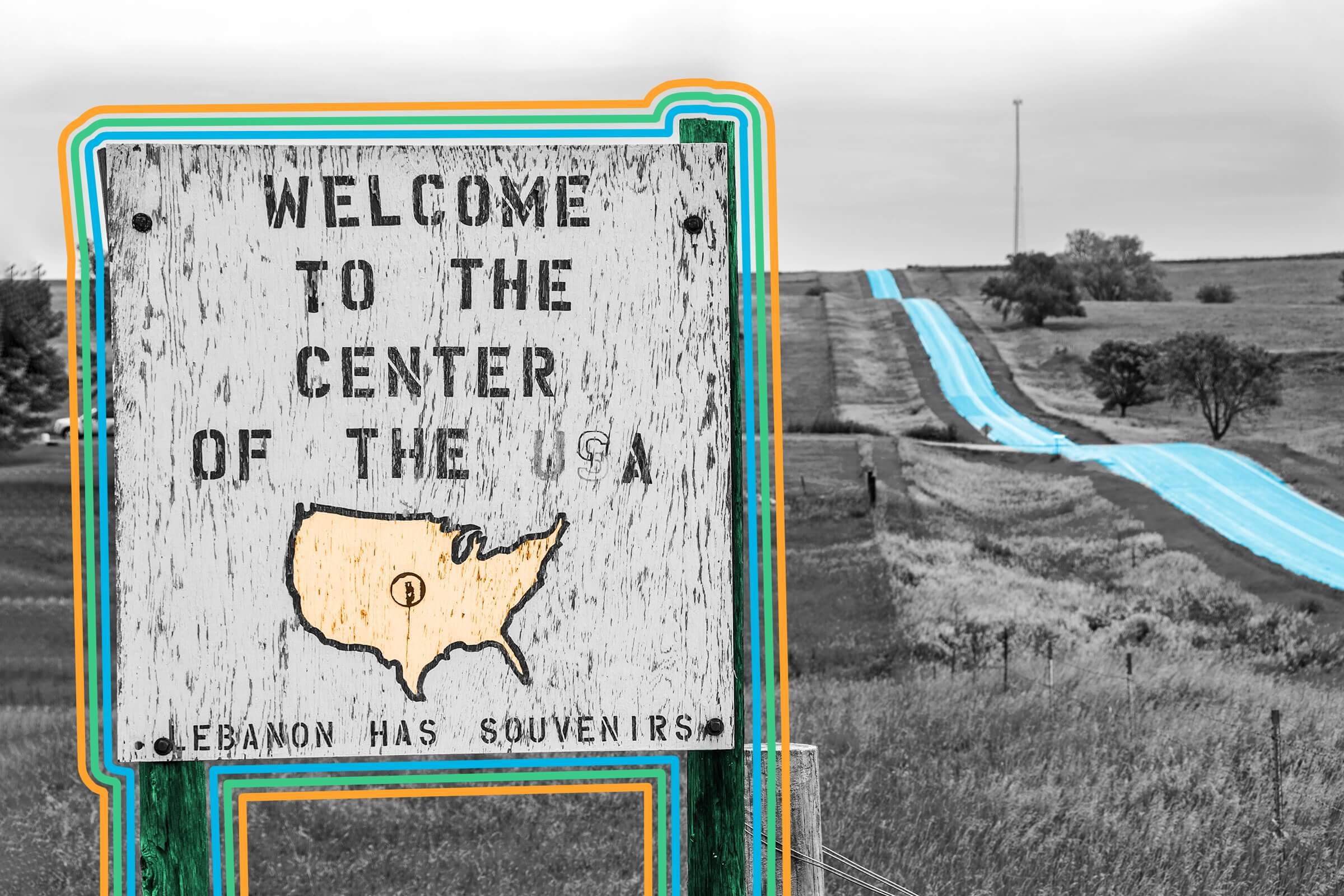
Many states consider themselves the heartland of America, but where exactly is the geographic center of the U.S.? If you’re including only the lower 48 states, look no further than a nondescript field north of Lebanon, Kansas, located at 39° 50' 00" N 98° 35' 00" W. Not much marks this otherwise typical stretch of Midwestern farmland, except for a nearby historical marker noting that the location was determined by the U.S. Geological Survey, and that the point is “where a plane map of the 48 states would balance if it were of uniform thickness.” In earlier times, this accolade garnered enough tourists for a motel to be built nearby, selling souvenirs and a night’s rest at the center of the country. While the souvenirs remain (in downtown Lebanon), the motel has since closed up shop.




Oops, incorrect!
It's a fibWhile Kansas does produce its fair share of corn, the total is a far cry from that grown in the nearby state of Iowa, which produced 2.5 billion bushels of corn in 2023.
Of course, this isn’t the center of the entire U.S., which drastically stretched its borders when it welcomed Alaska and Hawaii into the union at the end of the 1950s. In 1959, a U.S. Coast and Geodetic Survey concluded that the new center of the U.S. (excluding territories) had lurched northwest toward the small town of Belle Fourche, South Dakota, which today posts a similar plaque regarding its centralized status. How long Belle Fourche keeps its title remains to be seen, as many contenders to be the 51st state — whether Puerto Rico, Guam, or some other territory — could once again relocate the bullseye of the U.S.

Numbers Don't Lie
More Interesting Reads





Kansas is named after the Kansa tribe, whose name means “______.”
Ready to reveal?
Confirm your email to play the next question?
Kansas is named after the Kansa tribe, whose name means “wind people.”

Helium gas was discovered on Earth in a Kansas field in 1903.
One of the biggest discoveries in chemistry began with a party foul. In May 1903, residents of Dexter, Kansas, planned a major celebration in honor of a “howling gasser” that had recently been drilled nearby, and which was unleashing 9 million cubic feet of gas a day. Excited for what they believed were vast natural gas reserves, the residents dreamed of the forthcoming economic opportunities, and held a big bash complete with a parade, speeches, and games, all leading to the final event of the night — lighting the gas in celebration of the town’s good luck. The town mayor set a bale of hay on fire that slowly moved toward contact with the gas, and then … the fire went out. The mayor tried to light the gas again. No luck. While dreams of economic prosperity quickly dimmed, scientific curiosity took over. Intrigued by this strange gaseous event, the state’s geologist, Erasmus Haworth, sent a sample of the gas to the University of Kansas. It was there that chemist David F. McFarland discovered an “inert residue” that essentially made the gas nonflammable — and part of that “inert residue” was helium. Although helium had been discovered decades earlier, scientists initially believed the gas was found only in high concentrations in the heavens. This happy (or, for the residents of Dexter, somewhat unhappy) accident in a small town in Kansas proved them wrong.

Darren Orf lives in Portland, has a cat, and writes about all things science and climate. You can find his previous work at Popular Mechanics, Inverse, Gizmodo, and Paste, among others.
top picks from the Inbox Studio network
Interesting Facts is part of Inbox Studio, an email-first media company. *Indicates a third-party property.