

Original photo by © Science Photo Library/Alamy
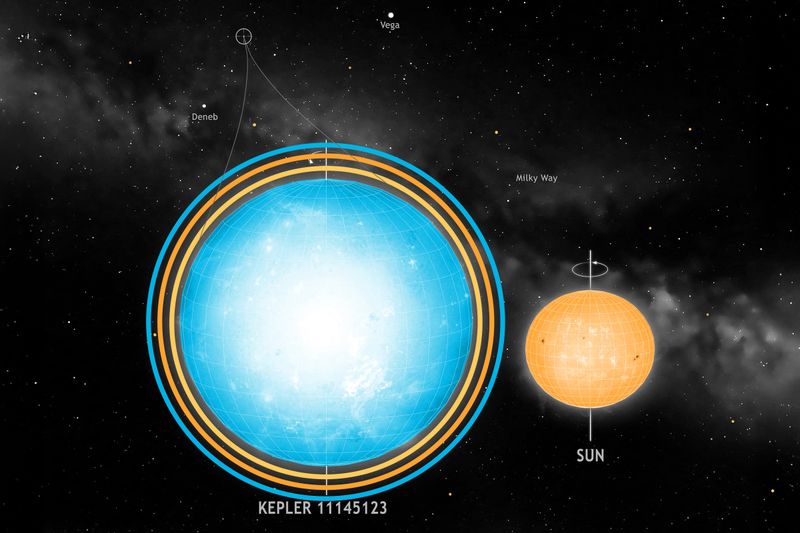
No object — whether made by humans or found in nature — is a mathematically perfect sphere. But that’s not to say that we can’t rank natural objects in terms of their sphericity. For many years, the sun held the record as the roundest known natural object ever measured. But then scientists found a star 5,000 light-years away that’s even rounder.
The sun is roughly 865,000 miles in diameter, yet despite its enormous size, it’s almost perfectly round. The difference between its widest and narrowest points (its equatorial and polar diameters, which differ slightly due to the effects of rotation) is only about 6.2 miles. That makes our star a 99.9997% perfect sphere — a staggering achievement of near-perfect cosmic geometry.
But the sun no longer holds the record. In 2016, a team of astronomers from the Max Planck Institute for Solar System Research announced they had discovered the roundest object ever observed in nature: Kepler 11145123. That hot, luminous A-type star is more than twice the size of the sun and rotates three times more slowly — which partly explains its remarkable shape, as the slower rotation produces less centrifugal flattening.




Oops, incorrect!
It's a factA 1-inch cube of water contains about 600 sextillion molecules (written out, that’s "6" followed by 23 zeros). In comparison, the observable universe contains an estimated 5 sextillion stars.
Other factors that could contribute to the star’s roundness include the possibility of a weak magnetic field surrounding the star’s equator (essentially acting as a giant girdle and keeping the star in trim spherical shape) and differential rotation between its core and surface. In other words, the exterior layers of the star could rotate faster than the core, meaning the star may not be spinning as fast as it appears by looking at it from the outside.
Using asteroseismology — the study of the oscillations of stars — the astronomers were able to measure the star’s shape with extraordinary precision. They found the difference between the equatorial and polar radii of the star is a mere 1.86 miles — an astonishingly small number compared to the star’s mean radius of approximately 932,000 miles. When it comes to roundness, Kepler 11145123 will be very hard to top.

Numbers Don't Lie
More Interesting Reads






The color of sunsets on Mars is ______.
Ready to reveal?
Confirm your email to play the next question?
The color of sunsets on Mars is blue.

Light takes an average of eight minutes and 20 seconds to reach Earth from the surface of the sun.
It may seem as if light from the sun reaches us here on Earth almost instantly, but it actually takes more than eight minutes on average. Considering nothing in the universe travels faster than light, that may seem like quite a long time. But at any given time, Earth is an average of 93 million miles from the sun — a distance even light takes some time to cover.

Tony is an English writer of nonfiction and fiction living on the edge of the Amazon jungle.
top picks from the Inbox Studio network
Interesting Facts is part of Inbox Studio, an email-first media company. *Indicates a third-party property.