

Original photo by Mr.Kuiku/ Shutterstock
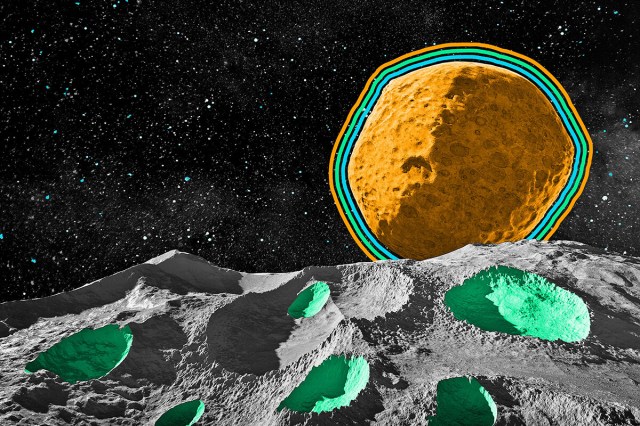
There are more than a million known asteroids in our humble solar system, most of which are fairly small and irregularly shaped. There are some outliers, however. Some asteroids are nearly spherical, and some are so big they have their own moons — around 150 of them are in this category, in fact. There are even binary and trinary asteroids that orbit one another like celestial twins and triplets, which surely makes hurtling through the vacuum of space less lonely than it would be otherwise. (In February 2022, astronomers even discovered a quaternary asteroid — 130 Elektra, which has three moons.) Like their moonless counterparts, the majority of these asteroids can be found in the asteroid belt between Mars and Jupiter, and are believed to be remnants from the creation of the solar system.




Oops, incorrect!
It's a fibSpare a thought for Mercury and Venus, which have a grand total of zero moons between them. Astronomers believe this is because they’re so close to the sun, which would likely capture any natural satellites orbiting them.
The first asteroid moon discovered was Dactyl, a mile-wide natural satellite orbiting the asteroid Ida and initially spotted in 1994. Other asteroids with moons include 45 Eugenia, 3122 Florence (which has two moons), and 87 Sylvia, which is roughly the same size as West Virginia and was the first trinary asteroid discovered. It’s also among the largest known asteroids in our solar system. As for the largest asteroid to ever hit Earth, it wasn’t the one that killed the dinosaurs (RIP). That distinction may belong to the asteroid that caused the Vredefort crater in South Africa, which once may have been around twice as large as it is now. A recent study concluded that the asteroid that made the crater may have been between 12.4 and 15.5 miles across when it made impact some 2 billion years ago. Hopefully, we won’t see one like it again any time soon.

Numbers Don't Lie
More Interesting Reads






“Asteroid” comes from a Greek word meaning “______.”
Ready to reveal?
Confirm your email to play the next question?
“Asteroid” comes from a Greek word meaning “starlike.”

The first asteroid ever discovered is now considered a dwarf planet.
If you find Pluto’s unjust trajectory from planet to dwarf planet hard to follow, wait until you hear about Ceres. Discovered on New Year’s Day 1801 by Guiseppe Piazzi at Sicily’s Palermo Astronomical Observatory, it was originally considered a planet before being reclassified as an asteroid in the 1850s — the first time we mere mortals realized that asteroids were a distinct class. Other early asteroids include Pallas (1802), Juno (1804), and Vesta (1807), all of which are smaller than Ceres — which is why the latter was reclassified again, this time as a dwarf planet, in 2006. In addition to Pluto and Ceres, the International Astronomical Union (IAU) recognizes three other dwarf planets: Eris, Makemake, and Haumea.

Michael Nordine is a writer and editor living in Denver. A native Angeleno, he has two cats and wishes he had more.
top picks from the Inbox Studio network
Interesting Facts is part of Inbox Studio, an email-first media company. *Indicates a third-party property.