

Original photo by murat4art/ iStock
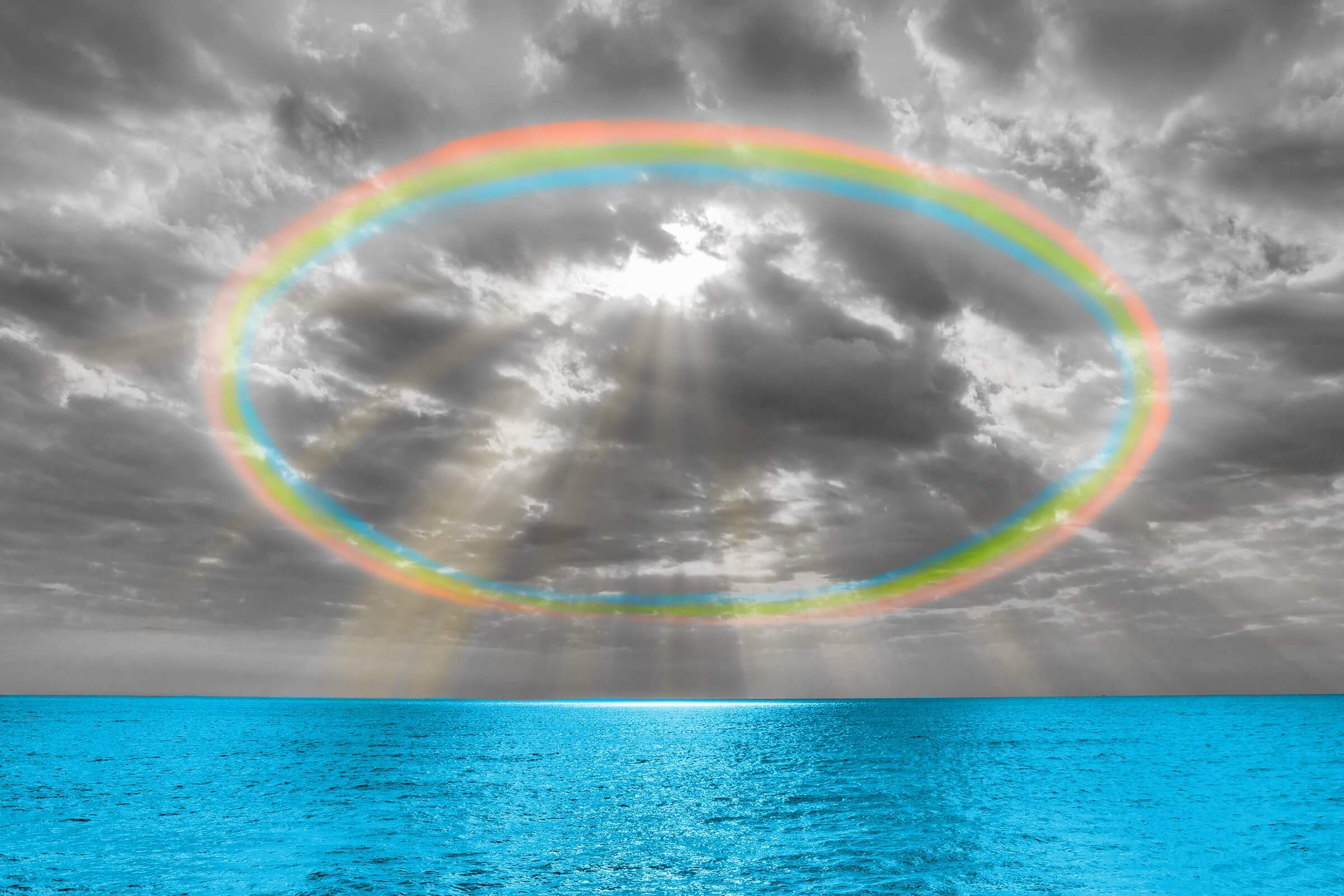
Most of us think of rainbows as arches that stretch across the sky, but in reality, every rainbow forms a complete circle. That circle is centered on the point in the sky directly opposite the sun — the same direction your shadow points. From the ground, the horizon blocks the lower half of that circle, so you usually see only the rainbow’s upper arc.
The higher your vantage point, the more of that hidden circle you can see. From airplanes, observers can sometimes view the complete circular rainbow, since nothing blocks the ring’s lower half from that perspective. Photographs taken from research and weather aircraft often capture those full rings floating in clouds, revealing the rainbow’s true shape.




Oops, incorrect!
It's a factLunar rainbows — or moonbows — form when moonlight refracts through rain or mist, just like sunlight does. Because moonlight is faint, they often appear white to the naked eye, but cameras can reveal their full spectrum of color.
A rainbow is formed by the way sunlight interacts with millions of tiny raindrops. As light enters a droplet, it bends (refracts), reflecting off the inside of the droplet, and then bends again as it exits. Those changes in direction separate the light into its different colors and direct them back toward your eyes. Only the droplets positioned at a specific angle relative to the sun — about 42 degrees for red light, for instance — send color your way.
Every raindrop that sends light to your eye does so at the same angle from the point opposite the sun, and all the droplets at that shared angle form a circle around that point, creating that curved colorful band in the sky. Because the effect depends on your exact position relative to the sun, the rainbow you see is tied to your unique viewpoint. Move even a few steps, and a different set of droplets creates slightly different colors. No two people ever see precisely the same rainbow.

Numbers Don't Lie
More Interesting Reads





The spot directly opposite the sun at the center of a rainbow is called the ______.
Ready to reveal?
Confirm your email to play the next question?
The spot directly opposite the sun at the center of a rainbow is called the antisolar point.

One of the most recognizable album covers of all time features a rainbow.
The prism and color spectrum on Pink Floyd’s 1973 album The Dark Side of the Moon is arguably the most iconic rainbow in rock history. The original album artwork, designed by Storm Thorgerson, depicts a beam of white light entering a triangular prism from the left and emerging on the right as a rainbow — though it omits the indigo band typically included in a full spectrum.

Kristina is a coffee-fueled writer living happily ever after with her family in the suburbs of Richmond, Virginia.
top picks from the Inbox Studio network
Interesting Facts is part of Inbox Studio, an email-first media company. *Indicates a third-party property.