

Original Photo By © Zakhar Vozhdaienko/Pexels.com
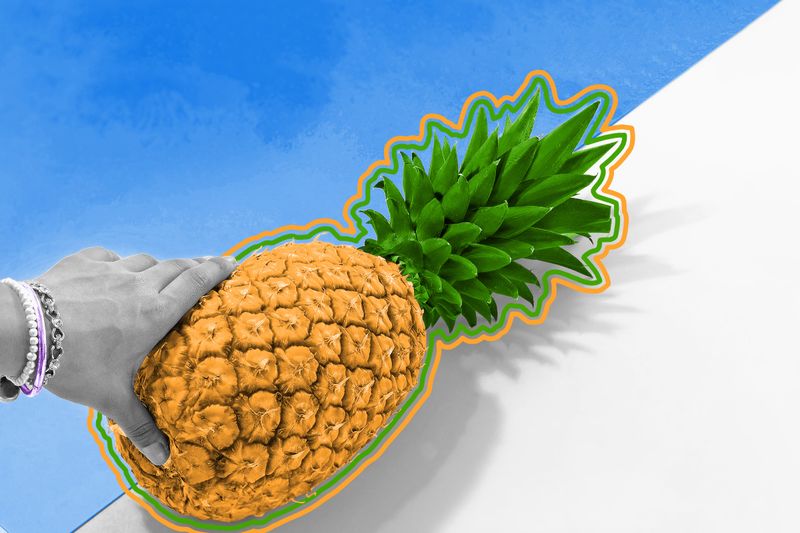
In our everyday language, berries are typically small, juicy fruits. But in botany, a berry is a fruit that develops from the single ovary of an individual flower and has seeds throughout its fleshy interior. By that definition, each segment of a pineapple begins as a berry. As dozens of these berries grow and fuse together, they form the fruit we know as a pineapple.




Oops, incorrect!
It's a factThose tiny dots are called “achenes”; each one is technically an entire one-seeded fruit itself.
Pineapples grow as a cluster of flowers arranged around a central stalk. Each flower produces its own small fruit; as the fruits grow, they press together and eventually merge into a single structure. Botanists classify this type of structure as a multiple fruit. That’s why the rough exterior of a pineapple has a diamond-shaped pattern: Each section marks the location of a separate flower — and a separate berry — that became part of the finished fruit. Figs and mulberries also fit the multiple-fruit bill; both form from clusters of flowers that combine as they develop.
Surprisingly, bananas and tomatoes are true botanical berries, too, while the most common fruits that have the label — strawberries, raspberries, and blackberries — are not. The latter three qualify as aggregate fruits, botanically speaking. Unlike a multiple fruit, which develops from multiple flowers, an aggregate fruit develops from multiple ovaries inside a single flower. This results in a cluster of tiny fruitlets that form the larger “berry.”

Numbers Don't Lie
More Interesting Reads






In Old English, the word “berry” (or “berie”) originally meant ______.
Ready to reveal?
Confirm your email to play the next question?
In Old English, the word “berry” (or “berie”) originally meant grape.

When you eat pineapple, it eats you back.
If you’ve ever felt a strange tingling or burning sensation on your tongue after eating fresh pineapple, you’re not imagining it. The tropical fruit contains a group of enzymes called bromelain, which breaks down proteins.
When we eat pineapple, bromelain begins to dissolve the protective layer of mucus on our mouth’s soft tissues. That also makes the pineapple’s natural acidity feel more irritating. Because the mouth continuously repairs and replaces surface tissues, bromelain doesn’t cause any lasting harm in humans, but it can lead to a few tingly bites.
Bromelain isn’t all bad: It has, somewhat ironically, been studied for its anti-inflammatory properties as well. In the meantime, cooking, canning, or salting your pineapple should help destroy most of the bromelain and make for a gentler snacking experience.

Nicole is a writer, thrift store lover, and group-chat meme spammer based in Ontario, Canada.
top picks from the Inbox Studio network
Interesting Facts is part of Inbox Studio, an email-first media company. *Indicates a third-party property.