

Original photo by fieldwork/ iStock
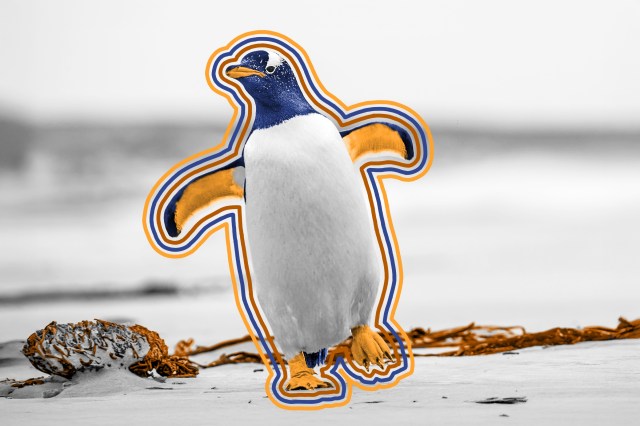
Not unlike their human counterparts, penguin legs have a femur, tibia, fibula, and knee. But unlike ours, the knees are covered by feathers — as is the rest of the upper leg, which is why penguins’ legs look so adorably stubby.
That appearance is most evident when the less-than-graceful birds are seen waddling on land, which is a more energy-efficient means of locomotion than it appears. They use 80% less energy than they would walking the way we do, as their movement relies on momentum and gravity to propel them forward rather than their own effort.




Oops, incorrect!
It's a fibQuite the opposite — they’re almost exclusively found in the Southern Hemisphere, primarily Antarctica. Only the Galápagos penguin sometimes ventures north of the equator.
Even so, penguins — which are collectively known as a “waddle” when on land and a “raft” when in water — are at their most elegant when swimming. An adult king penguin can hold its breath for 23 minutes and dive more than 1,000 feet deep in search of food. The animals spend up to 75% of their lives in water, which may help explain why they sometimes look like, well, a fish out of water when going about their business on land.

Numbers Don't Lie
More Interesting Reads




The largest penguin species by size is the ______.
Ready to reveal?
Confirm your email to play the next question?
The largest penguin species by size is the emperor penguin.

Penguins give each other pebbles as a sign of affection.
Most penguins live in rather barren environments, so they have to get creative when it comes to keeping their young warm. That makes pebbles especially precious as a building material for their “love nests.” Male gentoo penguins also give these desirable stones to their mates as a sign of affection. Picking an especially good pebble out of the water and carrying it a significant distance back to a shared nest is essentially the penguin equivalent of giving someone a love note or a bouquet of flowers.

Michael Nordine is a writer and editor living in Denver. A native Angeleno, he has two cats and wishes he had more.
top picks from the Inbox Studio network
Interesting Facts is part of Inbox Studio, an email-first media company. *Indicates a third-party property.