
What’s the most boring day in history — a day where truly nothing important happened? That was the question posed in 2010 to a computer program named True Knowledge. Designed by computer scientist William Tunstall-Pedoe, the program contained 300 million facts, many of them tied to dates. After scouring those facts and comparing them to their respective dates, True Knowledge decided that April 11, 1954, was the most boring day in the 20th century. Belgium held a general election, some sports events happened, a coup in India was possibly planned but not carried out until two days later, and no notable births or deaths occurred — at least as far as the computer program could figure out.
Although the phrase “April showers bring May flowers” seems to crown the month as a pretty soggy time of year, April is actually the fifth-wettest month on average in the U.S. The actual wettest month is usually June, though the wettest month ever recorded was May 2015.
However, scientists may have some other days to suggest when it comes to the most boring day in history ever. The period from around 1.8 billion to 800 million years ago is known to geologists as “the Boring Billion,” because very little happened on Earth in terms of evolution, atmospheric chemistry, or geologic formation. Basically, it’s like the Earth was on pause for a billion years. It wasn’t until the Cambrian Explosion some 530 million years ago, when most major animal groups started to appear in the fossil record, that things really started to get exciting. So chin up, April 11, 1954: You weren’t very interesting, but there’s at least a billion years that you easily beat.
According to a 2022 University of Essex study, the most boring job is data analysis.
Advertisement
Boredom may be good for your brain.
Today, boredom is under threat, with billions of smartphones bringing nearly limitless distraction to us worldwide. But while boredom may be uncomfortable, it can also be good for our brains. These precious moments of downtime give our brains a much-needed chance to rest, consolidate memories, and reflect on lessons learned throughout the day. Studies have shown that those who experience boredom spend more time thinking about their future, and boredom is also known to spur creativity as well as altruism. So the next time you’re feeling a mind-numbing sense of restlessness, don’t reach for your phone. Instead just let your mind wander — who knows what you’ll dream up?

Darren Orf
Writer
Darren Orf lives in Portland, has a cat, and writes about all things science and climate. You can find his previous work at Popular Mechanics, Inverse, Gizmodo, and Paste, among others.
Advertisement
top picks from the Inbox Studio network
Interesting Facts is part of Inbox Studio, an email-first media company. *Indicates a third-party property.
The human body has 206 bones — unless you’re talking about babies, in which case the number is closer to 300. Many of a newborn’s bones are actually made of cartilage, which is much more malleable and allows fetuses to curl inside the womb as they develop. As children grow, cartilage turns into bone in a process called ossification, and the excess bones fuse together. (If you’ve ever wondered how those “soft spots” on an infant’s head — technically known as fontanelles — become stronger, bone fusion is the answer.) This is also a big part of why calcium is so important for babies: New bone tissue can’t grow without it.
For the first weeks of their life, babies don’t technically cry. They may make a lot of noise when expressing their displeasure, but because tear ducts don't fully form for a month or so, their eyes will remain dry while they do so.
Ossification doesn’t happen overnight, however — it continues until a person reaches their mid-20s, which is around when humans reach their peak bone mass. In much the same way that we’re constantly shedding our skin, our bones are constantly changing as well, with old bone gradually destroyed and new bone material formed. The process is called remodeling, and it helps keep the skeletal system healthy long after we’ve settled down at 206 bones.
The smallest bone in the human body is the stapes.
Advertisement
Humans and giraffes have the same number of neck bones.
Despite having the longest necks in the animal kingdom — they can reach a length of 8 feet, twice as long as the neck of any other creature — giraffes have the same number of cervical vertebrae as humans: seven. The key difference is that giraffes’ vertebrae are much longer, with each of them measuring close to 10 inches in length; in humans, the entire vertebral column is around 28 inches for men and 24 inches for women. We have the same number of neck bones as our tall, spotted friends for the simple reason that we’re both mammals — sloths and manatees are the only members of this particular class that don’t have seven.
Michael Nordine
Staff Writer
Michael Nordine is a writer and editor living in Denver. A native Angeleno, he has two cats and wishes he had more.
Advertisement
top picks from the Inbox Studio network
Interesting Facts is part of Inbox Studio, an email-first media company. *Indicates a third-party property.
Mentions of radioactivity can send the mind in a dramatic direction, but many ordinary items are technically radioactive — including the humble banana. Radioactivity occurs when elements decay, and for bananas, this radioactivity comes from a potassium isotope called K-40. Although it makes up only 0.012% of the atoms found in potassium, K-40 can spontaneously decay, which releases beta and gamma radiation. That amount of radiation is harmless in one banana, but a truckload of bananas has been known to fool radiation detectors designed to sniff out nuclear weapons. In fact, bananas are so well known for their radioactive properties that there’s even an informal radiation measurement named the Banana Equivalent Dose, or BED.
One of the most ubiquitous facts about bananas is that they’re loaded with potassium. While the berry (yes, a banana is a berry) has a good amount of potassium, many other foods provide more milligrams of the stuff, including lima beans, spinach, potatoes, and avocados.
So does this mean bananas are unhealthy? Well… no. The human body always stores roughly 16 mg of K-40, which technically makes humans 280 times more radioactive than your average banana. Although bananas do introduce more of this radioactive isotope, the body keeps potassium in balance (or homeostasis), and your metabolism excretes any excess potassium. Oh, and in case you were wondering, a person would have to eat many millions of bananas in one sitting to get a lethal dose (at which point you’d likely have lots of other problems). So go ahead and eat that banana cream pie — you can leave the Geiger counter at home.
India grows more bananas than any other country, producing more than a quarter of the world’s total.
Advertisement
Scientists have measured the slipperiness of a banana peel.
Slipping on a banana peel is one of the world’s oldest jokes, but it’s also based on some solid physics. In 2011, researchers from Kitasato University in Tokyo analyzed the slipperiness of banana peels compared to orange and apple peels. Without a doubt, bananas were the slipperiest, due to polysaccharide follicular gels that spill out when the peels are crushed (or stepped on). These same chemicals are found in membranes where human bones meet, and further research on them could lead to better prosthetics. Not content with just taking a scientist’s word for it, Twitter users in 2016 created the viral Banana Peel Challenge, which provided even more qualitative data proving the devilish slipperiness of the banana peel.
Darren Orf
Writer
Darren Orf lives in Portland, has a cat, and writes about all things science and climate. You can find his previous work at Popular Mechanics, Inverse, Gizmodo, and Paste, among others.
Advertisement
top picks from the Inbox Studio network
Interesting Facts is part of Inbox Studio, an email-first media company. *Indicates a third-party property.

You’ve probably heard people say things like “I’ll be there in a jiffy,” using “jiffy” to mean a very short period of time — something like the blink of an eye. But it may surprise you to learn that for some scientists, the term has a more precise definition. That definition varies depending on who’s doing the talking: The physical chemist Gilbert Newton Lewis (1875–1946) defined a jiffy as the length of time it takes for light to travel 1 centimeter in a vacuum. However, some physicists have defined a jiffy as the time it takes light to travel 1 femtometer — one-millionth of a millionth of a millimeter. By this account, each second contains roughly three hundred thousand billion billion jiffys.
We owe a lot to ancient Egyptians for dividing time into something close to our own clocks and calendars. However, they divided the day and night into 12 hours each, which varied from 45 to 75 minutes long, depending on the season. Our 60-minute hour comes from the Babylonians.
But a jiffy has also been defined outside of physics and chemistry. An electrical engineer, for example, might describe a jiffy as the time it takes for a single cycle of alternating current, which is one-fiftieth or one-sixtieth of a second depending on the electrical system. Whatever definition holds true, one thing is certain — no one in the history of the world has ever truly accomplished much “in a jiffy.”
A leading theory suggests that “jiffy” was originally slang for a flash of lightning.
Advertisement
Technically, a second is not 1/60 of a minute.
It’s forgivable to think a second is one-sixtieth of a minute (or 1/86,400 of a day). After all, it’s pretty prominently displayed on every clock and watch ever built. But time isn’t nearly as neat as our timekeeping devices make it out to be. The universe is full of astronomical quirks, and for scientific purposes a second needs to be much more precise than a simple fraction. That’s why, in 1967, scientists changed the official definition of a second from 1/86,400 of a day to “the duration of 9,192,631,770 periods of the radiation corresponding to the transition between the two hyperfine levels of the ground state of the caesium-133 atom.” This is the basic principle behind atomic clocks, super-accurate instruments that use atomic physics to maintain long-lasting accuracy. For some state-of-the-art devices, it would take 15 billion years for the clock to be off by one second.
Darren Orf
Writer
Darren Orf lives in Portland, has a cat, and writes about all things science and climate. You can find his previous work at Popular Mechanics, Inverse, Gizmodo, and Paste, among others.
Advertisement
top picks from the Inbox Studio network
Interesting Facts is part of Inbox Studio, an email-first media company. *Indicates a third-party property.

Original photo by Sueddeutsche Zeitung Photo/ Alamy Stock Photo
Before founding the animation studio that bears his name, Walt Disney was a commercial artist in Kansas City, Missouri. It was there, around 1919, that he began making hand-drawn cel animations of his own, which were screened in a local theater and dubbed “Laugh-O-Grams.” The studio he acquired following his cartoons’ success had the same moniker, but it was a short-lived venture — Laugh-O-Gram’s seven-minute fairy tales and other works were popular with audiences, but financial troubles forced Disney to declare bankruptcy in 1923.
Intriguing though it may be to think otherwise, “Disney on Ice” is just a show. Not unlike Elvis still being alive and Paul McCartney being replaced by a look-alike, this odd urban legend has persisted for decades despite being based on nothing more than tabloid rumors.
Disney, his brother Roy, and cartoonist Ub Iwerks moved to Hollywood the same year and founded Disney Brothers Cartoon Studio, which quickly changed its name to Walt Disney Studios at Roy’s behest. Had it not been for Laugh-O-Gram, however, it’s likely that Disney’s most famous creation would never have been born. The inspiration for Mickey Mouse came from a brown mouse who frequented his Kansas City studio trash basket — a “timid little guy” Disney was so fond of that before leaving for Hollywood, he “carefully carried him to a backyard, making sure it was a nice neighborhood,” at which point “the tame little fellow scampered to freedom.”
Walt Disney was the original voice of Mickey Mouse.
For the first 20 years of his existence, Mickey Mouse was voiced by none other than Walt Disney himself. The world was introduced to Mickey in 1928’s animated short Steamboat Willie, though Disney produced two prior shorts featuring Mickey that same year, Plane Crazy and Gallopin’ Gaucho, which weren’t picked up by distributors. Steamboat was the first of these to feature sound, though Mickey didn’t utter his first actual words (“Hot dogs!”) until the following year’s The Karnival Kid. The last regular short Disney lent his vocal talents to was 1947’s Fun and Fancy Free, though 2013’s Get a Horse! patched together previous recordings to once again feature him as the voice of his most famous creation.
Michael Nordine
Staff Writer
Michael Nordine is a writer and editor living in Denver. A native Angeleno, he has two cats and wishes he had more.
Advertisement
top picks from the Inbox Studio network
Interesting Facts is part of Inbox Studio, an email-first media company. *Indicates a third-party property.

Gravity is an essential force on Earth: It keeps the planet in orbit at a safe and comfortable distance from the sun, and even holds our atmosphere in place. It does have a downside, however: It weighs down the human body, making us a tiny bit shorter by the end of the day. From the moment we climb out of bed in the morning, gravitational forces push down on us, applying downward pressure on our joints, compressing our spines, and causing our organs to settle. All that strain adds up, enough to shrink a body by 1 centimeter. Gravity is at work whether we’re sitting or standing, but at bedtime, our bodies get a slight reprieve as lying down redirects the force. Sleeping horizontally gives our spines and joints time to decompress and gain back the height lost during the day, making us once again slightly taller by morning.
At birth, humans tend to have 33 vertebrae — the individual bones that make up the spinal column. By adulthood, many of those bones have completed the normal process of fusing together, leaving the average adult with just 24 vertebrae.
Even though this ebb and flow is a normal process our bodies endure, over time humans tend to shrink in stature. The human body constantly breaks down and replenishes its bones to keep them healthy, though by age 35, that process tends to slow, with bones breaking down faster than they rebuild. The aging process also causes the cushions between our bones to retain less water and deteriorate, which makes the bones settle together. These processes slowly chip away a few millimeters of height at a time, which can eventually add up — on average, men tend to lose an inch of height between 30 and 70 years old, while women can lose up to 2 inches.
On average, the world’s tallest people are from the Netherlands.
Advertisement
Astronauts get taller in space.
Most people reach their maximum height by early adulthood — unless they’re astronauts. That’s because scientists who rocket into space for extended periods tend to grow about 3% taller during their time off Earth. In astronaut Scott Kelly’s case, a 340-day trip aboard the International Space Station gave him the souvenir of around 2 additional inches of height. NASA research on astronaut bodies shows that while in space, the spine’s vertebrae decompress and relax, giving space explorers the benefit of added height. However, that increase in statute is temporary; once back on Earth, the planet’s gravitational forces are back in play, causing those extra inches to disappear.
Interesting Facts
Editorial
Interesting Facts writers have been seen in Popular Mechanics, Mental Floss, A+E Networks, and more. They’re fascinated by history, science, food, culture, and the world around them.
Advertisement
top picks from the Inbox Studio network
Interesting Facts is part of Inbox Studio, an email-first media company. *Indicates a third-party property.

Standing 29,032 feet above sea level in between Nepal and Tibet, Mount Everest is the world’s highest peak. It’s also still growing. While there’s a push-pull dynamic at work in its vertical expansion — plate tectonics push it further into the sky at the same time that erosion does the opposite — the mountain gets about 4 millimeters (0.16”) taller per year on average. That means it’s actually growing at a slightly slower rate than many of its Himalayan counterparts, some of which are rising about 10 millimeters (0.4”) each year.
Mount Everest is the tallest mountain in the world.
Hawaii’s Mauna Kea is actually taller, but because more than half of its 33,500 feet are underwater it reaches a much lower point above sea level. The volcanic mountain reaches an altitude of 13,802 feet above the Pacific, which still makes it an imposing peak in its own right.
At least 4,000 people have summited Mount Everest since 1953, although precise numbers vary depending on the source. It’s getting increasingly expensive to do so, however; the average cost is about $45,000 per person, and some spend as much as $160,000 on travel, guides, food, and equipment. There are also growing concerns that expeditions up the mountain, which have increased in recent years, are having a negative impact. Both the crowds and the waste they leave behind degrade the mountain, and some have suggested it may be time to cease climbing the summit completely. Even so, adventurous spirits remain called to summit the highest peak on the planet — and will likely continue to feel that way for a long time to come.
George Everest didn’t want the mountain named after him.
Before it was Mount Everest, the world’s tallest peak was officially known as Peak XV for a time — and, if the mountain’s namesake had had his druthers, it might have stayed that way. Sir George Everest was Surveyor General of India from 1830 to 1843, during which time he helped survey the entire Indian subcontinent as part of the Great Trigonometrical Survey. It was for this and other accomplishments that his successor and former pupil, Andrew Scott Waugh, proposed renaming Peak XV (which he identified as the world’s highest peak in 1856 based on work by Indian mathematician Radhanath Sikdar) in Everest’s honor. Everest thought a local name would be more suitable, as his own last name couldn’t be written in Hindi and he had no actual involvement in the mountain’s discovery, but his objections went unheard. Funnily enough, he was more right than he knew about people having trouble with his name — it’s actually pronounced EEV-rest. (Meanwhile, the Tibetan name for the mountain is Chomolungma, or “Goddess Mother of the World,” while the Nepali name is Sagarmatha, or “Goddess of the Sky.”)
Michael Nordine
Staff Writer
Michael Nordine is a writer and editor living in Denver. A native Angeleno, he has two cats and wishes he had more.
Advertisement
top picks from the Inbox Studio network
Interesting Facts is part of Inbox Studio, an email-first media company. *Indicates a third-party property.

Original photo by sharpner/ iStock/ Getty Images Plus
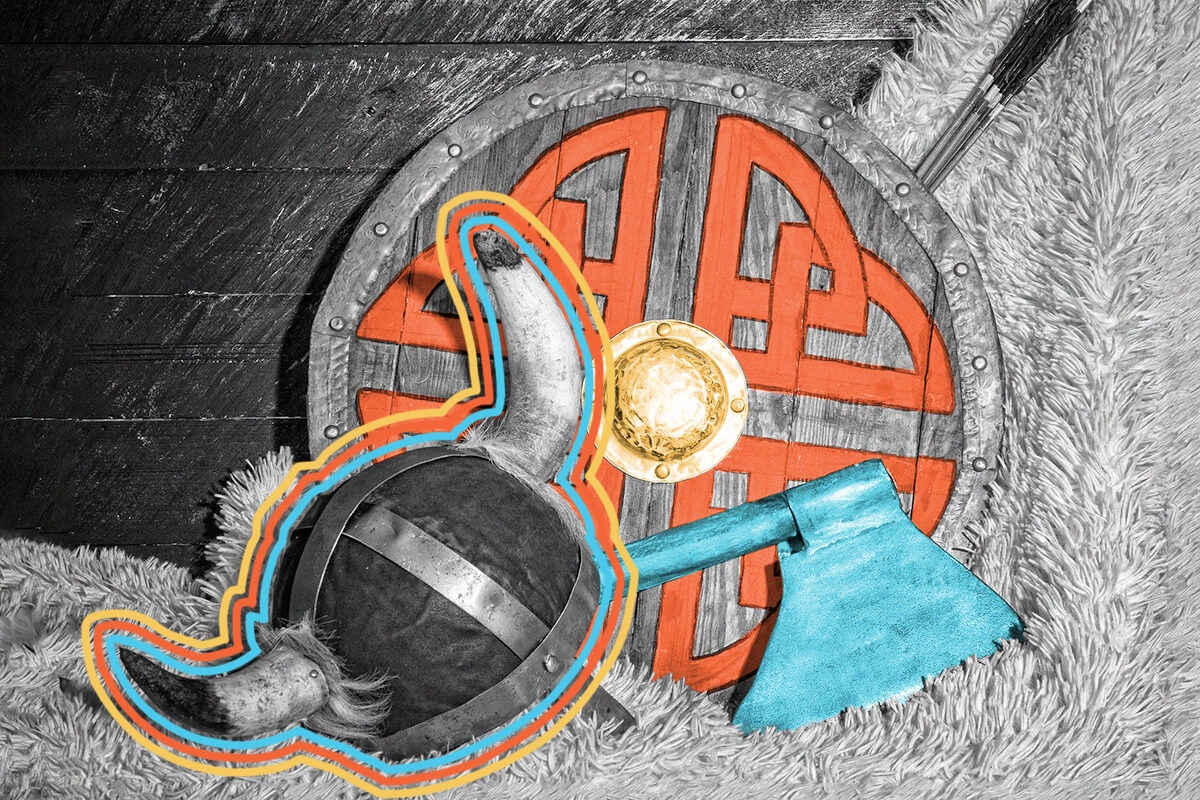
Aside from long blond hair, horned helmets are probably the most famous Viking accessory — but that would have been a surprise to the real Scandinavian warriors who plundered Europe between the 9th and 11th centuries. The Viking horned helmet convention dates only to the 19th century: In 1876, costume designer Carl Emil Doepler introduced it in Richard Wagner’s famous opera "Der Ring des Nibelungen" ("The Ring of the Nibelung," often called the Ring Cycle). At the time, Germans were fascinated with the story of the Vikings, so Doepler plopped the ancient headdress of the Germans — the horned helmet — on Wagner’s Viking protagonists. The opera proved so popular that by 1900 the horned helmet was inextricably entwined with Vikings themselves, appearing in art, ads, and literature.
Bluetooth technology is named after a Viking king.
Bluetooth is named after Viking king Harald Gormsson, known for a dead (“blue”) tooth. But why? “[He] was famous for uniting Scandinavia just as we intended to unite the PC and cellular industries with a short-range wireless link,” Intel’s Jim Kardach has said.
Yet during the Viking era, Norse warriors never actually wore horned helmets — and especially not during battle, where they’d probably have gotten in the way. Some artifacts, such as a tapestry discovered with the famous Oseberg ship burial in 1904, do depict horned figures, but these “horned” occurrences only happened — if they happened at all — during rituals. To date, archaeologists have uncovered only two preserved Viking helmets: Both are made of iron, both have guards around the eyes and nose, and both are entirely without horns.
Most of our knowledge of Norse mythology comes from two 13th-century Icelandic works known as the Eddas.
Advertisement
In English, four days of the week are named after Norse gods.
The names of the days of the week are a mixture of Roman and Norse influences. In 321 CE, Emperor Constantine established the seven-day week. While Romance languages, such as French, Spanish, and Italian, retained the original Latin-based names, the Germanic-based English language chose another pantheon. Saturday, Sunday, and Monday derive from the Romans, but Tuesday is named after the god Tyr, the Norse god of war. Wednesday comes from Odin, who’s also known as “Woden.” Thursday is the most obvious one — Thor’s day — while Friday comes from the goddess Frigg, or Freya.
Darren Orf
Writer
Darren Orf lives in Portland, has a cat, and writes about all things science and climate. You can find his previous work at Popular Mechanics, Inverse, Gizmodo, and Paste, among others.
Advertisement
top picks from the Inbox Studio network
Interesting Facts is part of Inbox Studio, an email-first media company. *Indicates a third-party property.

Original photo by GoodLifeStudio/ E+ via Getty Images
Inspiration can come from the unlikeliest of places. While living in Jamaica in the early 1950s, author Ian Fleming was in search of a name for the secret agent main character in his new book, Casino Royale. “I wanted to find a name which wouldn’t have any romantic overtones,” Fleming later said. “I wanted a really flat, quiet name.”
The film “Thunderball” is named after Ian Fleming’s estate in Jamaica.
The 1995 film “GoldenEye” is named for Fleming’s estate in Jamaica, where he wrote his Bond novels. The name may be a reference to a WWII operation he oversaw as a British naval intelligence officer.
Fleming was an avid bird-watcher, and one of his favorite books was Birds of the West Indies, written by American ornithologist James Bond. “I thought, ‘Well, James Bond, that’s a pretty quiet name,’” Fleming continued, “so I simply stole it and used it.” For years, Bond (who actually went by Jim) had no idea that his name adorned a series of spy novels, but as the popularity of the books grew — and particularly after the premiere of the first 007 film, Dr. No, in 1962, turned Bond into a bonafide pop culture phenomenon — the ornithologist learned about his moniker’s double life. Fleming eventually apologized to Bond, offering his own name for “a particularly horrible species of bird” if Bond ever discovered one. The two met on February 5, 1964, when Jim Bond and his wife showed up at Fleming’s house while on a trip to Jamaica, and left as friends. Fleming even gave Bond a signed copy of the then-unreleased novel You Only Live Twice, inscribed “to the real James Bond.”
Ornithologist Jim Bond’s great-grandfather designed the Brooklyn Bridge.
Advertisement
The inspiration behind James Bond’s code name, 007, remains a mystery.
A 16th-century occultist. A Rudyard Kipling short story. A British bus line. The international dialing code for Russia. A hotel room number. All of these things have been suggested as the inspiration behind Bond’s numerical nickname, 007. In the universe of the novels, the double-0 prefix denotes Bond’s “license to kill,” and the most compelling evidence for its real-world origin also comes from the spy world. In one of his last interviews, Fleming said that he borrowed the “00” because “in the Admiralty, all top-secret signals had the double-0 prefix” at the beginning of WWII. Sounds good, but what about the “7”? Some have posited that it came from part of a code used to encrypt the famous 1917 “Zimmerman Telegram,” in which German foreign secretary Arthur Zimmermann made secret overtures to Mexico calling for an alliance against the U.S. (British decryption of the telegram was considered a major triumph and part of the reason the initially neutral U.S. finally entered the war.) Others think that “7” is just a lucky number. Whatever the case, it makes sense that an international man of mystery has an equally mysterious code name.
Darren Orf
Writer
Darren Orf lives in Portland, has a cat, and writes about all things science and climate. You can find his previous work at Popular Mechanics, Inverse, Gizmodo, and Paste, among others.
Advertisement
top picks from the Inbox Studio network
Interesting Facts is part of Inbox Studio, an email-first media company. *Indicates a third-party property.

Original photo by Cornerstone Photos/ Alamy Stock Photo
In 1954, Sir Hugh Beaver, the managing director of Guinness, thought up a way to reduce pub disputes so bartenders could focus on pouring his company’s signature beers. He suspected that every bar could benefit from a book filled with verified facts and stats about subjects that might arise mid-conversation over a drink. Two events in particular prompted his decision: Earlier in the decade, he and fellow guests at a hunt in Ireland memorably argued about Europe’s fastest game bird, which they had no means of identifying. Then, on May 6, 1954, English athlete Roger Bannister became the first person to run a mile in less than four minutes, causing public interest in records-related news to surge. Norris McWhirter had served as the stadium announcer during Bannister’s historic run, and Beaver hired both him and his identical twin, Ross McWhirter — another sports journalist — to assemble The Guinness Book of World Records. At the time, the pair had already begun working at a London-based agency that supplied facts to newspapers and advertisers.
The U.S. is the second-largest market for Guinness beer.
That claim belongs to Nigeria. The dark brew has been sold there since 1827, although in glass bottles rather than cans. The country that drinks the most Guinness is the U.K., while Ireland comes in third, and the U.S. is fourth.
The McWhirter twins spent about three months working feverishly on their 198-page compendium. Released in the U.K. on August 27, 1955, the book featured about 4,000 records, ranging from the world’s tallest man to the smallest pub. Eight pages of black-and-white photographs broke up the text, along with a few ink drawings. Although initially meant to be given out for free at bars to promote Guinness, the book became so popular, the company started selling it, soon to great success. To date, more than 150 million books from the series — eventually renamed Guinness World Records — have been purchased, educating readers in 40-plus languages. But the brand is no longer beverage-based: Diageo, the alcohol conglomerate that now owns Guinness, sold Guinness World Records in 2001, and it’s now owned by a Canadian conglomerate called the Jim Pattison Group.
From 1976 to 1995, New York City's iconic Empire State Building was home to a Guinness World Records museum.
Advertisement
Guinness prompted the Irish government to adjust the trademark of its coat of arms.
All Guinness bottles and cans share the same harp-shaped logo, a nod to a national treasure — a famed 14th-century harp — preserved inside the library of Trinity College Dublin. The harp has been incorporated into Guinness labels since 1862, and the beverage titan trademarked the design 14 years later, although the design has been updated over the years. A harp (a reference to the same instrument at Trinity College) has also been Ireland’s emblem since the Irish Free State was established in 1922, starring in its seal of state, coat of arms, and coins. In the early 1980s, Ireland’s office of the attorney general suggested attempting to trademark the harp under international intellectual property jurisdictions with the instrument facing in both directions, but the government had concerns that the move would elicit a lawsuit from Guinness, which is associated with a harp that has a left-sided straight edge. So since 1984, the official, nine-string Irish harp is always pictured with its straight edge to the right.
Interesting Facts
Editorial
Interesting Facts writers have been seen in Popular Mechanics, Mental Floss, A+E Networks, and more. They’re fascinated by history, science, food, culture, and the world around them.
Advertisement
top picks from the Inbox Studio network
Interesting Facts is part of Inbox Studio, an email-first media company. *Indicates a third-party property.