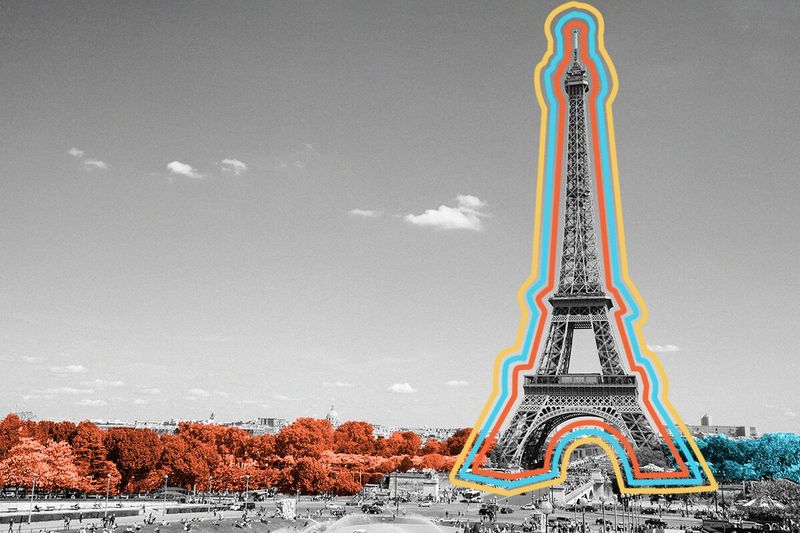

The arrival of autumn 2010 in the City of Light brought with it a bold public experiment in the form of a new drinking fountain in the Jardin de Reuilly. As with other public drinking stations in Paris, this one connected to a well-maintained system of water sourced from underground wells and the Seine and Marne rivers. But it had a twist: With the press of a button, visitors were treated to a stream of chilled H2O infused with carbon dioxide, providing a steady supply of sparkling water.
Eighteenth-century English theologian and chemist Joseph Priestley may be most celebrated for his discovery of oxygen, but his work with gases also fueled the development of carbon dioxide-enhanced drinking water.
The concept of what locals call la fontaine pétillante didn't originate in this corner of Europe; sparkling water fountains first surfaced in Italy around 2009. Yet the idea certainly seems tailor-made for France, the country of origin for popular mineral water brands such as Evian and Perrier. Paris is also home to famed water-spouting structures such as Fontaine Saint-Michel and Fontaine des Mers. Several sparkling water fountains can now be found throughout Paris, and the city has the ultimate goal of installing at least one in each of the city's 20 arrondissements.
From an aesthetic standpoint, the sparkling water fountains are hardly on par with the ornate older fountains; one reviewer recalled a graffiti-tagged fountain as seemingly "designed to troll visiting fantasists with its simple look and battered condition." Yet this same reviewer described the fountain’s cool, bubbly water as "utterly delicious." Considering that the water is free, and that an estimated 12 pounds of plastic waste per year is saved when a family of four ditches plastic bottles for tap water, this citywide initiative should do its part to help keep Paris relatively clean and affordable.
The American locale known as the "City of Fountains" is Kansas City, Missouri.
Advertisement
Some European spots have free wine fountains.
While Paris has provided a public service by bringing sparkling water to the masses, it lags behind other European locales when it comes to free-flowing servings of another beverage festive travelers crave. Wine fountains have unsurprisingly proved popular at various spots, most notably in Villa Caldari, Italy, and Ayegui, Spain. In both cases, the fountains are operated by wineries stationed near traditional Christian pilgrimage routes — Italy’s Cammino di San Tommaso and Spain’s Camino de Santiago. Similarly, both places encourage participants to enjoy the free wine responsibly, as more can easily be purchased if desired. While there will always be freeloaders who scoff at the honor system, those who intend to continue the walking path are advised to practice moderation, as even the most devoted pilgrims can lose their way with too many drinks under their belt.
Tim Ott
Writer
Tim Ott has written for sites including Biography.com, History.com, and MLB.com, and is known to delude himself into thinking he can craft a marketable screenplay.
Advertisement
top picks from the Inbox Studio network
Interesting Facts is part of Inbox Studio, an email-first media company. *Indicates a third-party property.
Of all the world records to hold, “most world records” might be the most impressive. That title belongs to American Ashrita Furman, who has set more than 600 world records and currently holds more than 200. He first became smitten with Guinness’ famous book as a child in the 1960s and made it his lifelong mission to set as many records as he could. Among his many feats are the longest continuous distance somersaulting (12 miles and 390 yards), most hopscotch games completed in 24 hours (434), world's largest popcorn sculpture (20 feet, 10 inches), most apples cut midair with a samurai sword in one minute (29), and translating and reciting a poem in the most languages (203).
His pursuits have indeed taken him to every continent — including Antarctica, where he set both speed and distance records for pogo stick jumping.
His first attempt in 1978 ended in disappointment when he failed to break the record for most consecutive jumping jacks, but he persevered and broke it the following year by completing a whopping 27,000 in 6 hours and 45 minutes. He has since gone on to break hundreds more records and regularly works to reclaim titles that have been taken from him by other record-breakers.
Furman holds the record for most Ping-Pong balls caught with chopsticks in one minute.
Advertisement
Guinness has more world records than it can print.
The company tracks a total of around 65,000 records, which is far more than can fit into the annual book. It makes a number of editorial decisions to whittle that number down to about 4,000, and the rest are featured online. Some record-holders have been unhappy with the promotion (or lack thereof) their feats have achieved, which led one of them, Dean Gould, to launch his own registry of world records, Record Holders Republic, in response. Other Guinness critics include former adjudicators such as Anna Nicholas, who told USA Today the company’s current output is “a far cry from the book [she] worked on” in the late 1980s, and that the current version places too much emphasis on sensationalism. Guinness nonetheless remains synonymous with world records, an association that’s unlikely to be broken anytime soon.
Michael Nordine
Staff Writer
Michael Nordine is a writer and editor living in Denver. A native Angeleno, he has two cats and wishes he had more.
Advertisement
top picks from the Inbox Studio network
Interesting Facts is part of Inbox Studio, an email-first media company. *Indicates a third-party property.
Punxsutawney Phil — the star of Groundhog Day — has a big job. Every February 2, the furry critter is responsible for encouraging (or dashing) our dreams of an early end to winter. However, it seems that basing our meteorological forecasts on a den-dwelling mammal’s shadow may not be the wisest bet. By some estimates, Phil’s forecasts have had a mere 39% accuracy rate since they began in 1887 (although data from some early years is missing). In recent years, the groundhog’s predictions have been about as accurate as a coin toss; according to the National Oceanic and Atmospheric Administration, Phil was spot-on 50% of the time between 2011 and 2020.
Groundhogs are among the largest members of the Sciuridae family, which includes squirrels, chipmunks, marmots, prairie dogs, and more. All of these rodents are known for digging abilities, and groundhogs are no exception, often creating complex burrows with multiple rooms and paths.
The Punxsutawney Groundhog Club — the group responsible for Phil’s care and the official Groundhog Day ceremony — has said in the past that Phil is always correct, and that Phil’s handlers are to blame for any inaccuracies, suggesting that in those instances they likely misinterpreted the “groundhogese” he speaks and inaccurately relayed his message.
The tradition of watching groundhogs search for their shadow as a means of winter forecasting came to the U.S. from German immigrants, who brought with them celebrations of Candlemas Day. Observed on February 2, the holiday commemorates when the Virgin Mary went to Jerusalem’s holy temple to be purified 40 days after Jesus’ birth. Celebrants of old noted that a sunny holiday likely indicated snow to come in late spring. The original Germanic tradition required observing a badger or hedgehog, but immigrants found that groundhogs (native to North America) were a good enough substitute, saddling the rotund rodents with the job of predicting spring’s arrival — a tradition that’s drawn thousands of onlookers to Punxsutawney each February for more than 130 years.
Punxsutawney Phil’s groundhog companion is named Phyllis.
Advertisement
Bill Murray’s character in "Groundhog Day" relives the same day for three decades.
The 1993 film Groundhog Day centers on a surly newscaster (played by comedian Bill Murray), forced to repeat February 2 over and over until he learns a lesson in humility. While the screenplay never confirms how long it takes for Murray’s character to break the cycle, some reviewers estimate the loop occurs 12,395 times — the equivalent of 33 years and 350 days. (Internet lore suggests filmmakers had originally planned for the cycle to last 10,000 years, though that claim is disputed by screenwriter Danny Rubin.) On set, Murray may have had his own bit of déjá vu, reportedly being bitten by his groundhog co-star (named Scooter) two times despite wearing protective gloves.
Nicole Garner Meeker
Writer
Nicole Garner Meeker is a writer and editor based in St. Louis. Her history, nature, and food stories have also appeared at Mental Floss and Better Report.
Advertisement
top picks from the Inbox Studio network
Interesting Facts is part of Inbox Studio, an email-first media company. *Indicates a third-party property.
Beer is as old as history — and by some counts, even older. Many experts assert that the emergence of Sumerian cuneiform in the fourth millennium BCE marks the beginning of recorded history. Similarly, the first hard evidence of beer brewing also comes from the Sumerians of Mesopotamia, in a town called Godin Tepe (now part of Iran). In 1992, archaeologists there discovered traces of beer in jar fragments dated around 3500 BCE. However, some scholars suggest that beer is as old as grain agriculture itself — which would put the boozy beverage’s invention at around 10,000 BCE, somewhere in the Fertile Crescent.
The minimum drinking age in the U.S. has always been 21 years old.
Between 1970 and 1975, 29 U.S. states lowered the legal drinking age in reaction to the new voting age of 18 after ratification of the 26th Amendment in 1971. But in 1984, the U.S. government set the national age limit to 21 with the Federal Uniform Drinking Age Act.
Strangely (or not), thousands of Sumerian tablets make mention of beer. In fact, it even makes an appearance in the Epic of Gilgamesh, often regarded as the oldest surviving piece of literature. But among all these references, no recipes for this ancient brew were ever recorded. The closest thing to step-by-step instructions is a text known as the Hymn to Ninkasi (aka the goddess of beer). Written around 1800 BCE, this hymn describes the malts, cooked mash, and vats used in the beer-making process. It seems that Sumerian beer had mostly two ingredients: malted barley and beer bread, or bappir, which introduced yeast for fermentation. The beer was then drunk from communal jars, and its sediments were largely filtered out by drinking the concoction from reed straws. In 1989, the Anchor Brewing Company of San Francisco worked with anthropologists to recreate this Sumerian concoction; they deemed their results “drinkable.” Thankfully, beer has undergone significant innovations since its invention thousands of years ago.
China makes the most beer of any country in the world — 9.5 billion gallons of the stuff in 2021.
Advertisement
The “beer before liquor” rule has no scientific basis.
“Beer before liquor, never been sicker; liquor before beer, you’re in the clear” is an adage of unknown origin claiming that low alcohol-by-volume (ABV) beers are best imbibed at the end of a night of drinking rather than early on. However, no scientific studies support this myth. Once in your stomach, alcohol is absorbed immediately into the bloodstream, so the order in which you drink that alcohol won’t positively or negatively affect your hangover future. The only kernel of truth is in how these drinks affect your decision-making abilities. If you switch to higher ABV beverages (like liquor) late into the evening, your impaired judgment might miscalculate how many drinks you’re actually having. In the end, it doesn’t matter what order you knock ’em back, but other factors can impact your morning hangover — such as smoking history, genetics, and food intake (contrary to popular belief, drinking water won’t save you). At the end of the day, the best advice is to just drink less; experts recommend never drinking more than four drinks in an evening.
Darren Orf
Writer
Darren Orf lives in Portland, has a cat, and writes about all things science and climate. You can find his previous work at Popular Mechanics, Inverse, Gizmodo, and Paste, among others.
Advertisement
top picks from the Inbox Studio network
Interesting Facts is part of Inbox Studio, an email-first media company. *Indicates a third-party property.

Original photo by Grethe Ulgjell/ Alamy Stock Photo
The reedy hum of bagpipes calls to mind tartan attire and the loch-filled lands of Scotland, which is why it might be surprising to learn that the wind-powered instruments weren’t created there. Music historians believe bagpipes likely originated in the Middle East, where they were first played by pipers thousands of years ago. The earliest bagpipe-like instruments have been linked to the Egyptians around 400 BCE, though a sculpture from the ancient Hittites — a former empire set in present-day Turkey — from around 1000 BCE may also resemble bagpipes.
American astronaut Kjell Lindgren made history in 2015 when he became the first person to play bagpipes in space. Lindgren chose “Amazing Grace” as his musical selection, performed as a memorial to Victor Hurst, a research scientist who helped train NASA astronauts.
Bagpipes slowly made their way throughout Europe, occasionally played by notable names in history like Roman Emperor Nero, and becoming widespread enough to be depicted in medieval art and literature. By the 15th century they had made their way to Scotland, where Highland musicians added their own influence. By some accounts, they modified the pipes to their modern appearance, by adding more drones, which emit harmonized sounds. Highland musicians also began the practice of hereditary pipers, aka passing the knowledge and skill of bagpiping through families, along with the duty of playing for Scottish clan leaders. All pipers of the time learned music by ear and memorization, a necessity considering the first written music for the pipes may not have appeared until the 18th century. One family — the MacCrimmons of the Scottish island of Skye — was particularly known for its influence in bagpiping, with six generations continuing the art, composing music, and teaching through their own piping college in the 17th and 18th centuries.
More bagpipes are manufactured in Pakistan than in any other country.
Advertisement
Contrary to popular belief, bagpipes were never banned in Scotland.
Not many instruments have been likened to weapons, but bagpipes have, and it’s a common misconception that they were even once banned in Scotland. The myth comes from the mid-18th century, when thousands of Scottish Highlanders rebelled against the British crown in an attempt to install their own monarch. Following their defeat at the Battle of Culloden in 1745, the British government imposed severe restrictions, banning kilts and traditional Scottish clothing alongside firearms. After one piper was convicted by the British for his association with Scottish troops during the incident, many Scots interpreted the law as also banning the musical instrument, though historians point out that the pipes were never illegal. The law against traditional dress was lifted in 1782, and bagpipes, which many believed were taboo, eventually became synonymous with the British army, allowing the military musical tradition of marching pipes into battle to carry on in and out of Scotland.
Nicole Garner Meeker
Writer
Nicole Garner Meeker is a writer and editor based in St. Louis. Her history, nature, and food stories have also appeared at Mental Floss and Better Report.
Advertisement
top picks from the Inbox Studio network
Interesting Facts is part of Inbox Studio, an email-first media company. *Indicates a third-party property.
Original photo by Moviestore Collection Ltd/ Alamy Stock Photo
The first rule of Fight Club is: You do not talk about Fight Club. The second rule of Fight Club is: When breaking the first rule, be sure to point out that almost every shot in Fight Club features a Starbucks cup. David Fincher’s cult classic, an adaptation of Chuck Palahniuk’s counterculture novel of the same name, has become an anti-establishment rallying call since it first hit theaters in 1999. Few companies symbolize the kind of corporate ubiquity the film satirizes quite like the coffee behemoth, leading Fincher to feature their instantly recognizable cups throughout. Somewhat surprisingly, Starbucks approved of this: “They read the script, they knew what we were doing, and they were kind of ready to poke a little fun at themselves,” Fincher said.
David Fincher wasn’t the first choice to direct “Fight Club.”
The studio initially considered Peter Jackson, now best known for directing the “Lord of the Rings” trilogy. Jackson was working on his film “The Frighteners” at the time and therefore unavailable, so the gig eventually went to Fincher.
Finding each and every Starbucks cup has become a treasure hunt of sorts for devoted fans, who pause and rewind so as not to miss a single Easter egg. Jokes about Starbucks stores being everywhere aren’t unique to Fight Club — see also this hilarious exchange from Best in Show — but it might be one of the most pointed popular movies in its critique of consumerism. Even so, it wasn’t personal for Fincher: “We had a lot of fun using that — there are Starbucks cups everywhere, in every shot. I don’t have anything personal against Starbucks … they’re just too successful.”
Edward Norton’s character in the film is named Narrator.
Advertisement
The film's ending was changed in China.
With its bleak view of the establishment and rebellious bent, Fight Club was bound to receive some edits in the Middle Kingdom. Even so, few could have expected the country’s take on the film’s ending, at least on the streaming platform Tencent Video. Rather than the original finale, in which the (anti)heroes watch as skyscrapers representing the financial industry crash to the ground around them, this version’s ending is replaced by the following on-screen text: “Through the clue provided by Tyler, the police rapidly figured out the whole plan and arrested all criminals, successfully preventing the bomb from exploding. After the trial, Tyler was sent to [a] lunatic asylum receiving psychological treatment. He was discharged from the hospital in 2012.” The real-life story does have a happy ending, though. After backlash — not to mention a good amount of ridicule — the original ending was restored in China.
Michael Nordine
Staff Writer
Michael Nordine is a writer and editor living in Denver. A native Angeleno, he has two cats and wishes he had more.
Advertisement
top picks from the Inbox Studio network
Interesting Facts is part of Inbox Studio, an email-first media company. *Indicates a third-party property.

The hemispheres divide the world into four sections, with the equator separating the Northern and Southern hemispheres at zero degrees latitude and the prime meridian separating the Western and Eastern hemispheres at zero degrees longitude. Most continents fall within only a few of these invisible boundaries, but one has land in all four hemispheres: Africa. The equator passes through seven African nations (the Democratic Republic of the Congo, Gabon, Kenya, Republic of Congo, São Tomé and Príncipe, Somalia, and Uganda), while the prime meridian crosses five (Algeria, Burkina Faso, Ghana, Mali, and Togo).
Asia is the world’s largest continent by both size and population, with an area of 17.2 million square miles and a population of more than 4.7 billion. Africa is No. 2 on both lists — it has an area of 11.7 million square miles and is home to 1.3 billion people.
Countries beyond Africa that lie in both the Western and Eastern hemispheres include the United Kingdom, France, and Spain, while Indonesia, Brazil, Ecuador, Colombia, Kiribati, and the Maldives intersect the Northern and Southern hemispheres. (In fact, the atolls of Kiribaticross all four hemispheres; some other nations also cross several hemispheres if you include their overseas possessions.) But with 12 hemisphere-spanning countries and land at both the prime meridian and equator, Africa’s spot on the map is unparalleled.
A town in Nigeria is known as the twin capital of the world.
In Europe, 16 sets of twins are born for every 1,000 live births. In the U.S., the rate is 33 for every 1,000. In Igbo-Ora, Nigeria, the rate is 158 per 1,000. That’s earned the small town some 50 miles away from Lagos the nickname of “the twin capital of the world” — as well as a great deal of interest from the scientific community. It’s speculated that the high rate of twin births may be linked to the eating habits of the Yoruba people, an ethnic group who also reside in Benin and Togo. Cassava and yam tubers are both staples of their diet, and research suggests that phytoestrogen found in their peelings may be linked to the release of more than one egg during fertilization.
Michael Nordine
Staff Writer
Michael Nordine is a writer and editor living in Denver. A native Angeleno, he has two cats and wishes he had more.
Advertisement
top picks from the Inbox Studio network
Interesting Facts is part of Inbox Studio, an email-first media company. *Indicates a third-party property.

Throughout more than a century of publication, the Sears catalog was a go-to source for American shoppers seeking out standard home goods. But in addition to those traditional products, the catalog also offered some curious items for sale, including live chickens, 14-room mail-order houses, and even highly explosive dynamite. A 1902 edition of the catalog advertised dynamite as a tool for removing tree stumps, claiming it to be “far superior to any other agent.” The company also offered more powerful varieties that could be used for blasting into hard rock and even underwater. Sears sold dynamite for as little as 13 cents a pound — less than $5 today — along with all of the electric fuses, connecting wires, and blasting machines required for operation.
The former Sears Tower in Chicago used to be the world’s tallest building.
The Sears Tower (now the Willis Tower) stands 1,450 feet tall, making it the world’s tallest building from its completion in 1973 until 1996. It took the record from the North Tower of the World Trade Center (1,368 feet), and was surpassed by the Petronas Towers of Kuala Lumpur, Malaysia (1,483 feet).
There were no prerequisites for purchasing this dynamite, despite the obvious safety risks associated with amateur use. Instead, Sears promised to “mail a booklet giving full information” to “those who are not familiar with handling dynamite,” hoping buyers would carefully follow the instructions. The dynamite could be found in the catalog’s “sporting goods” section, just a few pages away from comparatively mundane products such as baseball uniforms and hammocks. Dynamite and other more unusual items were phased out as Sears largely trended toward selling housewares. In future editions of the catalog, Sears noted that “to conform with the insurance laws,” it had been “forced to omit carbide from [its] stock,” which prevented it from selling explosives and combustibles. The traditional Sears catalog was discontinued in 1993.
In 1990, Walmart surpassed Sears as the largest U.S. retailer.
Advertisement
Dynamite was invented by the namesake of the Nobel Prize.
Alfred Nobel was a Swedish chemist whose legacy consists of two major achievements: inventing dynamite and establishing the Nobel Prize. In 1862, Nobel opened a factory to produce nitroglycerin — an explosive liquid compound used in blasting mines. But the product was infamously unstable, and Nobel’s factory exploded in 1864. He spent the following years researching safer alternatives, and in 1867, he invented a more stable product by mixing nitroglycerin with kieselguhr (a porous rock). Nobel named this new compound dynamite — taken from the Greek dynamis, meaning “power” — and it earned him both global recognition as well as a staggering fortune.
After Nobel’s death in 1896, many wondered what would happen to his vast wealth. To the surprise of many, including his family, Nobel’s will mandated the money be used to establish a series of new international awards honoring annual achievement in topics including science, literature, and peace. After years of debated legal claims, the inaugural Nobel Prizes were awarded in 1901.
Bennett Kleinman
Staff Writer
Bennett Kleinman is a New York City-based staff writer for Inbox Studio, and previously contributed to television programs such as "Late Show With David Letterman" and "Impractical Jokers." Bennett is also a devoted New York Yankees and New Jersey Devils fan, and thinks plain seltzer is the best drink ever invented.
Advertisement
top picks from the Inbox Studio network
Interesting Facts is part of Inbox Studio, an email-first media company. *Indicates a third-party property.

The average person can probably name a couple of the more famous shipwrecks — maybe the Titanic or Queen Anne's Revenge — but there are many, many more that have sunk from sight and public recollection. Altogether, it's believed that at least 3 million such wrecks dot the ocean floors.
Bermuda has the most shipwrecks per square mile of any location on the planet.
Although Bermuda measures less than 21 square miles, the combination of its location within trade routes and hazardous coral reefs has produced more than 300 shipwrecks off its coast.
If that number doesn't seem particularly remarkable (humans have been building boats for at least 10,000 years, after all), then perhaps it's more surprising to learn that less than 1% of these submerged crafts have been explored. Why such a small percentage? Well, the world's oceans are enormous, reaching an average depth of more than 12,000 feet, and only 19% of the ocean floor has been charted in detail. There's also the matter of the money needed to launch expeditions to find these vessels. But times are changing in the realm of wreckage discovery: The digitization of archives has made records more accessible, and the development of technologies such as remotely operated vehicles (ROVs) has rendered the searching process less treacherous for explorers.
So what becomes of most shipwrecks? Some of them are looted for profit, despite legal efforts to preserve the historical value of their artifacts. Some are turned into underwater museums. But most others become reefs — playgrounds for fish and other varieties of marine life. They may not receive the fanfare showered on the wreck of Titanic, but they nevertheless take on new and important functions far below the waves.
A 2022 Antarctic expedition found the wreck of explorer Ernest Shackleton's ship, named Endurance.
Advertisement
The deepest shipwreck was discovered more than 22,500 feet below the ocean's surface.
Combine cutting-edge technology with the nerve needed to explore the most extreme corners of the Earth, and you wind up finding treasures once thought inaccessible. Such was the case with a former U.S. Navy intelligence officer named Victor Vescovo, who turned his attention from scaling the world’s highest peaks to scouring its deepest depths by way of a first-of-its-kind submersible dubbed the Limiting Factor. In 2021, Vescovo came upon the largely intact WWII destroyer USS Johnston resting some 21,180 feet below the surface of the Philippine Sea. A little more than a year later, Vescovo followed the trail of the Johnston and the Limiting Factor’s sonar capabilities to locate another WWII craft, the destroyer escort USS Samuel B. Roberts, elsewhere in the Philippine Trench, at a depth of 22,523 feet. Although that latter mark currently stands as the world record for the deepest shipwreck, it probably won’t be long before Vescovo or another intrepid soul ventures even further into the unknown to see what can be uncovered.
Tim Ott
Writer
Tim Ott has written for sites including Biography.com, History.com, and MLB.com, and is known to delude himself into thinking he can craft a marketable screenplay.
Advertisement
top picks from the Inbox Studio network
Interesting Facts is part of Inbox Studio, an email-first media company. *Indicates a third-party property.
Compared to other planets in our solar system, Earth is filled with impressive landscapes, including snow-capped peaks, lush rainforests, and vast oceans. But some places on our planet are so extreme, they’re otherworldly — like Venus otherworldly. The Atacama Desert in Chile is one of the driest places in the world, so it makes sense that such a parched ecosystem would get its fair share of sun. But in the summer of 2023, scientists discovered that some parts of this immense plateau in fact get far more sunlight than any other place on Earth. While taking measurements of solar irradiance (light energy from the sun) on the Chajnantor plateau, researchers discovered — via a complex meteorological process known as “forward scattering” — that this area was nearly as sunny in summer as the surface of Venus.
While most planets spin counter-clockwise, Venus flouts the trend and spins clockwise. Astronomers theorize that a huge celestial collision involving Venus in the early solar system flipped the planet upside down. A similar process may have happened to Uranus, which spins on its side.
Despite some key differences between the two planets, scientists often call Venus Earth’s twin. Venus is roughly the same size as Earth, formed in the same area of the inner solar system, and is composed of much the same material — scientists even theorize that Venus was just like Earth some 3 billion years ago. But it is definitely not Earthlike now; it’s a sweltering hell planet thanks to an atmosphere of thick carbon dioxide that traps all greenhouse gases. If you somehow found yourself on Venus, high levels of solar irradiance would be the least of your immediate worries, considering its surface temperatures of 900 degrees Fahrenheit and sulfuric acid-filled clouds.
The brightest objects in the universe are called quasars.
Advertisement
The world’s largest telescope is being built in the Atacama Desert.
Low humidity, high altitudes, and zero light pollution make the Atacama Desert arguably the best place on Earth for stargazing, and astronomers around the world have used its unparalleled nighttime views to their advantage. The region is home to a variety of telescopes and surveys, including the Atacama Large Millimeter/submillimeter Array, the Cosmology Large Angular Scale Surveyor, and the Vera C. Rubin Observatory (previously the Large Synoptic Survey Telescope). The European Southern Observatory is also currently at work in the area building the largest telescope in the world, known (rather unimaginatively) as the Extremely Large Telescope (ELT). Just the main mirror of the telescope stretches 128 feet in diameter, which is three times larger than the current record holder, and that immense size will aid astronomers studying black holes and dark matter when ELT is ready to point its impressively huge eye skyward by the end of the decade.
Darren Orf
Writer
Darren Orf lives in Portland, has a cat, and writes about all things science and climate. You can find his previous work at Popular Mechanics, Inverse, Gizmodo, and Paste, among others.
Advertisement
top picks from the Inbox Studio network
Interesting Facts is part of Inbox Studio, an email-first media company. *Indicates a third-party property.