
Credit: Vaivirga/ iStock
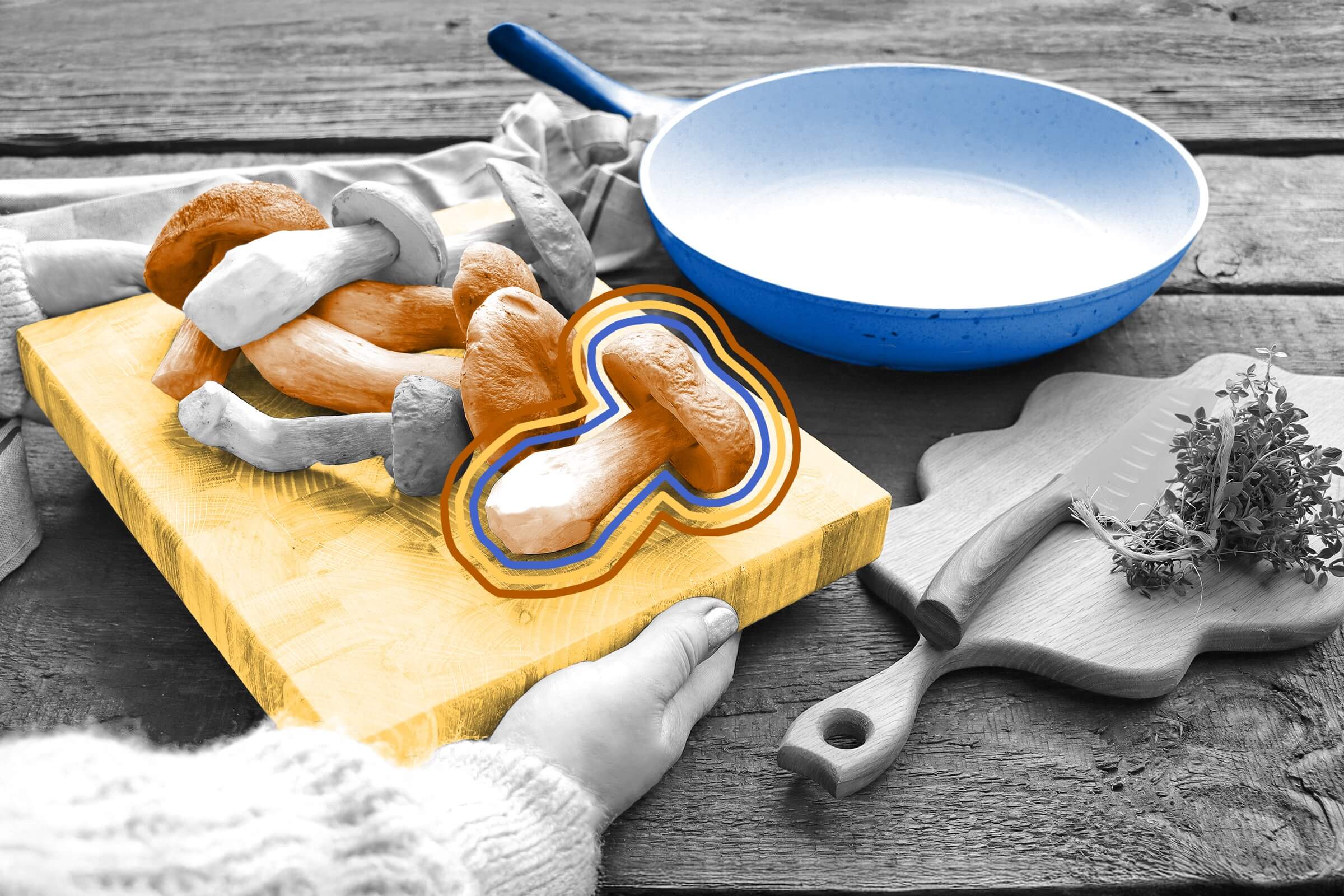
Overcooking ingredients is one of the most common mishaps in the kitchen and can result in mushy vegetables, tough meats, and other gastronomic woes. Mushrooms, however, are incredibly forgiving, being almost impossible to overcook. Their ability to maintain an agreeable texture over a wide range of cooking times is all due to the unique cellular structure of fungi. The secret lies in chitin, the material that forms the cell walls in mushrooms.
Chitin, which is also found in insect exoskeletons and crustacean shells, is very durable and heat stable — unlike the cellulose found in plant cells or the proteins in animal tissue. In most foods, cooking often produces dramatic structural changes. The proteins in meat go through a process of denaturation and coagulation, causing the meat to firm up and, when overcooked, become tough. Vegetables, meanwhile, are held together by pectin, which starts to break down during cooking, releasing the bond between cells and making the vegetables turn soft — potentially too soft if overcooked.




Oops, incorrect!
It's a fibMushrooms cannot change their color in the same way as chameleons. But around 100 mushroom species do possess bioluminescent properties, allowing them to glow in the dark. By emitting light, those mushrooms attract the attention of insects, which can help spread fungal spores.
But thanks to the magic of chitin, mushrooms maintain their structural integrity, and therefore their firmness, when cooked for even long durations. Any textural change that occurs in mushrooms while cooking is more likely due to water loss than cellular breakdown. Mushrooms have a high water content, and this liquid is released while cooking, which concentrates the flavor and changes the texture slightly without compromising structure. So while it is possible to burn mushrooms through overly high heat and negligence, it’s difficult to overcook them, whether you’re sautéing a chanterelle or roasting a portobello.

Numbers Don't Lie
More Interesting Reads



Mushrooms are more closely related to ______ than to plants.
Ready to reveal?
Confirm your email to play the next question?
Mushrooms are more closely related to animals than to plants.

The Armillaria ostoyae honey mushroom is the heaviest living organism on Earth.
Deep within the Malheur National Forest of Oregon lives the heaviest living thing on Earth: a giant mushroom playfully dubbed the “humongous fungus.” This gigantic specimen of Armillaria ostoyae honey mushroom is estimated to weigh somewhere between 7,500 and 35,000 tons and occupies a total area of 2,385 acres — equivalent to 1,350 soccer fields.
DNA testing has revealed this to be a single organism, consisting of a massive mycelial network located mostly underground. While the humongous fungus can claim to be the heaviest living organism in the world, it’s not necessarily the largest in terms of area. A specimen of Posidonia australis seagrass, located in Shark Bay in Western Australia, covers an area of approximately 77 square miles — equivalent to around 28,000 soccer fields.
Both the Oregonian Armillaria ostoyae and the Shark Bay seagrass rank among the oldest living organisms on Earth. Based on current growth rates, the seagrass is estimated to be around 4,500 years old, while the honey mushroom is estimated to be at least 2,400 years old and possibly even as ancient as 8,650 years.

Tony is an English writer of nonfiction and fiction living on the edge of the Amazon jungle.
top picks from the Inbox Studio network
Interesting Facts is part of Inbox Studio, an email-first media company. *Indicates a third-party property.