
Original photo by OlyaSolodenko/ iStock
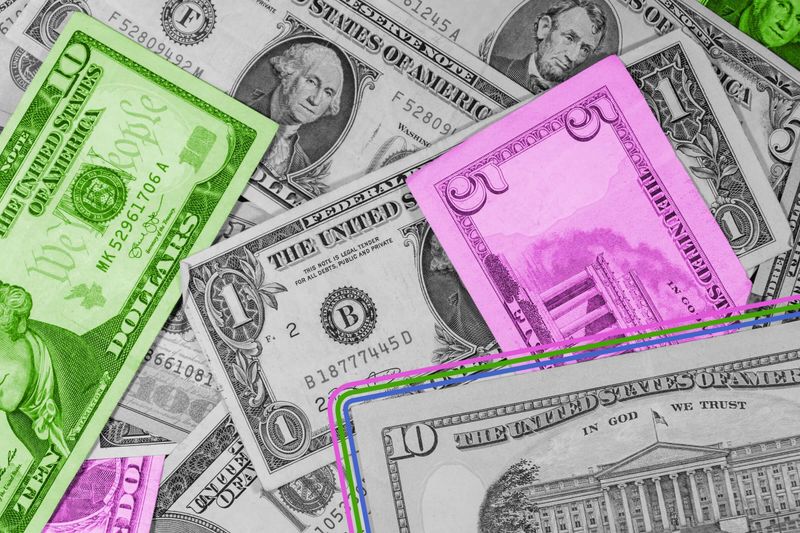
There’s only one spot outside the nation’s capital that you’ll see featured on some of the seven U.S. banknotes currently in circulation. The $5 bill features the Lincoln Memorial, while the $10 features the Treasury Building — fitting, since Alexander Hamilton, whose visage adorns the obverse, served as the Treasury Department’s first secretary. The $20 and $50 bills finish the architectural tour of Washington with the White House and Capitol, respectively. The $1 is notably absent from this list, as the only building-like structure on its reverse side is a pyramid with a floating eye — and no such pyramid exists in the U.S. (or the world).




Oops, incorrect!
It's a fibThe Benjamin isn’t the highest federal reserve note in the U.S. — that’d be the $10,000 bill. First printed in 1918 and featuring the face of Salmon P. Chase, Abraham Lincoln’s treasury secretary, the currency was discontinued in 1969 when Congress purged large denomination bills.
The $100 bill switches things up by featuring Independence Hall in Philadelphia. Although an immensely important building — it’s the site where revolutionaries signed the Declaration of Independence and where the Founding Fathers crafted the U.S. Constitution — it’s also a thematic choice, seeing as Benjamin Franklin (depicted on the obverse of the bill) is undoubtedly Philadelphia’s most famous historical figure. But this isn’t Independence Hall’s only appearance on U.S. currency. A very small section of the interior of the building is also displayed on the 1976 reissue of the $2, which includes a reproduction of John Trumbull’s 1818 painting “Declaration of Independence.”

Numbers Don't Lie
More Interesting Reads





The first U.S. banknotes were created in response to the ______.
Ready to reveal?
Confirm your email to play the next question?
The first U.S. banknotes were created in response to the Civil War.

No one knows when the Liberty Bell cracked.
Lots of myths surround the Liberty Bell, which hung in the bell tower of Independence Hall for nearly a century (and whose image is also woven into the $100 bill as a security measure). One myth explains how the bell pealed on July 4, 1776, which likely isn’t true; another says it cracked in 1835 to announce the death of Chief Justice John Marshall (also not true).
The story of the Liberty Bell begins in 1751; it was originally cast by a foundry in London, but cracked on its first test ring in Philadelphia. Metalworkers melted it down and cast a new one, which is the Liberty Bell we know today. For 90 years, the Liberty Bell alerted Philadelphians of news or, in Benjamin Franklin’s case, to go to work, as he once wrote in a letter: “The Bell rings, and I must go among the Grave ones, and talk Politicks.” No one recorded when or how the Liberty Bell began to crack, but the most likely reason is the most simple — hard use and time. What historians do know is that metalworkers tried to repair the crack for George Washington’s birthday in 1846, but only made the damage worse. Today, no one alive has heard the Liberty Bell ring with its original clapper, but a digital recreation of the bell’s sound can help transport you back to the early days of the republic.

Darren Orf lives in Portland, has a cat, and writes about all things science and climate. You can find his previous work at Popular Mechanics, Inverse, Gizmodo, and Paste, among others.
top picks from the Inbox Studio network
Interesting Facts is part of Inbox Studio, an email-first media company. *Indicates a third-party property.