

Original photo by S-F/ Shutterstock
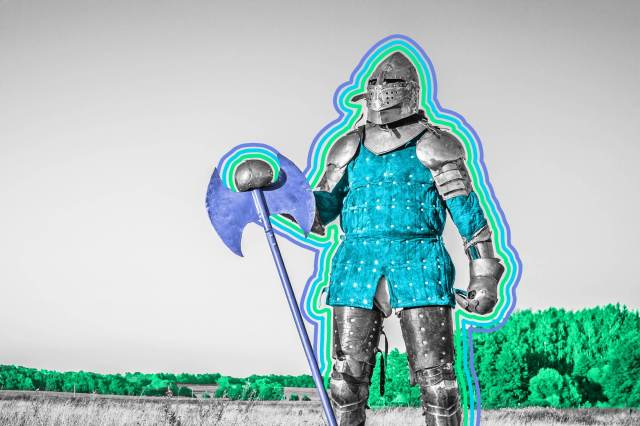
Today, sharp-tongued verbal jousting primarily exists in the art form known as battle rap, in which two rappers take lyrical aim at each other with intricate (and often devastating) rhymes. During these battles, no insult — artistic or otherwise — is off-limits, and that’s a sentiment that 15th- and early 16th-century Scottish poets might have shared. Medieval Scottish men of words linguistically barbed each other in a practice known as “flyting” (based on the Old English word flītan, meaning “to quarrel”), often as entertainment for the Scottish king and his royal court. The most famous of these “battles” that still survives, known as “The Flyting of Dunbar and Kennedie,” featured Scottish poets William Dunbar and Walter Kennedy entertaining the court of James IV in the early 16th century. Among its many famous attributes, it’s the first recorded moment of scatalogical humor. (One of the more family-friendly examples of its insults, translated from Middle Scots, reads: “Grovel for grace, dog-face, or I shall chase you all winter; Howl and yowl, owl.”)




Oops, incorrect!
It's a fibWhile English is the most widely spoken language in Scotland, a bill passed in 2025 gave both Scots and Gaelic official language status alongside English.
The biting lyricism of flyting wasn’t restricted to Scotland, of course. Ancient Irish professional poets, called filid, were also known for their insults, and a form of flyting can be found in Old English literature as well as the famous Norse text the Poetic Edda (in which the trickster god Loki goes on the verbal offensive against his fellow deities). Similar art forms can be found in Japan, Nigeria, parts of the Middle East, and elsewhere. Although flyting didn’t survive the Middle Ages, its influence can be seen in works ranging from Shakespeare to James Joyce. Thankfully, the birth of the rap battle in the 1980s once again provided a much-needed venue for settling serious artistic beef — and it’s been a fixture of hip-hop culture ever since.

Numbers Don't Lie
More Interesting Reads






The first major named poet to write in the Scots language was ______.
Ready to reveal?
Confirm your email to play the next question?
The first major named poet to write in the Scots language was John Barbour.

The first major rap battle, in 1981, was a transformative moment in hip-hop.
In December 1981, at the Harlem World club in New York City, hip-hop emcee Busy Bee Starski finished a set by bragging about his superior lyrical skills compared to other popular hip-hop artists at the time. Unknown to Busy Bee, one of those artists was in the crowd — another emcee named Kool Moe Dee. The dissed emcee took to the stage and dished a lyrical attack right back at Starski. His sharp, biting freestyle juxtaposed with Busy Bee’s simpler, more comedic technique sent rap in a new direction, in which emcees became more focused on serious lyricism rather than the typical party persona. Kool Moe Dee’s “battle” was recorded and became an influential mixtape that found its way onto the radio, and around the world.

Darren Orf lives in Portland, has a cat, and writes about all things science and climate. You can find his previous work at Popular Mechanics, Inverse, Gizmodo, and Paste, among others.
top picks from the Inbox Studio network
Interesting Facts is part of Inbox Studio, an email-first media company. *Indicates a third-party property.