

Interesting Facts
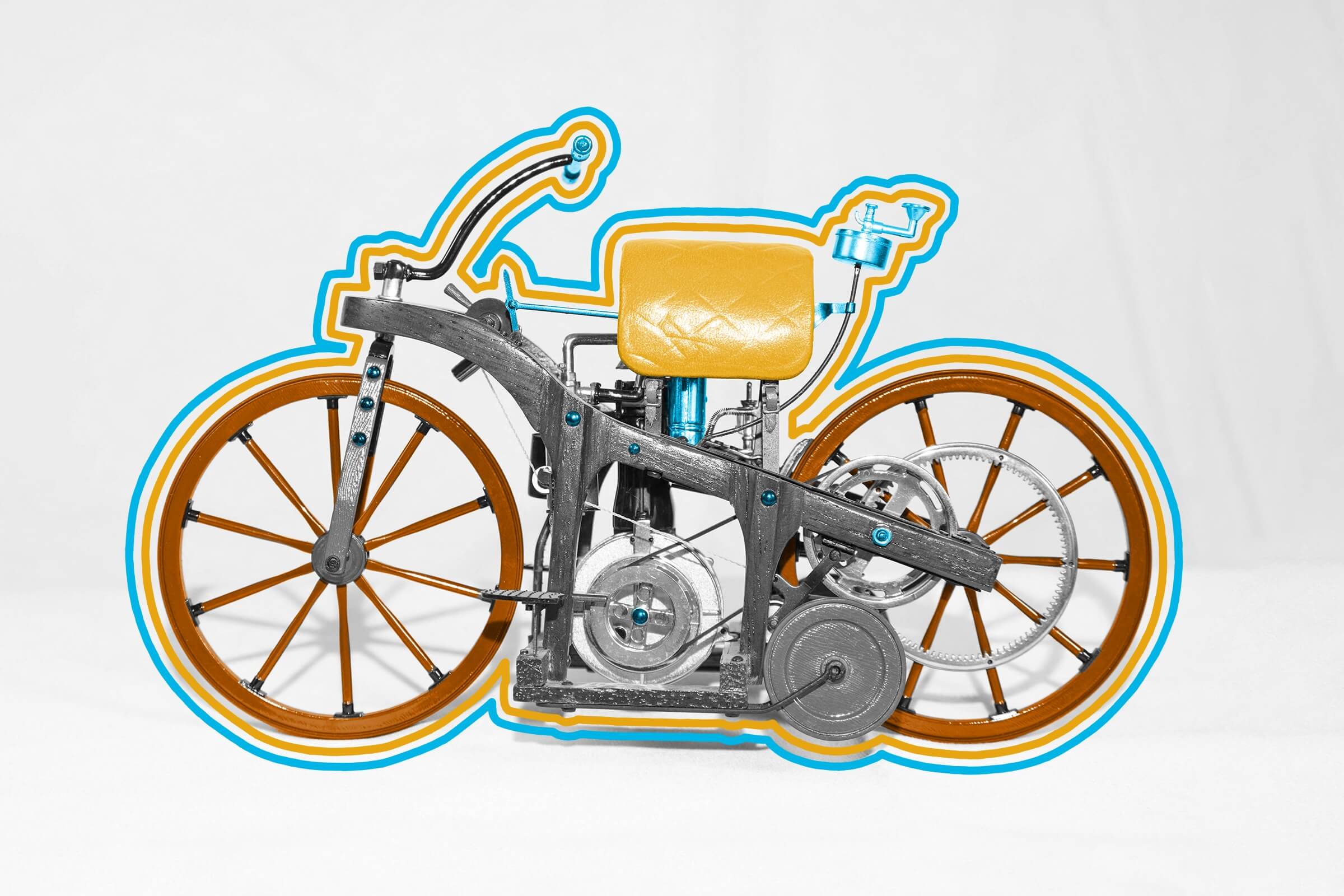
On November 10, 1885, German inventors Gottlieb Daimler and Wilhelm Maybach unveiled the first motorcycle. Known as the Reitwagen, or “riding car,” it had four wheels: two large wheels plus a pair of small stabilizers (sort of like training wheels) to help keep it upright.
Indeed, the wooden creation resembled a bicycle more closely than it did a modern motorcycle, and the low-mounted engine drove the rear wheel via a belt at a top speed of only about 7.5 miles per hour. Though crude by today’s standards, it demonstrated new possibilities for compact, engine-powered vehicles that could reliably carry a rider.




Oops, incorrect!
It's a factIt’s a household name now, but in 1903, the Harley-Davidson motorcycle company operated out of a 10-by-15-foot wooden shed behind the Davidson family home in Milwaukee, Wisconsin.
Just one year after the Reitwagen’s debut, Carl Benz introduced his motorcar, considered the first practical automobile. Benz’s car had just three wheels, a choice that was more practical than stylistic. Three wheels simplified steering, something Benz tinkered with until introducing his first four-wheeled vehicle, the Benz Victoria, in 1893.
The following year, German company Hildebrand & Wolfmüller introduced the first mass-produced, two-wheeled motorized vehicle marketed as a motorcycle (known in German as a “motorrad”). Unlike the earlier Reitwagen prototype, the Hildebrand & Wolfmüller machine rode on just two wheels and was the first motorcycle sold to the public.

Numbers Don't Lie
More Interesting Reads






The official term for a fear of driving is “______.”
Ready to reveal?
Confirm your email to play the next question?
The official term for a fear of driving is “amaxophobia.”

Folding motorcycles were parachuted out of planes.
World War II sparked a wave of rapid innovation, and one of its stranger byproducts was the Welbike, a small folding motorcycle developed for British paratroopers. Designed to fit inside a standard parachute supply canister, the bike was dropped from aircraft alongside troops and assembled upon landing.
The U.K.’s Excelsior Motor Company made around 3,600 Welbikes between 1942 and 1943. Though they could be unpacked and quickly ridden at a top speed of about 30 mph after landing, their lightweight design didn’t make them the most durable vehicle, and few Welbikes actually made it into service. The design later influenced civilian bikes such as the Corgi, which started production in 1948.

Nicole is a writer, thrift store lover, and group-chat meme spammer based in Ontario, Canada.
top picks from the Inbox Studio network
Interesting Facts is part of Inbox Studio, an email-first media company. *Indicates a third-party property.