
Original photo by revers/ Shutterstock
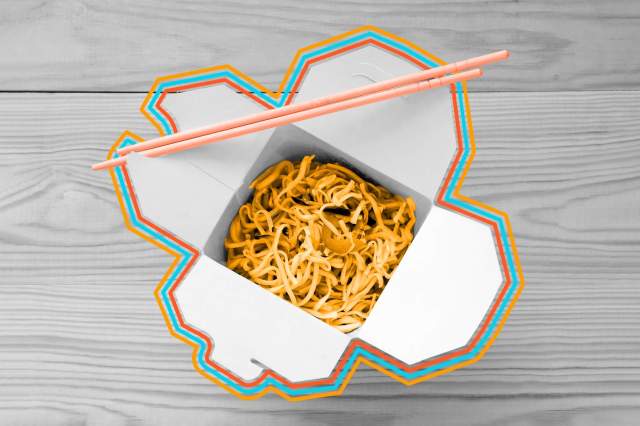
In the U.S., plenty of Chinese restaurant fare features produce that doesn’t grow in China, such as broccoli. Thus it shouldn’t be terribly surprising that Americans also took liberties with how Chinese food is packaged. While plastic containers are utilized to hold delivery and takeout dishes in China, diners in the States prefer a folded, six-sided box with a slim wire handle. Chicago inventor Frederick Weeks Wilcox patented this “paper pail” on November 13, 1894. Borrowing from Japanese origami, Wilcox elected to make each pail from a single piece of paper. This decision eventually proved critical in the transportation of Chinese cuisine, lessening the likelihood of leaks and allowing steam from hot foods to escape through the top folds. Another probable source of inspiration was the oyster pail, a wooden bucket with a locked cover that people used to carry raw oysters in the 19th century. Shortly after 1900, the company Bloomer Brothers started mass-producing Wilcox’s design specifically for toting oysters.




Oops, incorrect!
It's a factOne of the modern Seven Wonders of the World was made with help from grains. When portions of the Great Wall were constructed, the world's first composite mortar — a blend of heated limestone, water, and sticky rice — served as the binding agent for bricks.
As Americans began taking more advantage of suburban living and consumer conveniences after World War II, Chinese food delivery became an increasingly popular dinner option, with Wilcox’s containers of leftovers soon lining refrigerator shelves. During the 1970s, a graphic designer at Bloomer Brothers’ successor, the Riegel Paper Corporation, embellished the boxes to include a pagoda and the words “Thank You” and “Enjoy” — all in red, a color that represents luck in China. The Riegel Paper Corporation evolved into Fold-Pak, the world’s top producer of takeout containers, which assembles millions of cartons per year. Composed of solid-bleached-sulfate paperboard and boasting an interior polycoating, each food carrier expands into a handy plate if you remove the wire handle.

Numbers Don't Lie
More Interesting Reads



China’s flag is predominantly red, with ______ golden stars in the top left corner.
Ready to reveal?
Confirm your email to play the next question?
China’s flag is predominantly red, with five golden stars in the top left corner.

It’s very likely that fortune cookies were invented in Japan.
Numerous descendants of Chinese and Japanese immigrants to the U.S. contend that their relatives created or sold fortune cookies in California between 1907 and 1914. However, Dr. Yasuko Nakamachi, a Japanese researcher who wrote her thesis on the origin of fortune cookies, has found evidence that the crispy treats were present in her home country many years prior. Fortune cookies in Japan go by several names, including tsujiura senbei (“fortune cracker”). They are mentioned in a story written in the early 1800s called “Haru no wakagusa,” known in English as “The Young Grass of Spring,” and in an illustrated storybook from 1878 called Moshiogusa Kinsei Kidan. In the book, a bakery apprentice is pictured working at a station labeled “tsujiura senbei,” grilling wafers in irons while surrounded by baskets of the finished product. This image is similar to what Nakamachi witnessed when she visited centuries-old family bakeries outside Kyoto: Cooks working over flames would dispense batter into grills containing round molds. Eventually, tiny paper fortunes were placed inside the warm cookies.

Jenna is a writer whose work has appeared in The New York Times, The Hollywood Reporter, and New York Magazine.
top picks from the Inbox Studio network
Interesting Facts is part of Inbox Studio, an email-first media company. *Indicates a third-party property.