
Original photo by Deyan Georgiev/ Adobe Stock
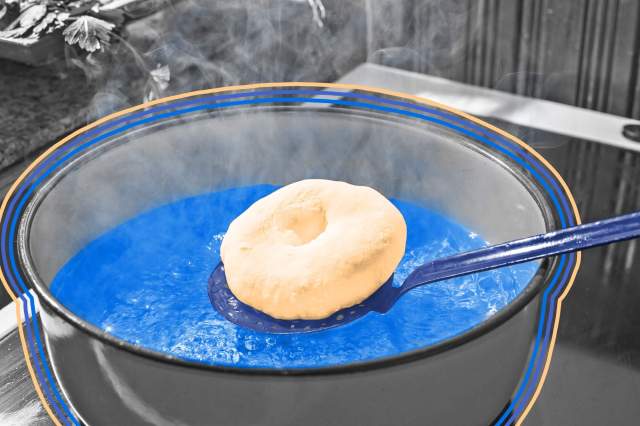
Whether you prefer yours plain, covered in sesame seeds, or colored like a rainbow, all bagels share one common characteristic: the dough is boiled prior to baking. Boiling is a crucial step that helps gelatinize the dough so it achieves the ideal density; it also partially deactivates the yeast so the bagel doesn’t rise quite as high as other bread rolls.
During a typical boiling period — about 30 to 60 seconds — bagels also absorb salts, sugars, or other seasonings that are added to the water, thus enhancing the dough’s flavor. For these reasons, culinary experts agree that it’s inaccurate to refer to bialys or any other unboiled, torus-shaped baked goods as “bagels.”




Oops, incorrect!
It's a factWhen Apple introduced its first bagel emoji in 2018, critics derided the design for its plain appearance and the lack of any filling. In response to the ridicule, Apple unveiled a redesigned bagel emoji featuring a healthy slathering of cream cheese.
Experts trace the origins of boiled bagels to Jewish communities in 13th-century Eastern Europe (specifically modern Poland); the technique was brought to New York City in the 19th century by Jewish immigrants. In 1907, local bakers in NYC formed the International Beigel Bakers Union, which worked to guard the boiling and baking process as a trade secret. The union was successful in doing so until the 1960s, when the invention of a new bagel-making machine helped popularize bagels nationwide.

Numbers Don't Lie
More Interesting Reads





The word “bagel” originated in the ______ language.
Ready to reveal?
Confirm your email to play the next question?
The word “bagel” originated in the Yiddish language.

There’s a unique style of bagel native to Montréal, Canada.
While many Americans are likely familiar with New York-style bagels, their neighbors to the north have a special variant of their own whose origins date to the early 20th century. What makes Montréal’s bagels unique is they’re always handmade and boiled in honey water to lend the dough a sweet flavor. The dough also lacks salt, which produces less crumbliness and more chewiness.
Additionally, Montréal-style bagels are cooked in a wood-fired oven, giving them a soft and fluffy interior with a crispier crust. The bagels also are rolled thinner than their NYC counterparts, resulting in a larger central hole.

Bennett Kleinman is a New York City-based staff writer for Inbox Studio, and previously contributed to television programs such as "Late Show With David Letterman" and "Impractical Jokers." Bennett is also a devoted New York Yankees and New Jersey Devils fan, and thinks plain seltzer is the best drink ever invented.
top picks from the Inbox Studio network
Interesting Facts is part of Inbox Studio, an email-first media company. *Indicates a third-party property.