

Original photo by Petr Kahanek/ Shutterstock
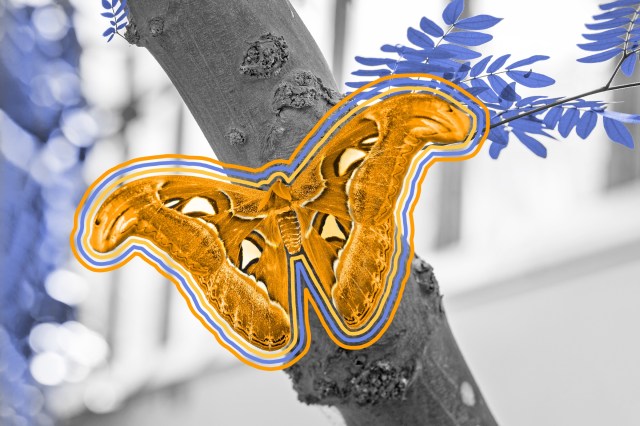
In the subtropical forests of the Malay Archipelago, a moth of seemingly impossible proportions flutters among the trees. Named the atlas moth (Attacus atlas), this saturniid — meaning a member of the Saturniidae family — is the largest moth in the world in terms of overall size, with a staggering maximum wingspan of nearly 12 inches and a surface area up to 62 inches. The moth is so huge that it’s often mistaken for a bird at first glance. Being a big moth means it’s also a big caterpillar, stretching up to nearly 5 inches long, and its silk cocoon is so durable that people in Taiwan sometimes use them as purses. Sadly, the moths are also short-lived, surviving only one to two weeks after emerging from their cocoons.




Oops, incorrect!
It's a factThe atlas moth and other moths don’t have a functioning mouth. Because adult atlas moths can’t feed, they rely on the fat reserves from their larval stage for the one to two weeks they’re alive. This is why moths are often so still — they’re trying to conserve their limited energy.
Although the atlas moth is considered the biggest in overall size compared to other lepidopterans (a taxonomic order that includes butterflies, moths, and skippers), it isn’t necessarily an outlier. The hercules moth (Coscinocera hercules), endemic to Papua New Guinea and Australia, comes in a close second with a wingspan of 11 inches, and the males have a graceful swallowtail that actually makes them the longest moth. Meanwhile, the white witch moth (Thysania agrippina), found mostly in Central and South America, has a maximum wingspan even slightly longer than that of the atlas moth, at 12.6 inches, although it’s smaller overall. So while your average U.S. moth might be only a tiny nocturnal annoyance, remember that its big and beautiful brethren are fluttering elsewhere.

Numbers Don't Lie
More Interesting Reads





The atlas moth may have been the inspiration behind the film monster ______.
Ready to reveal?
Confirm your email to play the next question?
The atlas moth may have been the inspiration behind the film monster Mothra.

There’s probably a reason atlas moth wings look like snakeheads.
The atlas moth isn’t just the largest moth in the world — it’s also visually stunning. Hidden in its multihued exterior are strange patterns on the upper tips of its wings (known as the apex of the forewing) that resemble two snake heads. This evolutionary trait warns off birds or other predators who are tricked by the impressive mimicry. Admiration for the atlas moth’s pattern extends to humans, as the Cantonese name for the creature translates to “snake’s head moth.” Atlas moths aren’t the only lepidopterans that have a natural tendency to blend in, though. The Indian leafwing butterfly (Kallima paralekta) has evolved to look like a dead leaf (at least when it raises its wings), while other moths resemble hawk eyes, lichen, hornets, or tree bark.

Darren Orf lives in Portland, has a cat, and writes about all things science and climate. You can find his previous work at Popular Mechanics, Inverse, Gizmodo, and Paste, among others.
top picks from the Inbox Studio network
Interesting Facts is part of Inbox Studio, an email-first media company. *Indicates a third-party property.