

Original photo by Yunfan Zheng/ iStock
Humans aren’t the only creatures with distinct sleep habits. From horses that snooze standing up to elephants that barely rest more than two hours a night, the animal kingdom is full of fascinating sleep strategies.
These habits often form out of necessity and are shaped by factors such as diet, predation risk, hunting patterns, and metabolism. Because of this, some species spend an impressive amount of time — even more than half their lives — asleep. Discover why certain animals, including penguins on Antarctica’s icy plains and sloths in the rainforests of Central America, spend more time catching zzzs than they do awake.

Parrotfish
Parrotfish are among the sleepiest fish, averaging around 13 hours of rest every night. During waking hours, they spend as much as 90% of their time eating algae growing on coral reefs. The fish inhabit tropical waters worldwide and grow to be 1 to 4 feet in length.
While most other fish choose sheltered spots to sleep in, parrotfish tend to sleep out in the open, though some hide in coral. But several larger species, such as the queen parrotfish (Scarus vetula), have a very unique sleep habit.
To protect itself from pathogens and parasites, it wraps itself in a cocoon made of mucus secreted by a special gland. This self-made sleeping bag also blocks the fish’s scent from predators, such as moray eels.
When disturbed, the cocoon alerts the fish by acting as a sort of alarm clock, which it reacts to by swimming away as quickly as possible. This allows parrotfish to sleep for more extended periods than other fish. Moreover, many kinds of reef sharks are active at night, so remaining still and cocooned instead of wandering is safer for parrotfish.

Platypuses
Platypuses are an unusual species: They’re semi-aquatic, egg-laying mammals that also happen to be venomous, but these southern Australian natives are perhaps best known for their duck-like bills. Those bills are utilitarian, aiding platypuses as they hunt for crustaceans during most of their waking hours. This high-calorie diet enables them to sleep for up to 14 hours a day.
Not only do platypuses sleep a lot, but they also spend more time in REM sleep than any other mammal. Mammalian sleep cycles are split into two stages, REM (rapid eye movement) sleep and non-REM sleep. Researchers have found that platypuses spend a lot of time in REM sleep — more than eight hours per day.
That’s nearly 60% of its daily sleep, which is a hefty amount, considering humans spend only around 25% of sleep time in REM. Because platypuses are an ancient species, experts believe that unusual pattern may reflect an early stage in the evolution of sleep, before REM sleep was segregated from SWS (slow-wave sleep) in the brains of animals.
Since dreaming occurs during REM, we can’t help but wonder: What do platypuses dream about? Perhaps hunting for shellfish in the streams of Tasmania.

Three-Toed Sloths
The world’s slowest mammal is also one of its soundest sleepers. Three-toed sloths sleep between 15 and 20 hours daily, usually while hanging from tree branches. Even during waking hours, they barely move, mostly shifting positions or slowly foraging.
At night, they wake for a few hours to eat leaves, shoots, and fruit from the trees they reside in. However, those meals can take up to one month to be fully digested. Due to their extremely slow metabolic rate (40–74% slower than that of other mammals of their size), sloths have less energy than most mammals and therefore require much more sleep.
Sloths are so stationary, in fact, that algae tends to grow on their fur. Conveniently, this greenish tint provides the slow-moving animal with much-needed camouflage in the rainforest canopy. Native to Central and South America, these gentle mammals rely on trees for safety from large predators, especially big cats, making their arboreal lifestyle essential to their survival.
More Interesting Reads


Owl Monkeys
Owl monkeys (Aotus trivirgatus) are the world’s only nocturnal species of New World monkey (the five families of primates found in the Americas). Also known as the “northern night monkey” or “three-striped night monkey,” this South American native requires lots of rest, nearly 17 hours a day.
The owl monkey is a rather diminutive species, measuring 11 to 15 inches long and weighing less than 2 pounds. Nocturnal predators don’t usually eat owl monkeys, so it’s more important for them to remain hidden from daylight predators who pose a greater danger.
Most active at dawn and dusk, owl monkeys live high in the forest canopy of Venezuela and Brazil. During the day, they sleep in the holes of trees or among dense foliage. Their eyes are larger and rounder than those of most other primates, enabling them to see better at night by taking in more moonlight.
They’re most active during the wet season, when fruit is abundant, and they tend to sleep and rest more during the dry season, when food is scarce. Due to their alternative sleep schedules, owl monkeys don’t compete with other larger primates for the same resources — another key reason for their long daytime slumbers.

Tigers
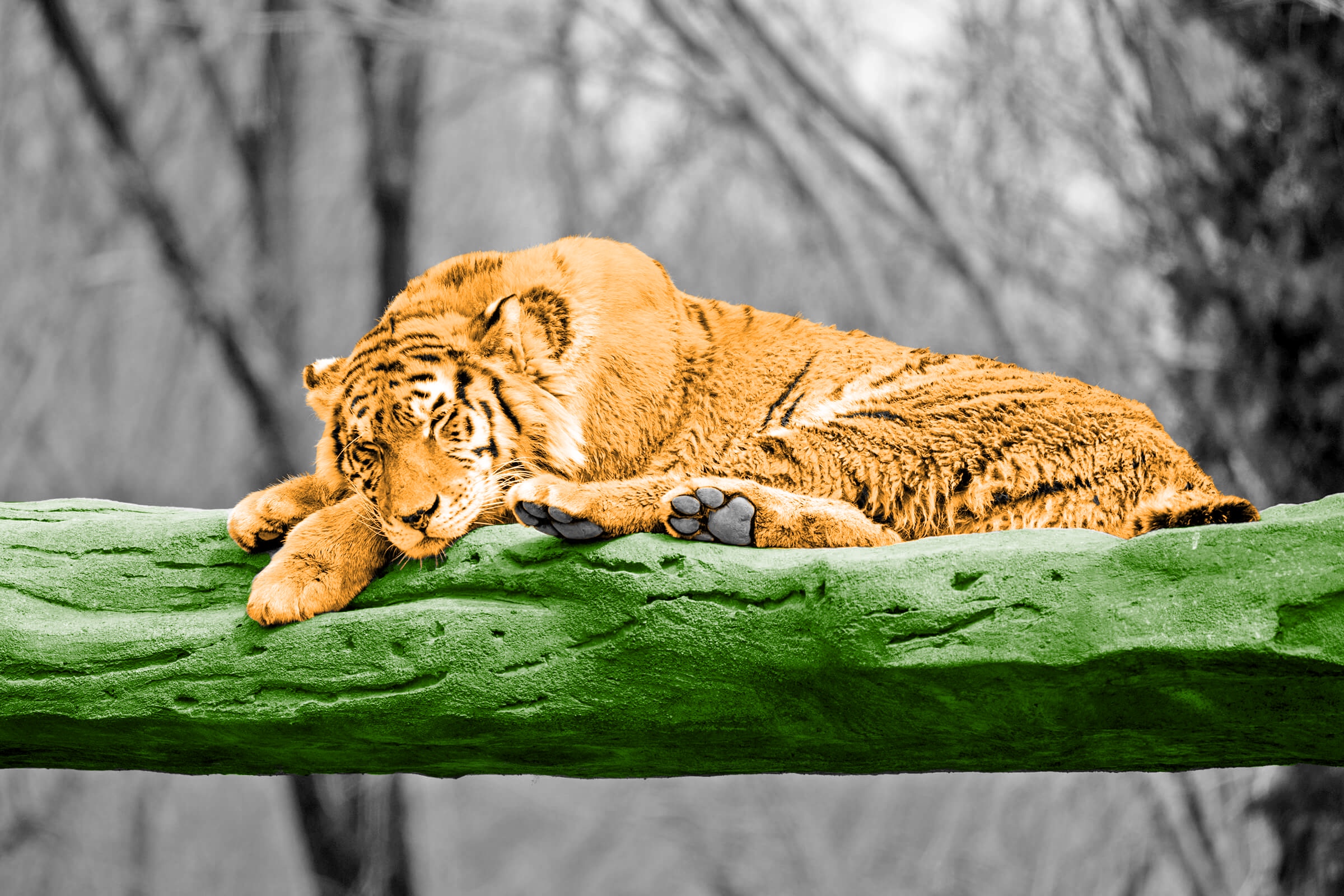
Tigers, the largest members of the cat family (Felidae), can measure up to 13 feet long and weigh up to 660 pounds, and they require more rest than smaller felines. There are six subspecies of tigers, all of which share many similarities, including the need to get about 18 to 20 hours of sleep daily.
Tigers spend all this time sleeping so they can conserve as much energy as possible for their rigorous hunting habits. They prefer large prey, such as deer and wild boar, which require intense bursts of energy to take down. They often can’t finish their prey in one sitting, so they hide the carcasses and sleep nearby until they’re ready to feed again.

Koalas
One of Australia’s most famous residents is also one of the animal kingdom’s top snoozers. On average, koalas spend between 18 and 22 hours sleeping, primarily due to their diet. Koalas feed on up to 3 pounds daily of eucalyptus leaves. It’s a myth that these leaves get the marsupials “high,” but they do have a sedative effect.
Koalas’ digestive systems require more energy than those of most animals, because their intestinal pouches are full of symbiotic bacteria that slowly work to safely break down the eucalyptus leaves, which contain tannins and toxins most species can’t digest. This unique diet is also low in nutrients, which further decreases energy levels.

Ball Pythons
Most snake species tend to sleep for long stretches, but ball pythons take the title for most hours of shut-eye. They sleep for around 20 to 23 hours per day, but not all at once. Instead, they wake several times for short periods, primarily to readjust and check that their surroundings are secure. Conserving energy is common among predators such as snakes because they must get sufficient rest for their digestive systems to function properly after large meals.
Ball pythons are popular pets, yet it can be difficult to tell if they’re asleep or not because, like all snakes, they lack eyelids. They do, however, have a thin layer of skin on each eye called a “brille” that protects them from dirt and debris. This layer is invisible to the human eye, so it always appears as if the snake is awake, even though it’s very likely asleep.

Rachel is a writer and period drama devotee who's probably hanging out at a local coffee shop somewhere in Washington, D.C.
top picks from the Inbox Studio network
Interesting Facts is part of Inbox Studio, an email-first media company. *Indicates a third-party property.